

Let us understand how we can help you
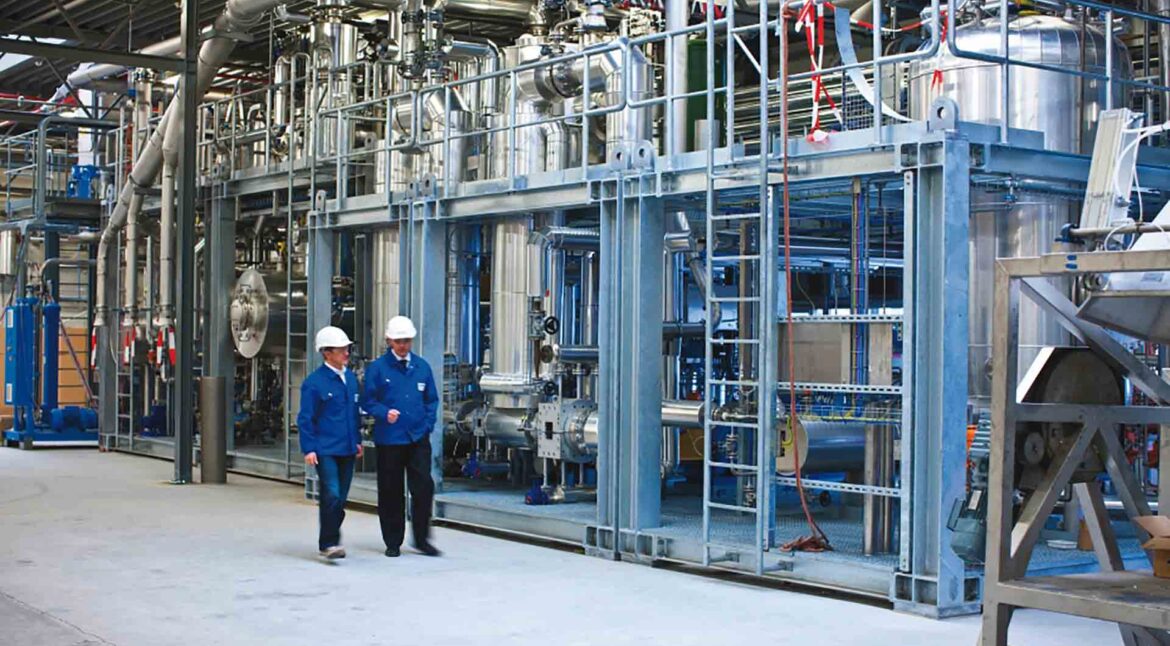

INDSAFE provides expert HAZOP study services to identify process hazards, improve safety, and support effective process safety management across industries.
What is HAZOP Study?
Process Hazard Analysis (PHA) is a systematic approach used to identify and analyze hazards and risks associated with processes, equipment, operations, and process changes. Common PHA methodologies include HAZOP (Hazard and Operability Study), HAZID (Hazard Identification), FMEA (Failure Modes and Effects Analysis), and What-If Analysis.
A HAZOP study is a structured, team-based technique used to identify potential hazards and operability problems by systematically examining deviations from the intended design or operating conditions of a process.
HAZOP is widely used in process industries as a detailed method for examining how deviations from design intent can occur, what their consequences may be, what safeguards are available, and where additional risk-reduction measures may be required.
Understanding HAZOP Study
HAZOP is a systematic and structured approach to identify deviations from design intent and analyze their possible causes and consequences.
The study is normally conducted by a multidisciplinary team consisting of relevant process, engineering, operations, instrumentation, maintenance, and safety expertise. The team systematically evaluates process parameters using established guidewords to identify meaningful deviations.
For example, parameters such as flow, pressure, temperature, level, composition, and reaction conditions may be examined against guidewords such as No, More, Less, Reverse, As Well As, Part Of, Other Than, and Early/Late, depending on the parameter and study methodology.
The objective is not simply to identify hazards, but to understand:
- What deviation could occur?
- What could cause the deviation?
- What could happen if it occurs?
- What safeguards are already provided?
- Are the existing safeguards adequate for the intended risk reduction?
- Are additional recommendations required?
HAZOP findings can also provide important inputs to other process safety activities, including QRA, LOPA, SIL assessment, consequence analysis, emergency planning, and process safety gap assessments, where applicable.

Why Conduct a HAZOP Study?
A HAZOP study helps organizations systematically examine process hazards and operational risks before they result in incidents, equipment damage, production losses, or unsafe operating conditions.
A properly conducted HAZOP can help organizations:
- Identify process hazards and potential operability problems.
- Identify credible causes of process deviations.
- Understand potential consequences of hazardous deviations.
- Review existing engineering and procedural safeguards.
- Identify opportunities for additional risk reduction.
- Improve understanding of process risks among multidisciplinary teams.
- Identify potential fire, explosion, toxic release, overpressure, loss-of-containment, and other hazardous scenarios.
- Support process safety management and risk management activities.
- Improve the basis for subsequent risk assessments where required.
- Identify opportunities to improve process design, operating procedures, instrumentation, alarms, interlocks, and safeguards.
- Reduce the potential for incidents, unplanned shutdowns, equipment damage, and business losses.
HAZOP does not by itself guarantee that an incident will be prevented. Its value comes from the systematic identification and evaluation of credible deviations and the implementation and follow-up of appropriate recommendations.
When Should HAZOP Be Conducted?
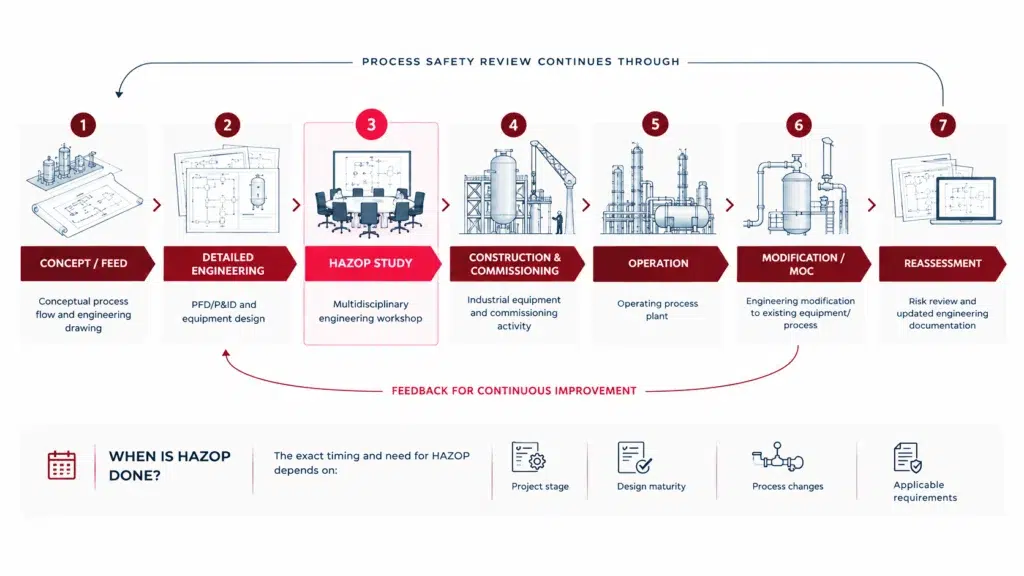
The timing of a HAZOP study depends on the project lifecycle, design maturity, process complexity, and objectives of the assessment.
Conceptual Design Stage
An early hazard review can help identify major process safety concerns and design issues before significant engineering decisions are finalized.
Detailed Engineering Stage
HAZOP is commonly conducted when sufficient engineering information is available, including P&IDs and other relevant design documentation. At this stage, the study can systematically examine process deviations, causes, consequences, safeguards, and recommendations.
Pre-Startup Stage
A HAZOP or related review may be undertaken before commissioning or startup when required by the project, risk-management process, or applicable requirements. The objective is to ensure that significant process safety issues identified during design and subsequent changes have been appropriately addressed.
Operational Stage
HAZOP studies can also be performed for existing and operating facilities, particularly when there are significant process changes, modifications, debottlenecking activities, changes in operating conditions, or a need for a systematic reassessment of process hazards.
INDSAFE can support HAZOP studies for greenfield projects, brownfield projects, plant modifications, and running operations, depending on the project requirements and available information.
Our Expertise in HAZOP Studies
INDSAFE provides expert HAZOP services in India, supported by experienced facilitators and technical professionals with process and design understanding.
Our approach combines process knowledge with structured risk analysis to identify credible hazards, evaluate potential consequences, review safeguards, and develop practical recommendations that can be considered in the context of actual plant and project conditions.
The effectiveness of a HAZOP depends significantly on the quality of the process information, the experience and participation of the study team, the effectiveness of facilitation, and the systematic application of the study methodology.
Our Approach to HAZOP Study

INDSAFE follows a structured HAZOP methodology to systematically examine the process and identify potential deviations.
1. System Breakdown into Nodes
The process is divided into appropriate HAZOP nodes based on process flow, equipment boundaries, operating conditions, and design intent.
A suitable node definition is important because overly large or poorly defined nodes can make the discussion too broad, while very small nodes may result in unnecessary repetition.
2. Review of Process Parameters
Relevant process parameters are identified for each node.
Typical parameters may include:
- Flow
- Pressure
- Temperature
- Level
- Composition
- Concentration
- Phase
- Reaction conditions
- Utility conditions
- Time
- Sequence and operating steps
3. Application of Guidewords
HAZOP guidewords are systematically applied to relevant process parameters to identify potential deviations from design intent.
Common guidewords include:
| Guideword | Typical meaning |
|---|---|
| No / Not | Complete absence |
| More | Quantitative increase |
| Less | Quantitative decrease |
| Reverse | Opposite direction or intended action |
| As Well As | Additional material or condition present |
| Part Of | Only part of the intended condition occurs |
| Other Than | Something different from the intended condition |
| Early / Late | Timing occurs earlier or later than intended |
The actual guidewords and their application depend on the parameter, process, and study methodology.
4. Identification of Deviations
The combination of parameters and guidewords produces deviations such as:
- No flow
- High pressure
- Low temperature
- Reverse flow
- High level
- More flow
- Less flow
- Wrong composition
- Loss of cooling
- Loss of instrument air
- Incorrect sequence
Each meaningful deviation is then examined systematically.
5. Identification of Causes
The team identifies credible causes that could result in the deviation.
Potential causes may include:
- Equipment failure
- Instrument failure
- Control-system failure
- Utility failure
- Human error
- Incorrect operation
- Valve failure
- Blockage
- Loss of containment
- Power failure
- External events
- Process upsets
- Maintenance or procedural issues
6. Evaluation of Consequences
The potential consequences of each credible cause and deviation are discussed.
Depending on the process, consequences may include:
- Fire
- Explosion
- Toxic exposure
- Hazardous material release
- Overpressure
- Equipment damage
- Environmental release
- Product contamination
- Loss of production
- Personnel injury
- Escalation to other equipment or process units
7. Review of Existing Safeguards
Existing safeguards are identified and reviewed in the context of the deviation and consequence.
Safeguards may include:
- Basic process control systems
- Alarms
- Trips and interlocks
- Pressure relief systems
- Emergency shutdown systems
- Detection systems
- Containment systems
- Procedural controls
- Operator intervention
- Mechanical protection
- Fire and gas systems
The HAZOP discussion provides a structured basis for identifying whether additional safeguards or recommendations should be considered.
8. Risk Evaluation
Where required by the project methodology, identified scenarios are evaluated using the applicable risk-ranking approach.
Depending on the project, HAZOP findings may subsequently be used as inputs to further studies such as LOPA, QRA, SIL assessment, or consequence analysis.
9. Recommendations and Reporting
Recommendations are developed for identified gaps or opportunities for risk reduction.
The final HAZOP documentation records the study basis, nodes, deviations, causes, consequences, safeguards, recommendations, and other relevant observations agreed during the study.
Guidewords and Deviations in HAZOP
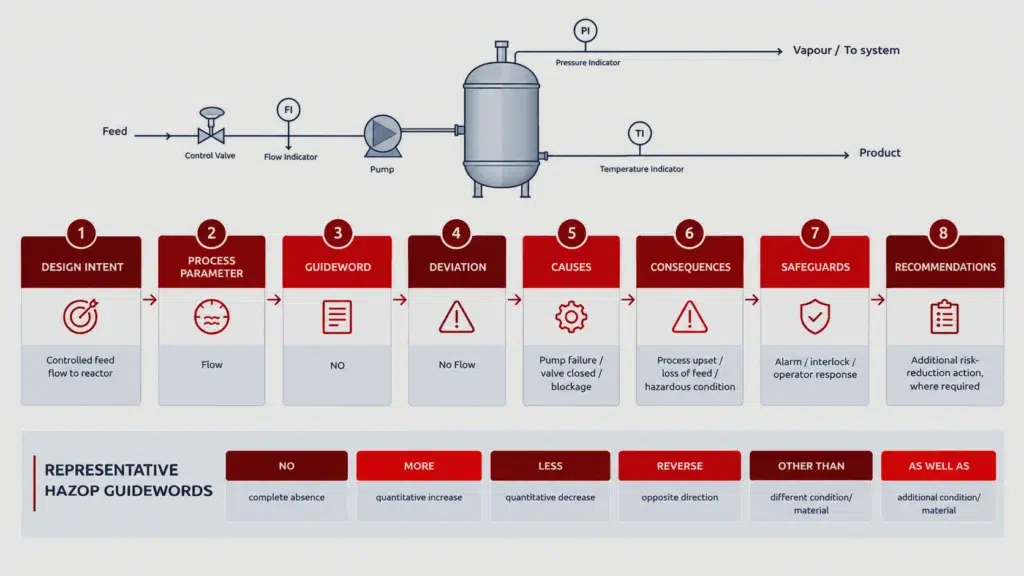
The strength of a HAZOP study comes from systematically challenging the intended operation of the process rather than relying only on previous incident experience or individual judgement.
For example:
Design intent: Maintain a controlled flow of feed to a reactor.
Parameter: Flow
Guideword: No
Deviation: No flow
The team may then consider:
Possible causes: Pump failure, closed valve, blocked line, loss of power, control-system failure.
Potential consequences: Loss of feed, process upset, incorrect reaction conditions, production interruption, or other process-specific consequences.
Existing safeguards: Low-flow alarm, standby pump, interlock, operator response, or other applicable safeguards.
Recommendation: Any additional action identified by the study team based on the specific scenario and existing protection.
This structured progression helps ensure that the study considers the cause → deviation → consequence → safeguard → recommendation relationship.
Information and Documents Required for a HAZOP Study
The quality of a HAZOP study depends on having sufficiently developed and accurate process information.
Depending on the project, relevant inputs may include:
- Process Flow Diagrams (PFDs)
- Piping and Instrumentation Diagrams (P&IDs)
- Process design basis
- Process descriptions
- Equipment specifications
- Equipment datasheets
- Line lists
- Valve lists
- Instrument lists
- Cause & Effect diagrams
- Control narratives
- Operating procedures
- Shutdown and startup procedures
- Relief-system information
- Safety-system information
- Material Safety Data Sheets / Safety Data Sheets (MSDS/SDS)
- Layout drawings
- Utility information
- Process chemistry and reaction information
- Previous risk assessment or HAZOP reports
- Relevant incident or operating history, where available
The exact input requirements depend on the scope, project stage, and type of facility.
HAZOP Study Team
HAZOP is a multidisciplinary team exercise. The composition of the team should reflect the process and systems being studied.
Depending on the project, participants may include:
- HAZOP facilitator
- Process engineer
- Operations representative
- Mechanical engineer
- Instrumentation and control engineer
- Electrical engineer
- Process safety / HSE professional
- Maintenance representative
- Project/design engineering representative
- Other subject-matter experts as required
The facilitator helps ensure that the study follows a systematic methodology, remains focused on the node and deviation under consideration, and records the discussion consistently.
HAZOP Study Deliverables
The exact deliverables depend on the agreed scope, but a HAZOP study may include:
- HAZOP study methodology and basis
- HAZOP team and participant details
- Documents reviewed
- Node identification and node descriptions
- HAZOP worksheets
- Identified deviations
- Causes
- Consequences
- Existing safeguards
- Risk ranking, where applicable
- Recommendations / actions
- Action ownership, where agreed
- HAZOP study report
- Executive summary of significant findings
The final report provides a documented record of the study and can support subsequent process safety activities and action tracking.
HAZOP, HAZID, LOPA and QRA – What Is the Difference?
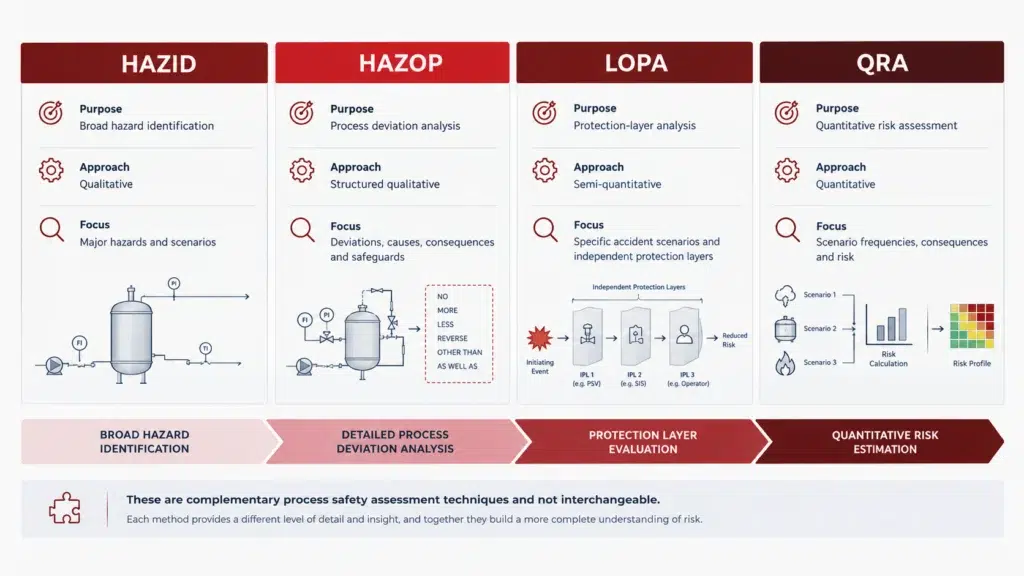
These techniques address different aspects of process safety and risk assessment and may be used together depending on project requirements.
HAZOP
HAZOP systematically examines deviations from design intent using guidewords to identify causes, consequences, safeguards, and recommendations.
HAZID
HAZID is generally used as a broader hazard identification technique to identify significant hazards and scenarios, often at an earlier stage of project development.
LOPA
LOPA (Layer of Protection Analysis) is a semi-quantitative technique used to evaluate specific accident scenarios and the adequacy of independent protection layers against defined initiating events and consequences.
QRA
QRA (Quantitative Risk Assessment) uses quantitative methods to estimate risks associated with defined hazardous scenarios, often considering event frequencies, consequences, and risk measures.
A HAZOP may therefore form one part of a broader process safety assessment program rather than being considered in isolation.
HAZOP for Greenfield and Brownfield Projects
Greenfield Projects
For new facilities, HAZOP can help identify process hazards and design issues before construction and commissioning. Conducting the study when the design information is sufficiently developed allows the team to systematically review process deviations and safeguards before the facility enters operation.
Brownfield Projects
For existing facilities, HAZOP can be applied to process modifications, revamps, debottlenecking projects, capacity changes, new equipment, changes in feedstock, or other modifications that may introduce new hazards or alter existing risk.
For operating facilities, available plant information and actual operating practices can provide important context for the study.
Common Challenges in HAZOP Studies
A HAZOP can become less effective when the study is not adequately prepared or when relevant technical expertise and information are unavailable.
Common challenges include:
- Incomplete or outdated P&IDs
- Insufficient process information
- Poorly defined HAZOP nodes
- Inadequate multidisciplinary participation
- Excessive focus on minor issues while significant scenarios receive limited attention
- Failure to identify realistic causes and consequences
- Treating procedural controls as equivalent to all types of engineered safeguards without considering their characteristics
- Recommendations that are too broad or difficult to implement
- Poor action tracking after the HAZOP
- Conducting the study too early, before sufficient design information is available
Effective preparation, experienced facilitation, appropriate team participation, and systematic documentation are therefore important elements of a useful HAZOP study.
Benefits of HAZOP Study
A structured HAZOP study provides several benefits to process and manufacturing organizations:
- Identify hazards and operational issues.
- Improve process safety and risk management.
- Identify scenarios involving fire, explosion, hazardous releases, and other process hazards.
- Improve understanding of process risks among project and operating teams.
- Identify potential improvements to safeguards and operating practices.
- Support informed process safety decision-making.
- Identify optimization and operability opportunities.
- Reduce the potential for business losses, production interruptions, and unplanned downtime.
- Provide documented inputs for further process safety assessments where required.
- Support compliance with applicable process safety and risk-management requirements.
Industries We Serve
INDSAFE provides HAZOP study services for a range of process and industrial sectors, including:
Oil & Gas
Process facilities, storage and handling systems, pipelines, terminals, and associated operations.
Chemicals & Petrochemicals
Chemical processing, storage, transfer, reaction, separation, and associated process systems.
Pharmaceuticals
Process systems, utilities, solvent handling, manufacturing operations, and associated facilities.
Food & Beverages
Processing systems, storage, utilities, material handling, and production operations.
FMCG & Manufacturing
Manufacturing processes, utilities, material handling, storage, and associated industrial systems.
Automotive
Manufacturing and process systems, utilities, chemical handling, and supporting operations.
Power & Energy
Power-generation and energy-related process systems, utilities, fuel handling, and associated facilities.
Other Industries
HAZOP studies can also be applied to other industrial processes where systematic identification of process hazards and operability issues is required.
HAZOP and Process Safety Management
HAZOP is one of the techniques that can support a broader Process Safety Management (PSM) framework.
The findings from a HAZOP may contribute to activities such as:
- Process hazard analysis
- Management of change
- Operating procedure development
- Emergency planning
- Safety instrumented system assessment
- Risk assessment
- Process safety gap assessment
- Action tracking and risk reduction
HAZOP should therefore be considered as part of an overall process safety management approach rather than as a standalone replacement for other required risk-management activities.
Technical References
HAZOP methodology should be selected and applied in accordance with the requirements and objectives of the specific project.
Relevant technical references may include recognized process safety guidance and standards such as:
- IEC 61882 – Hazard and Operability Studies (HAZOP Studies) – Application Guide
- CCPS / AIChE guidance on Process Hazard Analysis and process safety
- Applicable company engineering standards and project specifications
- Applicable national and international regulatory requirements
- Other relevant industry standards and guidance applicable to the facility and process
The specific references used for an INDSAFE study should be identified in the study methodology or report based on the project scope and applicable requirements.
Why Choose INDSAFE for HAZOP Studies?
INDSAFE approaches HAZOP as a structured engineering and process safety exercise rather than simply a documentation activity.
Our approach focuses on:
- Systematic node-by-node examination
- Multidisciplinary technical discussion
- Clear identification of causes and consequences
- Review of existing safeguards
- Practical and traceable recommendations
- Alignment of the assessment with available process and plant information
- Clear documentation for subsequent action tracking and risk-management activities
Where appropriate, HAZOP findings can also provide inputs to related process safety studies such as QRA, LOPA, SIL assessment, consequence analysis, and process safety gap assessments.
Frequently Asked Questions
What is a HAZOP study?
A HAZOP study is a structured, team-based process hazard analysis technique used to identify deviations from design intent, their causes and consequences, existing safeguards, and potential recommendations.
What is the difference between HAZOP and PHA?
PHA (Process Hazard Analysis) is a broader term for systematic approaches used to identify and evaluate process hazards. HAZOP is one commonly used PHA methodology.
When should a HAZOP study be conducted?
HAZOP is commonly conducted when sufficient process and engineering information is available to support a meaningful review. It may be performed during detailed engineering and can also be applied to existing facilities, modifications, and operational processes depending on project requirements.
Is HAZOP required for every industrial process?
The applicability and specific requirements depend on the process, facility, jurisdiction, applicable regulations, company requirements, and project objectives. A suitable hazard-analysis methodology should be selected based on the circumstances.
Does HAZOP include risk assessment?
HAZOP primarily focuses on systematically identifying deviations, causes, consequences, safeguards, and recommendations. A project may use a separate or complementary risk-ranking methodology, LOPA, QRA, or other assessment technique where appropriate.
Is QRA performed after HAZOP?
Not necessarily. QRA may be conducted as a separate or complementary assessment depending on the project objectives, identified hazards, regulatory requirements, and risk-assessment strategy. HAZOP findings can provide useful inputs to QRA.
What documents are required for a HAZOP?
Typical inputs include PFDs, P&IDs, process descriptions, equipment and instrument information, control narratives, cause & effect diagrams, operating procedures, relief-system information, and other relevant engineering and process safety documentation.
Who should participate in a HAZOP?
HAZOP is generally a multidisciplinary exercise. Depending on the scope, the team may include process, operations, mechanical, instrumentation and control, electrical, maintenance, process safety, and other relevant technical personnel.
Can HAZOP be conducted for an existing plant?
Yes. HAZOP can be applied to existing operating facilities, process modifications, revamps, debottlenecking projects, and other changes where systematic examination of process hazards and operability is required.
What are the outputs of a HAZOP study?
Typical outputs include HAZOP worksheets and a report documenting the study basis, nodes, deviations, causes, consequences, safeguards, recommendations, and agreed actions where applicable.
Get in Touch
Looking for HAZOP study services in India?
Contact INDSAFE to discuss your project requirements and determine an appropriate HAZOP study approach for your process, facility, modification, or operation.
A structured HAZOP study can help strengthen process hazard identification, improve understanding of safeguards, and support informed process safety decision-making