
Let us understand how we can help you


Process Safety Management (PSM) is a systematic approach used to identify, evaluate, and control hazards associated with industrial processes involving hazardous chemicals, flammable substances, and high-risk operations.
At Indsafe, we provide Process Safety Management services in India to help organizations identify and control major process hazards, prevent fires, explosions, toxic releases, and other catastrophic incidents, and improve process safety performance and regulatory compliance.
What is Process Safety Management (PSM)?
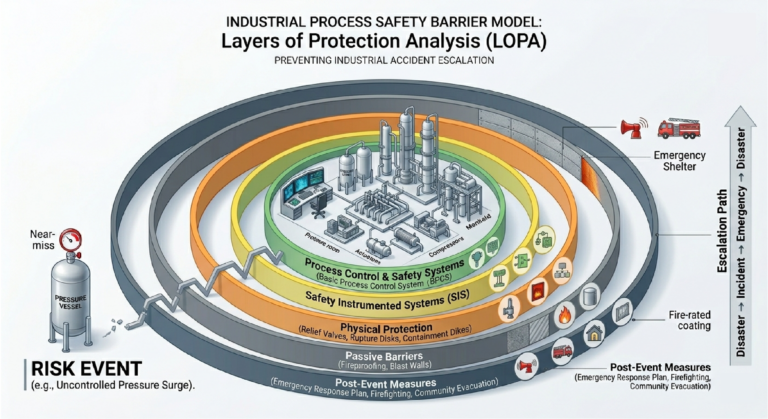
Process Safety Management focuses on preventing major industrial incidents by managing process-related risks throughout the lifecycle of a facility.
Unlike occupational safety, which primarily focuses on preventing workplace injuries and exposures, process safety focuses on preventing loss-of-containment events and other major accidents that can result in fires, explosions, toxic releases, equipment damage, environmental impact, and business interruption.
An effective PSM framework helps organizations:
- Identify and evaluate process hazards
- Understand and control major accident scenarios
- Establish appropriate safeguards and safety systems
- Maintain the integrity and reliability of safety-critical equipment
- Manage changes to processes, equipment, and operating conditions
- Improve operating procedures, competency, and emergency preparedness
- Support regulatory and industry good-practice requirements
Why is Process Safety Management Important?
Industrial facilities handling hazardous chemicals, flammable materials, combustible dusts, or high-energy processes may face hazards such as:
- Fires and explosions
- Toxic or flammable releases
- Pressure system failures
- Dust explosions
- Runaway chemical reactions
- Loss of containment
- Equipment and utility failures that can escalate into major incidents
A robust Process Safety Management system provides a structured framework for identifying and controlling these hazards throughout the facility lifecycle.
Effective PSM can help organizations:
- Prevent or reduce the likelihood of major process safety incidents
- Protect personnel, assets, communities, and the environment
- Improve the reliability of critical process and safety systems
- Reduce unplanned downtime and operational disruption
- Strengthen management of process safety risks
- Support regulatory compliance and continual improvement
CCPS 20 Elements of Process Safety Management
CCPS identifies 20 key elements of Process Safety Management that help industries establish a strong framework for identifying, managing, and controlling process-related risks.
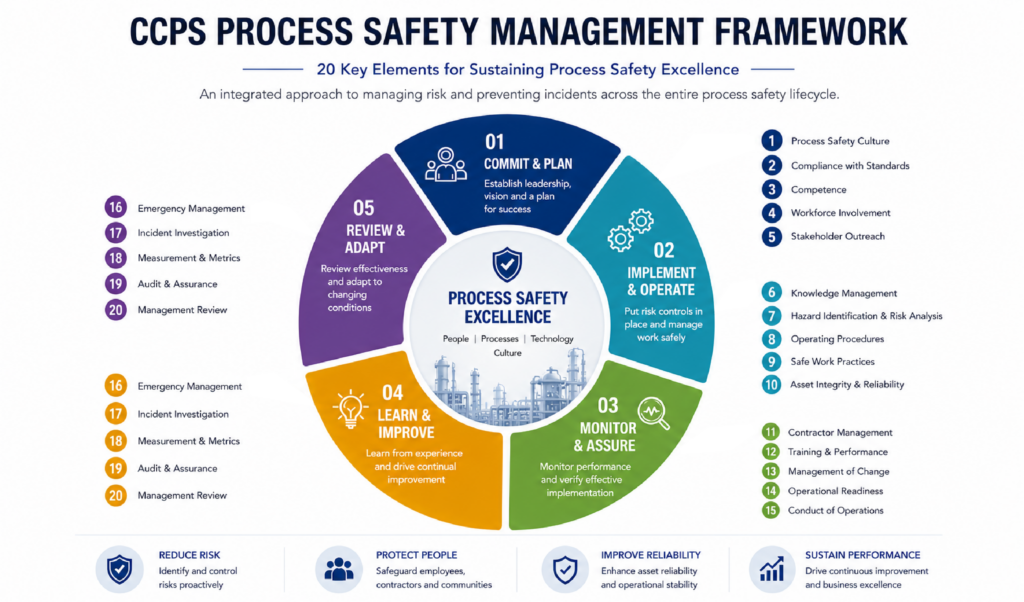
These elements cover:
• Process safety culture
• Risk identification and assessment
• Operating procedures
• Asset integrity and reliability
• Management of change (MOC)
• Emergency management
• Incident investigation
• Auditing and continuous improvement
What Does a Process Safety Management Assessment Include?
A PSM assessment evaluates how effectively an organization identifies, manages, and controls process safety hazards and whether its existing systems are suitable for the risks associated with the facility.
Depending on the facility and scope, a Process Safety Management assessment may include review of:
- Process safety information
- Process hazard analyses and risk assessments
- Operating and maintenance procedures
- Management of Change (MOC)
- Pre-Startup Safety Review (PSSR)
- Mechanical integrity and inspection practices
- Safety Instrumented Systems and other protection layers
- Training and competency
- Permit-to-work and operational controls
- Emergency preparedness and response
- Incident and near-miss investigation
- Contractor management
- Process safety performance indicators
- Auditing and management review
The assessment identifies gaps, evaluates the effectiveness of existing controls, and provides practical recommendations for improving the organization’s process safety management system.
Our Core Process Safety Services
HAZOP & Process Hazard Analysis
We conduct structured HAZOP and Process Hazard Analysis (PHA) studies to identify process deviations, causes, consequences, existing safeguards, and recommendations for risk reduction.
Functional Safety & SIL Studies
We support functional safety assessments, SIL assessment, LOPA, and Safety Instrumented System (SIS) evaluation in accordance with applicable functional safety principles and standards, including IEC 61508 and IEC 61511 where applicable.
Quantitative Risk Assessment (QRA)
Our Quantitative Risk Assessment (QRA) services evaluate major accident scenarios using consequence modelling, frequency assessment, individual risk, societal risk, and other appropriate risk measures.
ATEX, Hazardous Area Classification & Dust Explosion Safety
We provide Hazardous Area Classification (HAC), ATEX-related assessment, ignition source analysis, dust explosion risk assessment, and electrostatic hazard assessment for facilities handling flammable gases, vapours, liquids, and combustible dusts.
Process Safety Gap Assessment
Our Process Safety Gap Assessment identifies gaps in existing process safety systems, practices, documentation, and controls and provides prioritized recommendations for improvement.
Chemical Reaction Hazard Assessment
For processes involving reactive or potentially unstable chemicals, we assess reaction hazards and potential scenarios such as thermal runaway, decomposition, overpressure, and loss of temperature control.
Our Approach
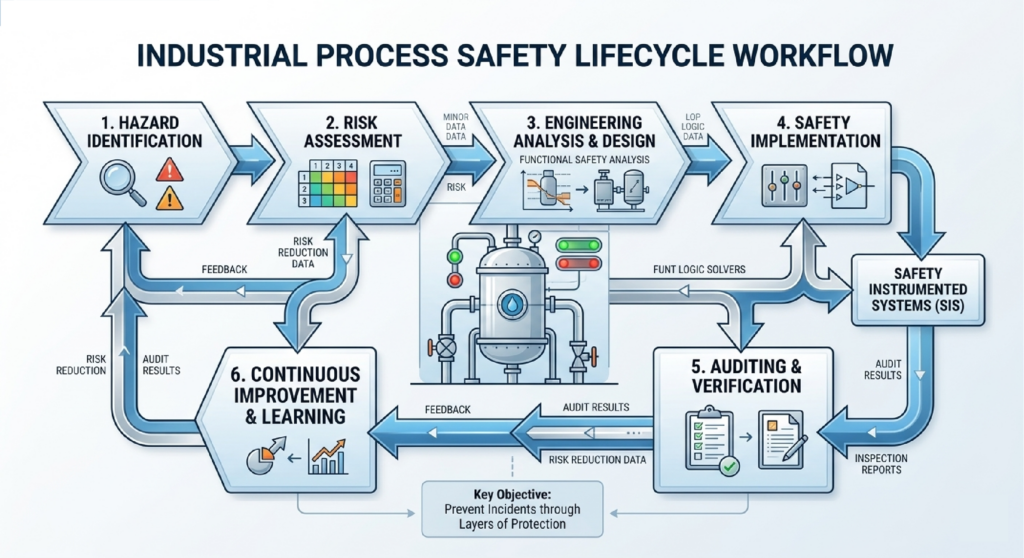
Our process safety methodology includes:
- Site assessment and process understanding
- Hazard identification and risk assessment
- Evaluation of safeguards and safety systems
- Engineering analysis and compliance review
- Practical recommendations and implementation support
Industries We Serve
We provide process safety solutions across multiple industries:
- Oil & Gas
- Chemicals & Petrochemicals
- Pharmaceuticals
- Food & Beverages
- FMCG & Manufacturing
- Automotive
- Power & Energy
- Miscellaneous
Why Choose Indsafe?
• Strong expertise in industrial process safety and risk management
• Multi-disciplinary team with process, electrical, and safety engineering knowledge
• Practical and implementation-focused recommendations
• Compliance with international standards and best practices
• Integrated approach covering HAZOP, QRA, SIL, HAC, and explosion safety studies
• Experience across diverse high-risk industries
Strengthen Your Process Safety Management System
A strong Process Safety Management system requires more than individual safety studies. It requires a structured approach to understanding process hazards, maintaining effective safeguards, managing change, ensuring asset integrity, and continually improving process safety performance.
Contact Indsafe to discuss your Process Safety Management requirements, PSM assessment, gap assessment, or process safety engineering needs.