


For decades, industrial establishments across India were familiar with the traditional Factory Inspector under the Factories Act, 1948. With the Inspector-cum-Facilitator framework introduced under the Occupational Safety, Health and Working Conditions (OSHWC) Code, 2020, the approach to factory inspection, compliance facilitation and enforcement has evolved.
At first glance, the change may appear to be a change in designation. However, the OSHWC Code combines regulatory inspection and enforcement with a formal compliance-facilitation role. Section 34 provides for the appointment of Inspector-cum-Facilitators and enables the appropriate Government to establish an inspection scheme, including web-based and randomized mechanisms.
The objective is therefore to move toward an inspection framework that combines:
- Enforcement
- Compliance Assistance
- Digital Monitoring
- Web-Based Inspection Mechanisms
- Employer Awareness
- Worker Protection
For factory owners, occupiers, EHS managers, HR professionals, safety officers and compliance teams, understanding this transition is important for maintaining continuous statutory readiness.
In simple terms: The Inspector-cum-Facilitator model does not eliminate inspections or enforcement. It combines regulatory oversight with compliance facilitation and a more structured inspection framework.
The applicable requirements can also vary by jurisdiction. See our State-Wise OSHWC Rules 2026 guide for a state-by-state compliance overview.
Why Was the Inspector-cum-Facilitator System Introduced?
Historically, labour inspections were largely experienced by businesses as regulatory exercises focused on identifying and addressing statutory non-compliances.
The OSHWC framework places greater emphasis on transparent inspection mechanisms, compliance awareness and technology-enabled processes.
The Ministry of Labour and Employment has explained that the Inspector-cum-Facilitator system is intended to make employers aware of applicable legal provisions, inform workers of their rights and support better compliance through randomized web-based inspections. The Ministry has also clarified that inspections may be undertaken on complaints with approval of the competent authority.
The broader objectives of the reform include:
- Improving transparency
- Promoting self-compliance
- Increasing use of digital processes
- Encouraging proactive safety management
- Improving regulatory efficiency
- Strengthening worker protection
The important point is that facilitation complements enforcement; it does not replace it.
What Is an Inspector-cum-Facilitator Under the OSHWC Code?

Section 34 of the Occupational Safety, Health and Working Conditions Code, 2020 provides for the appointment of Inspector-cum-Facilitators by the appropriate Government for enforcing the Code within their notified jurisdiction. It also provides for an inspection scheme that may include web-based generation of inspection lists and randomized selection of establishments and inspectors.
The Inspector-cum-Facilitator therefore performs two connected functions.
1. Inspector Role
Depending on the applicable provisions, rules and inspection scheme, the Inspector-cum-Facilitator may:
- Verify statutory compliance
- Conduct workplace inspections
- Examine records and documents
- Inspect machinery and workplace conditions
- Investigate accidents and dangerous occurrences
- Examine persons and seek relevant information
- Take samples where authorised
- Issue notices relating to identified non-compliances
- Exercise other statutory powers provided under the Code
Section 35 provides the powers of Inspector-cum-Facilitators, including examination of persons, calling for information, and search, seizure or taking copies of relevant records in specified circumstances.
2. Facilitator Role
The Inspector-cum-Facilitator framework also includes compliance facilitation.
This may involve:
- Providing compliance-related information
- Sensitizing employers and workers regarding applicable requirements
- Promoting awareness of statutory obligations
- Supporting better understanding of workplace safety and health requirements
The Ministry’s FAQ specifically states that Inspector-cum-Facilitators will make employers aware of legal provisions for compliance and workers aware of their rights.
The practical concept can therefore be expressed as:
Inspection + Compliance Facilitation + Enforcement
Factory Inspector vs Inspector-cum-Facilitator: What Has Changed?
The change is better understood as a change in the regulatory framework and inspection model, rather than simply replacing a strict inspector with a facilitator.
| Traditional Factory Inspection Framework | Inspector-cum-Facilitator Framework |
|---|---|
| Operated under the earlier statutory framework, including the Factories Act, 1948 | Operates under the OSHWC Code and applicable rules |
| Inspection and enforcement were central functions | Inspection, enforcement and compliance facilitation are combined |
| Inspection procedures followed the applicable earlier statutory system | Inspections are conducted under prescribed inspection schemes |
| Greater reliance on physical records and statutory registers | Electronic records and digital processes have a greater role |
| Inspection allocation followed the applicable administrative mechanism | The Code permits web-based and randomized inspection mechanisms |
| Focus on identifying statutory violations | Focus on compliance verification, facilitation and enforcement |
| Corrective action followed identified non-compliances | Follow-up on previously identified shortcomings is part of the inspection framework |
The OSHWC Code specifically enables the appropriate Government to establish an inspection scheme that may provide for web-based generation of inspection lists and randomized selection of establishments and inspectors.
The Ministry also describes the new approach as a transparent, technology-based inspection system that maintains accountability while facilitating compliance.
Major Change 1: Web-Based Inspection System
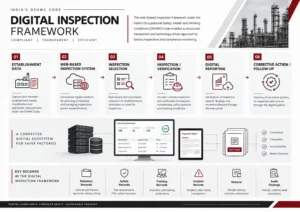
One of the significant changes under the OSHWC Code is the introduction of a web-based inspection framework.
Under Section 34, the appropriate Government may establish an inspection scheme that can provide for:
- Web-based generation of inspection lists
- Electronic collection of relevant information
- Randomized selection of establishments
- Randomized selection of inspectors
- Digital inspection-related processes
The exact operation of the inspection system depends on the applicable inspection scheme and jurisdiction.
Why Does This Matter for Factories?
As compliance processes become increasingly digital, factories should be prepared to produce and maintain relevant compliance information efficiently.
This can include:
- Statutory records
- Digital returns
- Factory registration and licensing information
- Safety documentation
- Training records
- Incident and accident records
- Occupational health records
- Risk assessments
- Audit reports
- Corrective-action records
The OSHWC Code requires prescribed registers and records to be maintained electronically or otherwise and provides for filing of prescribed returns electronically or otherwise in the manner specified by the appropriate Government.
The practical lesson: compliance records should be inspection-ready throughout the year, not assembled only when an inspection is expected.
Major Change 2: Randomized Selection of Inspections
The OSHWC Code allows inspection schemes to include randomized selection of establishments and inspectors.
The Ministry has also described the new system as involving randomized web-based inspections and stated that inspections can also be undertaken on complaints with approval of competent authorities.
For businesses, this reinforces the importance of maintaining continuous compliance rather than relying primarily on advance knowledge of an inspection.
Factories should therefore keep the following current:
- Statutory registers
- Licences and approvals
- Safety committee records
- Training records
- Risk assessments
- Emergency preparedness documentation
- Incident records
- Occupational health documentation
- Applicable returns
- Corrective-action status
- Audit reports
Inspection readiness should become a continuous activity.
Major Change 3: Risk-Based and Structured Inspection Approach
The inspection system under the OSHWC framework is intended to provide a more structured and transparent method of selecting and conducting inspections.
Depending on the applicable inspection scheme, relevant considerations may include the nature of the establishment, workplace hazards, compliance information and other prescribed parameters.
This is particularly relevant for higher-risk industrial environments such as:
- Chemical manufacturing
- Pharmaceuticals
- Petrochemicals
- Oil & gas
- Power generation
- Process industries
- Hazardous chemical storage and handling
For such facilities, maintaining robust hazard identification, risk assessment, safety controls and compliance documentation is particularly important.
Note: The exact criteria and inspection methodology may vary according to the inspection scheme and the jurisdiction of the appropriate Government.
Major Change 4: Compliance Facilitation Under the Inspector-cum-Facilitator Framework
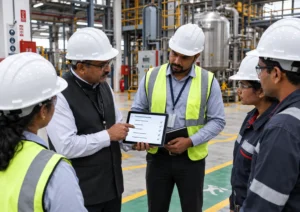
Perhaps the most significant conceptual change is that Inspector-cum-Facilitators are expected to actively support compliance.
Section 35 specifically authorizes Inspector-cum-Facilitators to supply information and sensitize employers and workers regarding compliance requirements.
This creates a formal legal basis for compliance guidance within the Inspector-cum-Facilitator framework.
Employers should therefore view inspections as opportunities to improve compliance systems rather than merely as regulatory events.
The intention is not to reduce enforcement but to encourage compliance before violations occur.
Major Change 5: Inspector-cum-Facilitator Inspection and Enforcement Powers
Although the title includes “Facilitator,” enforcement powers remain an important part of the framework.
Under Section 35, Inspector-cum-Facilitators have statutory powers that include examining persons, requiring information, inspecting establishments and, in specified circumstances, searching, seizing or taking copies of relevant records.
Depending on the applicable provisions and circumstances, inspectors may also:
- Enter and inspect workplaces
- Examine facilities and machinery
- Investigate accidents
- Examine relevant persons
- Review statutory records
- Take samples where authorised
- Record inspection findings
- Issue notices
- Initiate further statutory action where applicable
The Central Rules also provide for inspection follow-up and notices relating to identified shortcomings.
Therefore, businesses should not assume that the new designation represents a reduction in regulatory authority.
Facilitation does not mean the absence of enforcement.
Major Change 6: Power to Act Against Imminent Danger
The OSHWC Code retains significant special powers in relation to factories where serious hazards or imminent danger exist.
Section 38 provides special powers for factories where conditions may cause serious hazard or imminent danger by way of injury or death to persons employed in the factory or to the general public in the vicinity. In such circumstances, the Inspector-cum-Facilitator may issue a written order restricting employment in the affected area, subject to the conditions specified in the Code.
Examples of situations that may involve serious workplace hazards include:
- Major fire hazards
- Unsafe pressure systems
- Structural instability
- Toxic gas release risks
- Critical electrical hazards
- Serious process-safety deficiencies
These are practical examples of high-consequence hazards; the specific legal action depends on the circumstances and applicable provisions.
This demonstrates that while the system emphasizes facilitation and compliance, serious safety risks can still trigger strong regulatory intervention.
What Does the Inspector-cum-Facilitator System Mean for Factory Owners?
For factory management, the new inspection environment can be understood as increasingly:
More Digital
Electronic records, filings and web-based inspection mechanisms are becoming more important.
More Transparent
The Code provides for web-based and randomized inspection mechanisms as part of prescribed inspection schemes.
More Preventive
The compliance-facilitation function encourages establishments to understand and address requirements proactively.
More Documentation-Focused
Training records, risk assessments, SOPs, audit reports, statutory records and corrective-action documentation should remain current and accessible.
More Continuous
Factories should not treat compliance as an activity performed only before an inspection.
The Ministry itself describes the objective of the new system as promoting compliance and worker protection while maintaining accountability.
For organisations operating in Uttar Pradesh, these requirements should also be considered alongside the applicable State framework. Our guide to UP OSH Rules 2026 explains the key compliance areas factories in Uttar Pradesh should review.
How Should Companies Prepare for Inspector-cum-Facilitator Inspections?
Organizations should focus on the following areas.
Compliance Audits
Conduct periodic reviews of statutory and occupational safety requirements applicable to the establishment.
Safety Documentation
Maintain updated:
- Risk Assessments
- HIRA reports
- HAZOP studies, where applicable
- Emergency Response Plans
- SOPs
- Training Records
- Safety inspection records
- Corrective-action records
Digital Recordkeeping
Ensure that relevant statutory and safety records can be readily retrieved and produced when required.
The objective should not simply be to digitize documents, but to make the compliance system traceable, current and reliable.
Worker Training
Strengthen employee and contractor awareness of:
- Workplace hazards
- Safe operating procedures
- Emergency response
- Permit-to-work requirements, where applicable
- Relevant statutory safety requirements
Incident Reporting Systems
Maintain robust systems for reporting:
- Accidents
- Dangerous occurrences
- Near misses
- Significant unsafe conditions
Investigations should identify causes and track corrective actions through closure.
Management Accountability
Senior management should actively participate in safety governance and ensure that identified compliance gaps receive appropriate resources and corrective action.
What Documents Should a Factory Keep Inspection-Ready?
A practical inspection-readiness review should consider:
| Compliance Area | Typical Records / Evidence |
|---|---|
| Factory compliance | Registration, licence, approvals and applicable statutory records |
| Safety management | HIRA, risk assessments, SOPs, safety inspections |
| Process safety | For higher-risk process facilities, inspection readiness may also involve Process Safety Management, HAZOP and other process-safety documentation. |
| Training | Induction, job-specific and refresher training records |
| Safety committee | Meetings, minutes, observations and corrective actions |
| Occupational health | Medical examinations and relevant health-monitoring records |
| Emergency preparedness | Emergency plans, mock drills and inspection records |
| Hazardous chemicals | Chemical inventories, assessments and applicable compliance documents |
| Incidents | Accident, dangerous-occurrence and investigation records |
| Corrective actions | Observation, action, responsibility, target date and closure evidence |
| Digital compliance | Returns, electronic submissions and records where prescribed |
The exact records applicable to a factory will depend on its activities, workforce, hazards, jurisdiction and the relevant provisions and rules.
Common Misconceptions About Inspector-cum-Facilitators
Myth 1: Inspections Have Been Eliminated
False.
The OSHWC Code expressly provides for Inspector-cum-Facilitators and inspection schemes.
Myth 2: Inspector-cum-Facilitators No Longer Have Enforcement Powers
False.
The Code gives Inspector-cum-Facilitators substantial statutory powers relating to inspection, examination, investigation, records and other enforcement functions.
Myth 3: Facilitation Means Leniency
False.
Facilitation is intended to improve awareness and compliance. It does not eliminate enforcement.
The Ministry has specifically stated that replacing inspectors with Inspector-cum-Facilitators does not weaken enforcement.
Myth 4: Only Large Factories Will Be Inspected
False.
The OSHWC inspection framework is not defined simply by establishment size. Applicable inspection schemes, jurisdiction, complaints and other prescribed factors can determine how inspections are undertaken.
Myth 5: Factories Only Need to Prepare When an Inspection Notice Arrives
False.
A stronger approach is to maintain continuous compliance readiness.
Where inspection systems may use web-based and randomized mechanisms, relying on advance notice is not a substitute for maintaining current statutory and safety records.
Factory Inspection Readiness: A Practical 6-Step Approach
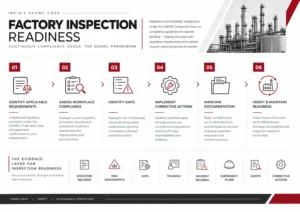
Companies can use a simple compliance cycle:
01 – IDENTIFY
Identify the Central and State requirements applicable to the establishment.
02 – ASSESS
Review statutory, safety, health and operational compliance.
03 – IDENTIFY GAPS
Compare documented requirements with actual workplace conditions.
04 – CORRECT
Assign responsibility and close identified deficiencies.
05 – DOCUMENT
Maintain reliable records and objective evidence of implementation.
06 – VERIFY & MAINTAIN
Conduct periodic internal reviews and keep the compliance system current.
The objective is not to prepare for an inspection. The objective is to maintain inspection readiness.
What Has Really Changed Under the Inspector-cum-Facilitator Framework?
The most important change is not simply the replacement of the words “Factory Inspector” with “Inspector-cum-Facilitator.”
The broader shift is toward an inspection and compliance framework in which:
Regulatory Oversight + Compliance Facilitation + Web-Based Processes + Continuous Readiness
operate together.
The OSHWC Code provides the legal framework for Inspector-cum-Facilitators, while the applicable rules and inspection schemes determine how those requirements are implemented within each jurisdiction.
For factories, the practical response is therefore to maintain:
Compliance → Safety Systems → Documentation → Training → Verification → Corrective Action
as an ongoing management cycle.
FAQs About Inspector-cum-Facilitator Under the OSHWC Code
What is an Inspector-cum-Facilitator under the OSHWC Code?
An Inspector-cum-Facilitator is an official appointed by the appropriate Government under Section 34 of the OSHWC Code, 2020 to perform inspection-related functions and support compliance with the Code within the notified jurisdiction.
Has the Factory Inspector been replaced by the Inspector-cum-Facilitator?
The OSHWC Code establishes the Inspector-cum-Facilitator framework for enforcement of the Code, replacing the earlier inspection architecture for matters governed by the Code. The precise administrative implementation depends on the applicable government notifications, rules and inspection schemes.
Do Inspector-cum-Facilitators still have enforcement powers?
Yes. The OSHWC Code provides Inspector-cum-Facilitators with statutory inspection and enforcement powers, including specified powers relating to examination of persons, information and records.
What is a web-based inspection scheme?
It is an inspection mechanism that the appropriate Government may establish under Section 34. The Code allows such a scheme to provide for web-based generation of inspection lists and randomized selection of establishments and inspectors.
Does the Inspector-cum-Facilitator system mean inspections are random?
The OSHWC Code allows the applicable inspection scheme to use randomized selection mechanisms. The actual inspection process depends on the scheme and jurisdiction.
How should factories prepare for Inspector-cum-Facilitator inspections?
Factories should maintain statutory documents, safety records, risk assessments, training records, occupational-health documentation, emergency preparedness records, incident reports and corrective-action evidence in a current and readily accessible form.
Can an Inspector-cum-Facilitator stop work in a factory?
Section 38 gives special powers in relation to factories where conditions may cause serious hazard or imminent danger resulting in injury or death. In specified circumstances, an Inspector-cum-Facilitator can issue a written order restricting employment in the affected area until the hazard or danger is addressed, subject to the Code’s provisions.
How INDSAFE Can Support Factory Compliance
INDSAFE supports organisations with integrated factory compliance and statutory safety requirements, including:
- Factory compliance reviews
- Statutory safety audits
- IS 14489 safety audits
- Occupational safety assessments
- Hazardous-process and chemical-safety compliance
- MSIHC-related compliance support
- Emergency preparedness and ERDMP
- Safety training and competency programmes
- Compliance documentation and corrective-action reviews
- Regulatory and statutory compliance support
The objective is to help organisations identify gaps, strengthen controls, document compliance and maintain inspection readiness.
Conclusion
The transition from the Factory Inspector framework to the Inspector-cum-Facilitator model represents an important change in India’s occupational safety and labour compliance system.
The objective is not to remove regulatory oversight. Instead, the OSHWC framework combines inspection, compliance facilitation, technology-enabled processes and enforcement.
For factory owners and EHS professionals, this means moving beyond inspection-driven compliance.
A more effective approach is to maintain statutory requirements, workplace controls, safety documentation, worker training, occupational-health systems, emergency preparedness and corrective actions throughout the year.
In the Inspector-cum-Facilitator era, compliance readiness should be continuous—not inspection-driven.
Official Regulatory References
- Occupational Safety, Health and Working Conditions Code, 2020 – Ministry of Labour & Employment, Government of India.
- FAQ on OSH&WC Code, 2020 – Ministry of Labour & Employment, including clarification on Inspector-cum-Facilitators, enforcement and randomized web-based inspections.
- Labour Codes – Draft Pre-Published Rules — Ministry of Labour & Employment.
Disclaimer: This article is intended for general informational purposes and should not be treated as legal advice. Applicability of specific requirements may depend on the establishment, industry, jurisdiction, applicable Central or State rules, notifications and amendments. In case of any difference between this article and the applicable legislation, rules or official notification, the latter will prevail.