
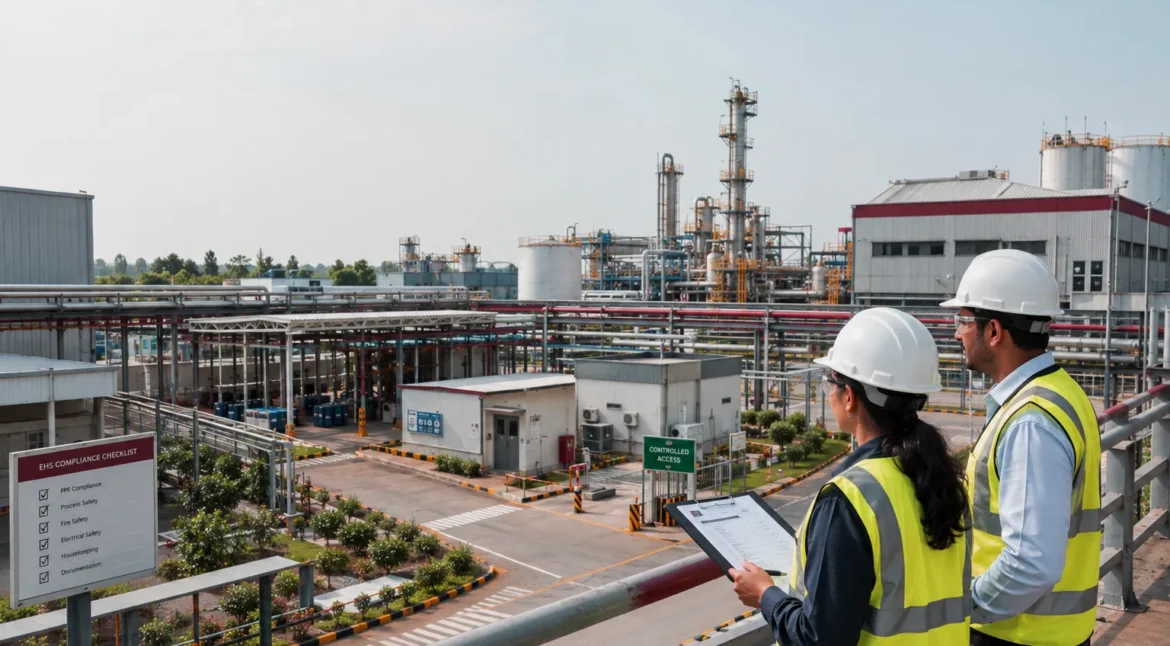
State-Wise OSHWC Rules 2026 have become an important compliance consideration for factories operating across India as the Occupational Safety, Health and Working Conditions Code, 2020 (OSHWC Code) moves into detailed Central and State-level implementation.
Last reviewed: 3 October 2026
For factory owners, occupiers, plant heads, EHS managers and compliance teams, however, compliance cannot be assessed only at the Central Government level.
The OSHWC Code provides the national statutory framework, while the applicable Central and State Rules provide detailed requirements, procedures, forms and administrative mechanisms. During 2026, several States have notified final OSHWC Rules, while others have published draft rules that remain subject to further notification.
This makes State-Wise OSHWC Rules 2026 an important consideration for companies operating factories across multiple locations.
A factory operating in Uttar Pradesh, for example, needs to track the UP OSH Rules 2026, while a company with facilities in Maharashtra, Haryana, Odisha or Telangana may need to monitor a different stage of State rule-making.
The practical approach is therefore not to use one national checklist for every factory, but to maintain a state-specific OSHWC compliance matrix based on the latest applicable legislation and notifications.
Quick answer: The OSHWC Code establishes the national framework for occupational safety, health and working conditions. The applicable Central and State Rules provide detailed requirements and procedures. In 2026, factories should therefore track both national requirements and the latest State-specific notifications applicable to each plant.
State-Wise OSHWC Rules 2026: What Is the OSHWC Code, 2020?
The Occupational Safety, Health and Working Conditions Code, 2020 is one of India’s four Labour Codes.
The Code consolidates 13 Central labour laws relating to occupational safety, health, working conditions and different classes of establishments and workers.
Among the laws consolidated by the OSHWC Code are the:
- Factories Act, 1948
- Contract Labour (Regulation and Abolition) Act, 1970
- Inter-State Migrant Workmen Act, 1979
- Building and Other Construction Workers Act, 1996
- Mines Act, 1952
- Plantations Labour Act, 1951
- Motor Transport Workers Act, 1961
- Dock Workers (Safety, Health and Welfare) Act, 1986
The Ministry of Labour and Employment states that all provisions of the OSHWC Code were brought into force from 21 November 2025.
The framework is intended to consolidate and simplify multiple Central labour laws while supporting mechanisms such as common registration, licensing and electronic compliance.
For employers, the important point is that the Code, applicable Central Rules and applicable State Rules need to be considered together.
What Are the OSHWC Central Rules 2026?
The Occupational Safety, Health and Working Conditions (Central) Rules, 2026 provide detailed Central-level rules under the OSHWC Code.
The notified Central Rules state that they extend to the whole of India and come into force on publication in the Official Gazette.
Among other things, the Central Rules provide procedures relating to establishment registration and electronic submission through the Shram Suvidha Portal.
However, State-specific requirements remain relevant for establishments falling under State jurisdiction.
This means a factory compliance team should not treat the Central Rules as a substitute for checking the applicable State framework.
Why Are State-Wise OSHWC Rules 2026 Important for Factories?
The OSHWC framework involves rule-making responsibilities at both Central and State levels.
As a result, operational requirements can differ depending on the jurisdiction and the type of establishment.
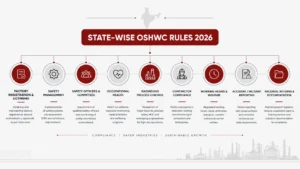
Areas that may require State-specific review include:
- factory registration and licensing;
- safety officers;
- safety committees;
- occupational health and medical examinations;
- welfare facilities;
- working conditions;
- hazardous processes;
- dangerous operations;
- accident and dangerous-occurrence reporting;
- contractor labour;
- inter-State migrant workers;
- registers, records and returns;
- inspection mechanisms;
- competency requirements; and
- administrative procedures.
The Ministry of Labour and Employment has also recognised the role of State Governments in framing rules under the Labour Codes.
For a company operating multiple manufacturing locations, this creates an important compliance-management principle:
One national framework does not necessarily mean one identical plant-level compliance checklist.
Each facility should therefore be assessed against the provisions applicable to its jurisdiction.
State-Wise OSHWC Rules 2026: Central Framework vs State Implementation
For compliance teams, it is useful to distinguish three levels:
1. OSHWC Code, 2020
The Code provides the national statutory framework and has been in force from 21 November 2025.
2. Occupational Safety, Health and Working Conditions (Central) Rules, 2026
The Central Rules provide detailed Central-level procedures and requirements. The notified Rules expressly identify themselves as the Occupational Safety, Health and Working Conditions (Central) Rules, 2026.
3. State OSHWC Rules
State Governments have separately progressed with their own rules.
As of 3 October 2026, the position is not uniform across India.
Some States have notified final rules, while others remain at the draft-rule stage.
This distinction is critical: a draft State Rule should not automatically be presented as a final statutory requirement.
State-Wise OSHWC Rules 2026: Current Position
The following overview reflects the regulatory information reviewed for this article as of 3 October 2026.
Important: State rule status can change through subsequent Gazette notifications, amendments and commencement orders. Factories should verify the latest official notification before taking statutory compliance action.
Uttar Pradesh: UP OSH Rules 2026
Uttar Pradesh has published the UP OSH Rules 2026. The official Invest UP notification portal lists the rules dated 12 August 2026.
For factories operating in Noida, Greater Noida, Ghaziabad, Lucknow, Kanpur and other industrial areas of Uttar Pradesh, the notification makes a State-specific compliance review particularly relevant.
Factories should review the requirements applicable to their establishment, including areas such as:
- factory registration and licensing;
- employer and occupier responsibilities;
- occupational safety;
- occupational health;
- welfare;
- hazardous processes;
- safety committees;
- safety officers;
- contractor management;
- working conditions;
- records and registers; and
- statutory reporting.
Companies should not simply assume that procedures developed under the earlier State framework remain sufficient without checking their applicability against the new OSHWC framework. For a detailed review of the Uttar Pradesh requirements, see our guide to [UP OSH Rules 2026].
Rajasthan: Final OSHWC Rules 2026
Rajasthan initially published draft Rajasthan Occupational Safety, Health and Working Conditions Rules, 2026 in February 2026. The draft stated that the Rules would come into force upon final publication in the Official Gazette.
The final Rules were subsequently notified on 30 June 2026. Independent regulatory tracking records identify the final notification as S.O.23 and report that the Rules came into force from the date of publication.
Factories operating in industrial regions such as Bhiwadi, Neemrana, Jaipur, Alwar, Jodhpur and Kota should therefore review the final State framework rather than relying on the earlier draft.
Areas for review can include:
- registration and licensing;
- safety management;
- safety officers and safety committees;
- occupational health;
- welfare;
- hazardous processes;
- contractor compliance;
- statutory records; and
- reporting requirements.
Andhra Pradesh: Final OSHWC Rules 2026
Andhra Pradesh notified the Occupational Safety, Health and Working Conditions (Andhra Pradesh) Rules, 2026 through G.O.Rt.No.146 dated 6 August 2026, published in Andhra Pradesh Gazette No. 432 on 7 August 2026.
For factories operating in Andhra Pradesh, compliance teams should therefore review their existing systems against the final State Rules.
The review should cover applicable requirements relating to:
- registration and licensing;
- occupational safety;
- occupational health;
- welfare;
- hazardous processes;
- safety committees;
- worker-related requirements;
- contractor compliance; and
- statutory records and reporting.
Bihar: Final OSHWC Rules 2026
Bihar notified the Occupational Safety, Health and Working Conditions (Bihar) Rules, 2026 on 1 July 2026, according to regulatory notification records. The Rules supersede specified earlier State rules covering areas including factories, contract labour, inter-State migrant workers and other covered establishments.
Factories operating in Bihar should therefore assess the applicable requirements against the notified State Rules rather than relying solely on earlier compliance procedures.
Bihar has also subsequently issued a Risk-Based Classification of Establishments (Occupational Safety, Health and Working Conditions) Scheme, 2026, demonstrating that State-level implementation can continue to develop after the principal Rules are notified.
Maharashtra: State Draft OSHWC Rules 2026
Maharashtra published State draft rules during 2026 covering:
- Maharashtra Occupational Safety, Health and Working Conditions (Factories and Other Ports) Rules, 2026; and
- Maharashtra Occupational Safety, Health and Working Conditions (Labour) Rules, 2026.
The Maharashtra Labour Department currently lists these as State draft rules.
This distinction is important.
Factories in Maharashtra should monitor the final notification rather than treating the draft provisions as final statutory requirements.
In the meantime, compliance teams can maintain a transition tracker covering:
- factory registration;
- safety officers;
- occupational health;
- safety committees;
- welfare;
- hazardous processes;
- contractor compliance;
- records and returns; and
- inspection-related requirements.
Haryana: Draft OSHWC Rules 2026
Haryana published a fresh draft of its Occupational Safety, Health and Working Conditions Rules, 2026 on 5 May 2026.
Available regulatory tracking indicates that the rules remained at the draft stage after the objection period, pending final notification.
Factories operating in Gurugram, Manesar, Faridabad, Sonipat, Panipat and other Haryana industrial areas should therefore distinguish between:
draft provisions being monitored
and
final requirements notified through the Gazette.
Until the final State position is verified, compliance teams should continue monitoring the Haryana Government’s official notifications and maintain a transition tracker.
Odisha: Draft OSHWC Rules 2026
Odisha published the Draft Odisha Occupational Safety, Health and Working Conditions Rules, 2026 in the Gazette on 16 February 2026, inviting objections and suggestions within the prescribed period. The official Odisha Labour & ESI Department continues to list the notification as a draft.
The draft itself states that it would be taken into consideration after the objection period and that the proposed Rules would come into force upon final publication.
Factories and industrial establishments in sectors such as:
- steel;
- aluminium;
- mining;
- chemicals;
- power;
- ports; and
- heavy manufacturing
should therefore continue monitoring the official State position.
Draft provisions should not be presented as final requirements until the applicable notification is verified.
Telangana: Draft OSHWC Rules 2026
Telangana published draft Occupational Safety, Health and Working Conditions Rules, 2026 during 2026.
The draft framework covers areas including:
- registration;
- licensing;
- safety committees;
- safety and welfare officers;
- medical examinations;
- accident reporting;
- welfare facilities;
- working hours;
- contract labour;
- inter-State migrant workers; and
- electronic registers and returns.
Available regulatory tracking identifies the Telangana Rules as a draft notification rather than a final State notification.
Factories in Hyderabad, Medchal, Sangareddy, Patancheru and other Telangana industrial areas should therefore monitor the final notification before treating draft provisions as definitive statutory requirements.
Punjab: Draft OSHWC Rules 2026
Punjab also entered the State rule-making process during 2026 with draft Occupational Safety, Health and Working Conditions Rules.
Factories in Punjab should verify the latest Gazette and Labour Department position before treating draft provisions as final requirements.
For compliance teams, the immediate priority should be maintaining a State-wise transition tracker covering:
- registration;
- licensing;
- safety management;
- occupational health;
- welfare;
- contractor compliance;
- records; and
- statutory reporting.
State-Wise OSHWC Rules 2026: What Should Factory Owners Track?
A State-Wise OSHWC compliance review should not stop at checking whether a State has notified its Rules.
Factory owners, occupiers, EHS teams and compliance managers should establish a structured compliance tracker covering the following areas.
1. State OSHWC Rule Status
For every State where the company operates, record whether the applicable rules are:
- draft;
- revised draft;
- finally notified;
- commenced;
- amended; or
- subject to subsequent notification.
The tracker should include:
- notification date;
- Gazette reference;
- effective date;
- applicable establishment type; and
- official source document.
2. Factory Registration and Licensing
Review:
- establishment registration;
- factory registration;
- applicable licences;
- licence validity;
- amendment requirements;
- renewal procedures;
- changes in occupier or management;
- process or capacity changes; and
- applicable electronic submissions.
The Central Rules provide electronic registration procedures through the prescribed portal for establishments covered by the Central framework.
3. Safety Officer Requirements
Factories should verify whether Safety Officer requirements apply based on:
- number of workers;
- hazardous processes;
- type of establishment; and
- applicable Central or State Rules.
The review should cover:
- qualifications;
- number of Safety Officers;
- duties;
- reporting structure; and
- statutory records.
4. Safety Committees
Where applicable, review:
- constitution;
- management and worker representation;
- meeting frequency;
- minutes;
- action tracking;
- worker participation; and
- closure of identified safety actions.
A Safety Committee should form part of the site’s safety-management structure rather than being treated only as a statutory meeting record.
5. Occupational Health and Medical Examination
Review applicable requirements for:
- pre-employment medical examinations;
- periodic medical examinations;
- health surveillance;
- hazardous-process workers;
- dangerous operations;
- occupational health facilities;
- medical records; and
- follow-up actions.
The exact requirement should be determined from the applicable Code and Rules rather than assumed to be identical for every factory.
6. Hazardous Process and Chemical Safety
Factories handling hazardous chemicals or conducting hazardous processes should separately assess the interaction between OSHWC requirements and other applicable legislation.
The review may cover:
- hazard identification;
- chemical exposure controls;
- process safety;
- safe operating procedures;
- emergency preparedness;
- worker training;
- health surveillance;
- chemical information;
- statutory reporting; and
- applicable hazardous-chemical legislation such as the MSIHC Rules.
OSHWC compliance should therefore be integrated with the site’s broader EHS and process-safety compliance system.
7. Contractor Compliance
Where contractor labour is involved, review:
- contractor licensing;
- worker records;
- competency;
- safety induction;
- PPE;
- supervision;
- welfare arrangements;
- training;
- incident reporting; and
- allocation of responsibilities between principal employer and contractor.
A factory compliance assessment should include contractor personnel working within its operational environment, not only direct employees.
8. Working Hours, Overtime and Welfare
Depending on the applicable provisions, review:
- working hours;
- rest intervals;
- overtime;
- shift arrangements;
- weekly holidays;
- welfare facilities;
- canteen requirements;
- crèche requirements;
- drinking water;
- washing facilities; and
- other prescribed workplace facilities.
The applicable State Rules should be checked before modifying shift patterns or relying on a generic national interpretation.
9. Accident and Dangerous Occurrence Reporting
Factories should verify that their incident-management procedure addresses both:
internal reporting
and
statutory reporting.
The review should cover:
- reportable accidents;
- dangerous occurrences;
- occupational diseases where applicable;
- notification responsibilities;
- statutory timelines;
- authorities to be notified;
- documentation; and
- corrective and preventive actions.
10. Registers, Returns and Digital Compliance
Compliance teams should identify every applicable:
- register;
- return;
- licence;
- certificate;
- inspection record;
- training record;
- medical record;
- committee record;
- incident record; and
- electronic submission.
The objective should be to maintain a single compliance calendar showing:
requirement → responsible person → frequency → due date → evidence → status
State-Wise OSHWC Compliance Matrix for Multi-State Companies
For companies operating factories across several States, a centralised State-Wise OSHWC Compliance Matrix can provide a practical way to manage differences.
| State | Rule status reviewed for this article | Factory compliance approach |
|---|---|---|
| Uttar Pradesh | 2026 rules listed by Invest UP | Review applicable State requirements |
| Rajasthan | Final 2026 Rules notified | Review final State requirements |
| Andhra Pradesh | Final 2026 Rules notified | Review final State requirements |
| Bihar | Final 2026 Rules notified | Review final State requirements |
| Maharashtra | 2026 State draft rules listed | Monitor final notification |
| Haryana | 2026 draft rules | Monitor final notification |
| Odisha | 2026 draft rules | Monitor final notification |
| Telangana | 2026 draft rules | Monitor final notification |
| Punjab | 2026 draft-rule process | Verify latest State notification |
Important: This table reflects the regulatory status reviewed for this article on 3 October 2026. It should be rechecked against the latest State Gazette before being used as a compliance decision-making document.
For a multi-State organisation, the detailed internal matrix should additionally record:
- plant location;
- applicable authority;
- notification number;
- notification date;
- effective date;
- applicable provisions;
- existing compliance;
- identified gap;
- corrective action;
- responsible person;
- target date; and
- evidence of closure.
Can Factories Continue Using Earlier State Factory Rules?
This requires careful review.
The transition to the OSHWC framework does not mean that every historical compliance document should simply be discarded, nor does it mean that every earlier requirement can automatically be treated as permanently applicable.
The OSHWC Code contains savings provisions, and the effect of earlier rules, notifications, actions and appointments must be assessed in the context of the Code, subsequent Rules and applicable notifications.
Factories should therefore avoid both assumptions:
“All old rules became invalid immediately.”
and
“All old rules continue unchanged.”
The appropriate approach is a documented applicability review considering:
OSHWC Code + Central Rules + State Rules + Gazette notifications + transitional/savings provisions + sector-specific requirements
What Does State-Wise OSHWC Compliance Mean for Multi-State Companies?
A manufacturing organisation operating facilities in Uttar Pradesh, Rajasthan, Maharashtra, Haryana, Andhra Pradesh, Telangana or other States may encounter different stages of State-level rule implementation.
One plant may already be working against final State Rules, while another may still be monitoring draft provisions.
This creates a practical requirement for corporate EHS and compliance teams:
Maintain a State-Wise OSHWC Compliance Register
For each plant, record:
1. Jurisdiction
State and applicable authority
2. Rule Status
Draft / final / amended / commenced
3. Applicable Requirements
Factory, safety, health, welfare and workforce requirements
4. Existing Compliance
Current licences, records, audits and procedures
5. Identified Gaps
Regulatory and operational gaps
6. Corrective Action
Action owner and target date
7. Evidence
Documents, registers, certificates, reports and records
8. Regulatory Source
Official Gazette or Government notification
This converts State-wise OSHWC monitoring from a legal-news exercise into an operational compliance-management system.
What Should Factory Owners Do in 2026?
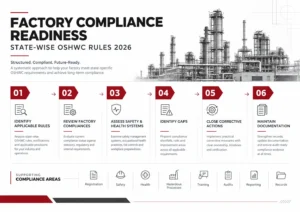
Factories should consider the following sequence:
01 – Identify the Applicable Framework
Determine which OSHWC provisions, Central Rules, State Rules and other EHS legislation apply to the establishment.
02 – Verify the Latest State Position
Do not rely on an old draft, secondary article or previous compliance checklist.
Verify the latest official Gazette or Government notification.
03 – Map Existing Compliance
Compare current factory licences, registrations, safety systems, medical records, training, committees, registers and reporting procedures against the applicable requirements.
04 – Identify Gaps
Separate gaps into:
- legal/statutory;
- documentation;
- organisational;
- technical;
- training;
- occupational health; and
- emergency-preparedness areas.
05 – Implement Corrective Actions
Assign responsibility, target dates and evidence requirements for identified gaps.
06 – Maintain a State-Wise Compliance Tracker
For multi-location organisations, maintain a central tracker and update it whenever a State publishes a new notification, amendment or final Rule.
Key Takeaway: State-Wise OSHWC Compliance Is an Ongoing Process
The implementation of the OSHWC framework should not be viewed as a single compliance event.
The OSHWC Code has been in force nationally since 21 November 2025, while the Central Rules 2026 and State-level rules provide detailed implementation mechanisms.
As of 3 October 2026, States are at different stages of implementation. Uttar Pradesh, Rajasthan, Andhra Pradesh and Bihar have published 2026 State Rules, while Maharashtra, Haryana, Odisha and Telangana remain important jurisdictions to monitor for their respective State rule-making developments.
For factories, the practical priority is therefore to maintain a jurisdiction-specific compliance system rather than relying on a single generic checklist.
The core review should bring together:
Central OSHWC requirements + applicable State Rules + Gazette notifications + transitional provisions + hazardous-process requirements + occupational health + factory compliance records.
A structured compliance review can help factories identify gaps in registration, licensing, safety governance, occupational health, hazardous-process management, contractor safety, emergency preparedness and statutory documentation before those gaps become more difficult to address during inspections or regulatory reviews.
For organisations operating across multiple States, a useful starting point is a State-Wise OSHWC Compliance Matrix covering every factory location and its current regulatory position.
Official Sources & Regulatory References
For regulatory monitoring, priority should be given to the latest official Government notification or Gazette applicable to the establishment.
- Ministry of Labour & Employment – OSHWC Code / Central Rules
- Invest UP – UP OSH Rules 2026
- Maharashtra Labour Department – State Draft OSHWC Rules 2026
- Odisha Labour & ESI Department – Draft Odisha OSHWC Rules 2026
- Rajasthan Factories & Boilers / Gazette notifications
- Relevant State Labour Departments and Official Gazettes
Disclaimer: This article is intended as a general compliance-information resource and should not be treated as legal advice. Regulatory status can change through subsequent Gazette notifications, amendments, commencement orders or other official directions. Factories should verify the latest official notification applicable to their establishment before taking statutory compliance action.
Need a Factory Compliance Review?
INDSAFE supports organisations with factory compliance reviews, statutory safety audits, IS 14489 audits, occupational safety assessments, hazardous-process compliance, emergency preparedness and related regulatory requirements.