


A factory compliance notice may be issued when an inspection, examination of records, investigation or other regulatory action identifies non-compliance with applicable requirements relating to occupational safety, health, working conditions, welfare, records, reporting or other statutory obligations.
Under India’s current occupational safety framework, the Occupational Safety, Health and Working Conditions Code, 2020 (OSH Code) provides the central framework for occupational safety, health and working conditions. The Code came into force on 21 November 2025. The Occupational Safety, Health and Working Conditions (Central) Rules, 2026 were notified on 8 May 2026, while State-specific OSHWC Rules provide detailed requirements and procedures within their respective jurisdictions. For a broader state-by-state overview, see our State-Wise OSHWC Rules 2026 guide.
In Uttar Pradesh, the Uttar Pradesh Occupational Safety, Health and Working Conditions Rules, 2026 were notified on 27 August 2026 under Notification No. 962/XXXVI-03–2026-1903305 and came into force from the date of publication in the Official Gazette. The Rules superseded specified earlier State rules relating to matters including factories, contract labour, safety officers, welfare and other areas covered by the consolidated framework.
A factory compliance notice should therefore not be viewed only as a “safety issue.” Depending on the finding, it may relate to physical safeguards, hazardous processes, accident reporting, statutory records, occupational health, safety-management arrangements, factory registration or other requirements prescribed under the applicable law.
Why do factories receive compliance notices?
Factories may receive compliance notices when inspections, record examinations, investigations or other regulatory actions identify gaps in workplace safety, hazardous-process controls, occupational health, statutory documentation, reporting, welfare or other applicable legal requirements.
What Is a Factory Compliance Notice?
A factory compliance notice is a formal communication from the competent regulatory authority identifying a contravention, deficiency or required corrective action.
The exact terminology can depend on the applicable law, rules and nature of the finding. Under Rule 78 of the Occupational Safety, Health and Working Conditions (Central) Rules, 2026, an Inspector-cum-Facilitator may, after an inspection where necessary, issue an improvement notice pointing out non-compliance with safety, health and working-condition requirements. The same rule requires the Inspector-cum-Facilitator to check whether shortcomings identified during an earlier inspection have been rectified and whether previously issued notices have been complied with.
Therefore, a compliance notice is not necessarily limited to an accident or serious incident. A factory can receive regulatory observations because required safeguards, records, procedures, reporting or statutory arrangements are not compliant.
Common Reasons for Factory Compliance Notice
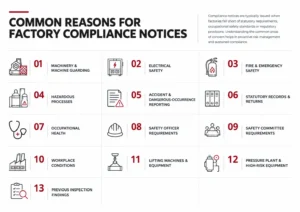
1. Unsafe Machinery or Inadequate Machine Guarding
Machinery-related deficiencies are an important area of factory safety compliance.
Examples of regulatory concerns can include:
- Inadequate guarding of dangerous moving parts
- Missing or ineffective protective devices
- Unsafe access to moving machinery
- Unsafe work near machinery in motion
- Deficiencies in isolation or power-cut-off arrangements
- Unsafe operation or maintenance practices
The OSH Code places responsibilities on employers relating to the health, safety and working conditions of workers, while detailed requirements for particular hazards and processes are prescribed through applicable rules.
Machine guarding should therefore be treated as a statutory safety-control issue rather than merely an internal housekeeping matter.
2. Unsafe Electrical Installations or Electrical Safety Conditions
Electrical hazards can lead to serious injury, fire and equipment damage. Regulatory concerns may arise where electrical installations or work practices do not comply with applicable safety requirements.
Areas that may require attention include:
- Electrical equipment and installations
- Protection against electrical contact
- Earthing and protective measures
- Electrical panels and enclosures
- Isolation arrangements
- Access around electrical equipment
- Electrical maintenance practices
- Conditions that create a risk of electric shock or fire
The exact legal requirement depends on the applicable provisions for the establishment and the nature of the installation. A compliance review should therefore assess the actual installation against the requirements applicable to that factory. INDSAFE’s Electrical Risk Assessment services can help identify electrical hazards and deficiencies requiring corrective action.
3. Fire and Emergency-Safety Deficiencies
Fire protection and emergency preparedness are another important area of factory compliance.
Possible compliance deficiencies may relate to:
- Emergency exits and means of escape
- Accessibility of emergency routes
- Fire-fighting arrangements
- Emergency preparedness
- Emergency procedures
- Availability of required safety information
- Conditions that increase fire or explosion risk
The OSH framework contains requirements relating to safety, hazardous processes and emergency preparedness, while applicable State rules can prescribe additional requirements.
For factories handling hazardous substances or conducting hazardous processes, emergency preparedness becomes particularly important because the consequences of an incident can extend beyond routine workplace hazards.
For a structured review of fire protection, egress and emergency arrangements, see INDSAFE’s Fire Safety Audit services.
4. Non-Compliance in Hazardous Processes
Factories carrying out hazardous processes are subject to additional safety and health requirements.
The OSH Code contains specific provisions dealing with hazardous processes, including occupational safety, health surveillance and exposure to hazardous substances. It also provides for maximum permissible limits for chemicals and toxic substances used in manufacturing processes to be prescribed by the State Government.
Compliance issues may therefore arise where a factory does not adequately address requirements applicable to:
- Hazardous substances
- Chemical exposure
- Hazard identification and control
- Health surveillance
- Emergency arrangements
- Information regarding workplace hazards
- Safe operating requirements for hazardous processes
The exact requirements depend on the process, substances involved and applicable rules.
For higher-risk process facilities, Process Safety Management provides a structured approach to identifying, evaluating and controlling process-related hazards.
5. Failure to Report Accidents or Dangerous Occurrences
Accident reporting is a statutory compliance matter.
The OSH framework requires employers to maintain prescribed information and records relating to workers and workplace events, including accidents and dangerous occurrences, and to make prescribed returns or notifications in the manner and within the period specified by the applicable rules.
A compliance problem can therefore arise where:
- A reportable accident is not notified within the prescribed period
- A dangerous occurrence is not reported as required
- Required accident records are incomplete
- Statutory accident registers are not maintained
- Information submitted to the authority is incomplete or inaccurate
This is particularly important because accident-reporting requirements are not the same as an organisation’s internal incident-reporting procedure. A company may have an internal incident-reporting system while still failing to satisfy a statutory reporting requirement.
6. Inadequate Statutory Registers, Records and Returns
Documentation is a significant part of factory compliance.
The OSH Code requires employers to maintain prescribed registers and records and to file prescribed returns. The applicable rules prescribe the forms, records and returns required for different establishments and circumstances. The Central Rules, 2026 include prescribed records relating to employees, attendance, leave, wages and overtime, health examination, accidents and dangerous occurrences, annual returns and other statutory matters.
A factory compliance notice may therefore result from:
- Missing statutory registers
- Incomplete records
- Records not maintained in the prescribed manner
- Failure to submit required returns
- Outdated information
- Inconsistency between records and actual workplace conditions
- Failure to produce required records when demanded by the competent authority
Good documentation is therefore part of legal compliance, not simply an administrative activity.
7. Failure to Provide Required Occupational Health Measures
Factory compliance is not limited to preventing physical accidents.
Occupational health requirements can become particularly important where employees are exposed to:
- Hazardous chemicals
- Dust
- Fumes
- Toxic substances
- Noise
- Other occupational health hazards
The OSH Code includes provisions concerning occupational health, hazardous processes and exposure to chemicals and toxic substances. Depending on the establishment and applicable rules, compliance may involve health examinations, health records, exposure controls, medical surveillance or other prescribed measures.
The requirement should always be assessed against the specific hazard and the applicable statutory provisions rather than assuming that the same medical programme applies to every factory.
8. Non-Compliance With Safety Officer Requirements
Certain establishments are required to appoint Safety Officers.
This requirement should not be confused with the requirement to constitute a Safety Committee.
Under Section 22 of the OSH Code, Safety Officers are required in specified establishments, including factories employing 500 or more workers and factories carrying on hazardous processes where 250 or more workers are employed, subject to the applicable provisions and rules.
The final Uttar Pradesh Occupational Safety, Health and Working Conditions Rules, 2026 prescribe Safety Officer requirements for specified establishments, including factories with 500 or more workers and factories carrying on hazardous processes with 250 or more workers, along with additional requirements in specified categories of establishments.
Therefore, failure to appoint the required Safety Officer, or failure to comply with related statutory requirements, can become a compliance issue where the establishment falls within the prescribed category.
9. Failure to Constitute a Required Safety Committee
Safety Committee requirements are separate from Safety Officer requirements.
Under the final Uttar Pradesh Occupational Safety, Health and Working Conditions Rules, 2026, specified establishments, including factories with 250 or more workers and establishments carrying on hazardous processes or certain dangerous operations, are subject to Safety Committee requirements. The Rules also prescribe requirements concerning composition, worker representation, meetings, records and follow-up.
Consequently, where the requirement applies, absence of the committee or failure to comply with prescribed committee requirements can create a statutory compliance gap.
10. Unsafe Workplace Conditions
Basic workplace conditions also form part of occupational safety and health compliance.
Depending on the applicable provisions, concerns can include:
- Unsafe access and movement
- Inadequate workplace conditions
- Unsafe floors, stairs or passages
- Inadequate ventilation
- Unsatisfactory lighting
- Poor workplace hygiene
- Inadequate welfare facilities
- Unsafe working arrangements
These should not be treated simply as housekeeping observations when they create a health or safety risk or amount to non-compliance with a prescribed requirement.
11. Deficiencies in Lifting Machines and Lifting Equipment
Factories using cranes, hoists, lifting machines, chains, ropes, slings and other lifting equipment must address the safety requirements applicable to those systems.
Compliance concerns may include:
- Unsafe lifting equipment
- Defective lifting accessories
- Inadequate inspection or examination
- Improper use of lifting equipment
- Inadequate safe working information
- Unsafe lifting operations
The former Factories Act framework specifically contained provisions dealing with hoists and lifts and lifting machines, chains, ropes and lifting tackles. The current OSH framework continues the regulatory focus on occupational safety, with detailed requirements established through the Code and applicable rules.
12. Pressure Plant and Other High-Risk Equipment
Pressure systems can present significant risks when improperly designed, operated, maintained or inspected.
Depending on the equipment and applicable rules, compliance concerns may include:
- Defective pressure equipment
- Missing or inadequate safety devices
- Inadequate examination or testing
- Unsafe operating conditions
- Failure to maintain required records
Factories should identify which statutory inspection, testing and certification requirements apply to each item of pressure equipment rather than assuming that one general certificate covers every requirement.
13. Failure to Address Previous Inspection Findings
A previous inspection notice does not automatically disappear after the factory submits a response.
Rule 78 of the Occupational Safety, Health and Working Conditions (Central) Rules, 2026 specifically requires the Inspector-cum-Facilitator to ascertain during each inspection the extent to which shortcomings identified during a previous inspection have been rectified and whether previously issued notices have been complied with. Findings, shortcomings and orders are also required to be recorded and maintained.
This means that repeated observations can become particularly significant.
A factory should therefore maintain evidence showing:
Observation → Corrective Action → Responsible Person → Target Date → Completion → Verification
This creates a traceable record of corrective action.
How Documentation Supports a Factory Compliance Notice
A common mistake is to treat physical compliance and documentary compliance as two completely separate subjects.
In practice, regulatory verification can involve both.
For example, a factory may have a safety arrangement physically in place, but if the applicable law requires a particular record, examination, report, notification or other documentation, the factory must also satisfy that requirement.
The OSH framework provides for maintenance of prescribed registers, records and returns, while the Central Rules prescribe various forms and records.
Important compliance evidence can therefore include, where applicable:
- Statutory registers
- Accident and dangerous-occurrence records
- Required returns
- Inspection and examination records
- Testing certificates
- Health records
- Safety Committee records
- Safety Officer-related records
- Training records where prescribed or otherwise required
- Risk assessments and safety documentation where applicable
- Corrective-action records
- Previous inspection notices and closure evidence
The exact documents required depend on the establishment, its processes and the applicable Central and State rules.
Can a Factory Compliance Notice Be Issued Without an Accident?
A factory does not have to experience a major accident before regulatory non-compliance can be identified.
An inspection can identify non-compliance during normal regulatory verification.
The Central OSH Rules, 2026 expressly provide for an improvement notice following inspection where non-compliance with safety, health and working-condition requirements is identified. The rules also require inspectors to review the status of shortcomings identified during earlier inspections.
This is why compliance management should be continuous rather than initiated only after receiving an inspection notice.
What Should a Factory Do After Receiving a Factory Compliance Notice?
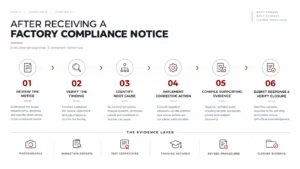
Receiving a factory compliance notice should trigger a structured response rather than an immediate attempt to close observations on paper.
1. Review the Notice
Identify each observation, the provision or requirement referred to, the corrective action expected and the applicable response timeline.
2. Verify the Finding
Check the actual workplace condition, relevant records and the circumstances referred to in the notice.
3. Identify the Root Cause
Determine whether the issue resulted from an unsafe condition, missing procedure, inadequate training, incomplete documentation, overdue inspection or another underlying cause.
4. Implement Corrective Action
Assign responsibility, define target dates and implement measures that address the underlying issue.
5. Compile Supporting Evidence
Maintain appropriate evidence such as photographs, inspection reports, test certificates, revised procedures, training records or other relevant documentation.
6. Submit the Response as Required
Respond to the competent authority within the prescribed period and address each observation clearly with supporting evidence where appropriate.
The specific response procedure and timeline should always be checked against the actual notice and applicable law.
How to Avoid Recurring Factory Compliance Notice
A practical compliance system should regularly verify five areas.
1. Legal Compliance
Identify the provisions of the OSH Code and applicable Central and State Rules that apply to the establishment.
2. Physical Compliance
Verify machinery, electrical systems, fire protection, access, lifting equipment, workplace conditions and other applicable safeguards.
3. Occupational Health Compliance
Identify workplace exposures and verify the applicable health surveillance and occupational-health requirements.
4. Documentation Compliance
Verify statutory registers, records, reports, certificates, returns and other required documentation.
5. Corrective-Action Closure
Track every regulatory observation until corrective action has been completed and its effectiveness has been verified.
A useful internal cycle is:
IDENTIFY → ASSESS → CORRECT → DOCUMENT → VERIFY → MAINTAIN
This approach helps move factory compliance from a reactive activity to a continuous management process.
Key Takeaway
Factory compliance notices can arise from far more than major accidents.
Unsafe machinery, electrical deficiencies, fire and emergency gaps, hazardous-process controls, accident reporting, statutory records, occupational health, Safety Officer requirements, Safety Committees, workplace conditions, lifting equipment, pressure systems and unresolved previous findings can all become compliance concerns when applicable requirements are not satisfied.
The most effective strategy is therefore not to prepare for a notice after it arrives.
It is to maintain the factory in a state of continuous compliance readiness.
Compliance should be demonstrated through safe conditions, effective systems, current documentation and verified corrective action.
How INDSAFE Can Support Factory Compliance
INDSAFE supports organisations with factory compliance and statutory safety requirements, including:
- Factory compliance reviews
- Statutory safety audits
- IS 14489 safety audits
- Occupational safety assessments
- Hazardous-process and chemical-safety compliance
- MSIHC-related compliance support
- Emergency preparedness and ERDMP
- Safety training and competency programmes
- Compliance documentation and corrective-action reviews
- Regulatory and statutory compliance support
The objective is to help organisations identify compliance gaps, strengthen controls, document evidence, close corrective actions and maintain inspection readiness.
Frequently Asked Questions About Factory Compliance Notices
Why do factories receive compliance notices?
Factories may receive compliance notices when inspections, record examinations, investigations or other regulatory actions identify non-compliance with applicable safety, health, working-condition, reporting, documentation or welfare requirements.
Can a factory receive a compliance notice without an accident?
Yes. Regulatory non-compliance can be identified during a routine inspection or examination of records even when no accident has occurred.
What are the most common reasons for a factory safety notice?
Common reasons include unsafe machinery, electrical deficiencies, inadequate fire and emergency arrangements, hazardous-process non-compliance, accident-reporting failures, incomplete statutory records, occupational-health gaps, Safety Officer or Safety Committee non-compliance, unsafe workplace conditions and unresolved earlier inspection findings.
What should a factory do after receiving a compliance notice?
The factory should review each observation, verify the finding, identify the root cause, implement corrective action, compile supporting evidence and submit the required response within the applicable period.
Can previous inspection findings lead to further compliance action?
Yes. Rule 78 of the Central OSH Rules, 2026 specifically requires the Inspector-cum-Facilitator to review whether shortcomings identified during previous inspections have been rectified and whether earlier notices have been complied with.
What documents should a factory keep ready for inspection?
Depending on the establishment and applicable requirements, these may include statutory registers, accident records, returns, inspection and testing records, occupational-health records, Safety Committee records, Safety Officer-related documentation, training records, risk assessments, emergency documentation and corrective-action evidence.
Regulatory References
- Occupational Safety, Health and Working Conditions Code, 2020 – Government of India, Ministry of Labour & Employment.
- Occupational Safety, Health and Working Conditions (Central) Rules, 2026 – notified by the Ministry of Labour & Employment on 8 May 2026.
- Uttar Pradesh Occupational Safety, Health and Working Conditions Rules, 2026 – Notification No. 962/XXXVI-03–2026-1903305, dated 27 August 2026, Government of Uttar Pradesh.
- Invest UP Notifications – official Uttar Pradesh Government investment and notification portal.
Disclaimer: This article is intended for general informational purposes and should not be treated as legal advice. Applicability of specific requirements may depend on the establishment, industry, workforce, jurisdiction, applicable Central or State rules, notifications and amendments. In case of any difference between this article and the applicable legislation, rules or official notification, the latter will prevail.