


The implementation of the Occupational Safety, Health and Working Conditions Code, 2020 (OSHWC Code) and the notification of the Uttar Pradesh Occupational Safety, Health and Working Conditions Rules, 2026 have introduced a new regulatory framework for occupational safety and health in Uttar Pradesh, including specific Safety Committee requirements for covered establishments.
One important requirement for covered industrial establishments is the constitution and functioning of a Safety Committee. The Committee provides a formal mechanism through which management and workers can participate in identifying safety and occupational-health issues, reviewing hazards, discussing incidents and supporting corrective action.
The final U.P. Rules were notified on 27 August 2026 and came into force from the date of publication in the Official Gazette. Rule 43 specifies when a Safety Committee must be constituted, while Rule 44 sets out its functions and duties.
For a broader overview of state-wise implementation, see our guide to State-Wise OSHWC Rules 2026.
When is a Safety Committee mandatory in Uttar Pradesh?
Under Rule 43 of the U.P. Rules, a Safety Committee is required where 250 or more employees are ordinarily employed, or where specified dangerous processes or operations, hazardous processes, hazardous-substance handling or Major Accident Hazard factory conditions apply.
This means factories should assess both their employee strength and the nature of their operations before deciding whether the requirement applies.
What Is a Safety Committee Under the OSHWC Code?
A Safety Committee is a formal body comprising representatives of management and workers that deals with occupational health, safety and environmental matters at an establishment.
The underlying statutory provision is Section 22 of the Occupational Safety, Health and Working Conditions Code, 2020. Section 22 provides that the appropriate Government may require an establishment or class of establishments to constitute a Safety Committee in the prescribed manner.
The Code also establishes an important representation principle: the number of worker representatives on the Committee cannot be less than the number of employer representatives.
The applicable State Rules specify the circumstances in which the Committee must be constituted and prescribe requirements relating to its composition, tenure, meetings, records and functions.
For factories in Uttar Pradesh, these details are set out principally in Rule 43 and Rule 44 of the Uttar Pradesh Occupational Safety, Health and Working Conditions Rules, 2026.
When Is a Safety Committee Required in Uttar Pradesh?
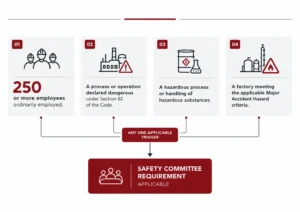
Rule 43 of the U.P. Rules specifies that a Safety Committee must be constituted in an establishment where any one of the following conditions applies:
1. 250 or More Employees
A Safety Committee is required where 250 or more employees are ordinarily employed.
2. A Dangerous Process or Operation
The requirement also applies where a process or operation declared to be dangerous under Section 82 of the OSHWC Code is carried on.
3. A Hazardous Process or Hazardous-Substance Handling
A Safety Committee is required where a hazardous process, as defined under Section 2(1)(za) of the Code, is carried on or hazardous substances are handled.
4. A Major Accident Hazard Factory
The requirement also applies where the establishment falls within the Major Accident Hazard factory category specified by the Rules.
These conditions operate as alternative triggers. An establishment does not have to meet all four conditions before the requirement applies.
The practical implication: a factory in Uttar Pradesh should not assume that a Safety Committee is required only after reaching 500 workers. The State Rules prescribe a separate 250-employee threshold, together with additional hazard-based triggers.
Why Does the 250-Employee Safety Committee Threshold Matter?
The distinction between the Code and the State Rules is important.
Section 22 of the OSHWC Code establishes the statutory framework for Safety Committees. Rule 43 of the Uttar Pradesh Rules then specifies the circumstances in which the Committee must be constituted in the State.
For Uttar Pradesh, the key workforce trigger is:
250 or more employees ordinarily employed → Safety Committee required.
The requirement can also arise below this workforce level where the establishment carries out specified dangerous operations, hazardous processes, or hazardous-substance handling, or falls within the applicable Major Accident Hazard factory category.
Factories should therefore assess both:
- Employee strength: whether 250 or more employees are ordinarily employed.
- Nature of operations: whether any of the prescribed hazard-based triggers apply.
The 500-worker threshold commonly discussed in relation to Safety Officers should not be used as a substitute for checking the separate Safety Committee requirements.
For a broader explanation of the State’s requirements, read our guide to UP OSH Rules 2026.
Who Should Be Represented on the Safety Committee?
Rule 43 specifies the management-side composition of the Safety Committee.
The management representatives are to include:
| Position | Role |
|---|---|
| Employer | Chairman |
| Senior official | Deputy Chairman |
| Safety Officer, where appointed under the Rules, or another responsible person | Member-Secretary |
| Medical Officer of the establishment | Member |
| Production department representative | Member |
| Maintenance department representative | Member |
| Purchase department representative | Member |
The senior official should be someone whose organisational position enables them to contribute effectively to the functioning of the Committee.
The Rules also establish the following requirements:
- Worker representatives must not be fewer than employer representatives.
- Worker representatives must be selected through the prescribed process.
- Proper representation must be given to women in the formation of the Safety Committee.
Factories should ensure that their committee structure reflects these requirements rather than relying on an informal group or an incomplete list of representatives.
How Are Safety Committee Worker Representatives Selected?
The U.P. Rules prescribe how worker representatives are to be chosen.
Where a Registered Trade Union Is Associated With the Establishment
Worker representatives are to be chosen through the associated registered trade union by:
- General consensus; or
- Election.
Where There Is No Registered Trade Union
The workers themselves are to choose their representatives through:
- General consensus; or
- Election.
The Rules also require proper representation of women in the formation of the Safety Committee.
This is important because worker representation is a defined part of the prescribed constitution process, not simply a matter of management nominating employees to attend meetings.
Factories should retain appropriate records of the selection process and the final composition of the Committee.
What Is the Tenure of a Safety Committee?
Under Rule 43, the tenure of the Safety Committee is for a maximum period of three years.
In an exigency, an extension of six months may be given with the concurrence of two-thirds of the members.
Factories should maintain a clear record of:
- Date of constitution
- Names and positions of members
- Management and worker representative categories
- Date on which the tenure begins
- Date on which the tenure ends
- Details of any applicable extension
- Reconstitution and changes in membership
This helps establish whether the Committee is properly constituted and whether its tenure remains current.
How Often Must the Safety Committee Meet?
Under Rule 43, the Safety Committee must meet as often as necessary, but at least once every quarter.
The Rules also require the following:
- The Committee’s constitution must be communicated electronically to the Inspector-cum-Facilitator having jurisdiction.
- Meeting minutes and follow-up action plans must be recorded in a register.
- These records must be produced to the Inspector-cum-Facilitator on demand.
- A copy of the minutes must be sent to the Inspector-cum-Facilitator having jurisdiction, electronically or otherwise.
Meeting frequency should therefore be planned around the minimum quarterly requirement, while additional meetings should be considered when significant incidents, hazards or other matters require discussion.
A properly maintained meeting record should identify the issues considered, recommendations made, responsible persons, target dates and status of previous actions.
What Information Must Be Provided to the Safety Committee?
Rule 43 gives the Safety Committee a right to be adequately and suitably informed about relevant workplace safety and health information.
This includes:
Potential Workplace Hazards
The Committee should be informed about potential safety and health hazards to which employees may be exposed at the workplace.
Accident Information
Relevant data concerning accidents should be made available to the Committee.
Workplace and Health Surveillance Data
For factories, the Rules also refer to data resulting from surveillance of:
- The working environment
- The health of employees exposed to hazardous substances
The Committee is expected to use this information to support measures that improve working conditions and employee health and safety.
For practical purposes, information should be sufficient for the Committee to understand the issue, consider its implications and make appropriate recommendations. The applicable requirements and the nature of the establishment determine which specific records and information are relevant.
What Are the Main Functions of the Safety Committee Under Rule 44?
Rule 44 specifies the functions and duties of the Safety Committee. These extend well beyond holding periodic meetings or maintaining a statutory register.
1. Supporting the Establishment’s Health and Safety Policy
The Committee is expected to assist and cooperate with management in achieving the aims and objectives outlined in the establishment’s Health and Safety Policy.
This connects the Committee’s activities with the wider safety-management arrangements of the organisation.
2. Addressing Health, Safety and Environmental Issues
The Committee must deal with matters concerning health, safety and the environment and work towards solutions to problems encountered.
This can include considering workplace hazards, examining recurring safety concerns and recommending appropriate corrective measures.
3. Promoting Safety Awareness and Training
The Committee’s functions include:
- Creating safety awareness among employees
- Undertaking educational activities
- Undertaking training activities
- Undertaking promotional activities
For example, where repeated incidents suggest that workers need a clearer understanding of a procedure, the Committee can consider the issue and support suitable awareness or training initiatives.
4. Reviewing Safety Audits and Risk Assessments
The Committee is required to discuss reports relating to:
- Safety surveys
- Environmental surveys
- Occupational-health surveys
- Safety audits
- Risk assessments
- Emergency and disaster-management plans
It must also consider the implementation of recommendations made in these reports.
This creates a formal link between technical safety assessments and the Committee’s review process. The Committee should be able to consider significant findings, understand their implications and monitor the implementation of recommendations.
5. Conducting Health and Safety Surveys

The Rules assign the Committee a role in carrying out health and safety surveys and identifying the causes of accidents.
Where recurring hazards or incidents are identified, the Committee can examine:
- Where the problem occurs
- Which employees may be exposed
- What controls are available
- What deficiencies have been observed
- What corrective measures may be appropriate
Recommendations should then be followed up to determine whether the identified issues have been addressed.
6. Considering Complaints About Imminent Danger
The Committee must look into complaints concerning the likelihood of imminent danger to the safety and health of employees and suggest corrective measures.
This provides a formal channel through which employee concerns about serious hazards can be considered before an accident occurs.
7. Reviewing Implementation of Recommendations
The Committee must review the implementation of recommendations made by it.
This is an important part of its continuing role. Recording an observation or making a recommendation is not the same as confirming that the issue has been resolved.
A practical follow-up process should identify:
Recommendation → Responsible Person → Target Date → Action Taken → Verification → Closure
8. Reviewing Accident and Dangerous-Occurrence Inquiries
The Committee must discuss reports of inquiries into accidents and dangerous occurrences and make appropriate recommendations.
This allows it to consider whether an incident points to a broader issue involving equipment, procedures, maintenance, training or supervision.
Where similar incidents recur, the Committee can use the findings to support preventive measures.
9. Formulating Safety Campaigns
The Committee is required to formulate and implement appropriate safety campaigns based on the analysis of accidents and dangerous occurrences.
This means safety campaigns can be linked to actual workplace risks and incident trends rather than being limited to general awareness activities.
10. Providing a Safety Communication Forum
The Committee serves as a forum for communication on safety and occupational-health matters.
Employees working directly with equipment and processes may identify hazards that are not immediately visible through management-level reviews. A functioning Committee provides a structured mechanism for such issues to be raised and discussed.
11. Discussing Standard Operating Procedures
Rule 44 specifically includes discussion of Standard Operating Procedures (SOPs) prepared for different operations among the Committee’s functions.
This allows safety-related concerns about operating procedures to be considered as part of the Committee’s activities.
Relevant questions may include whether procedures address identified hazards, whether workers understand the requirements and whether incident experience indicates a need for improvement.
Can a Safety Committee Have Subcommittees?
Yes. Rule 44 allows a Safety Committee to establish subcommittees where the size of the establishment or other circumstances make it difficult for the main Committee to carry out all its functions effectively.
There is also a specific requirement for establishments where more than 1,000 employees are ordinarily employed.
In these establishments:
- At least two subcommittees must be formed.
- They may be organised department-wise or otherwise.
- An employee of the rank of departmental head must head each subcommittee.
- The minutes of subcommittee meetings must be shared with the Member-Secretary of the Safety Committee.
This is particularly relevant for large factories with multiple departments, production areas or operational activities.
What Safety Committee Records Should a Factory Maintain?
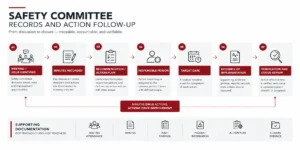
Factories should organise Safety Committee documentation so that they can demonstrate both its constitution and its functioning.
Constitution and Membership Records
Maintain records of:
- Safety Committee constitution
- Names and positions of members
- Employer representatives
- Worker representatives
- Worker selection or election process
- Date of constitution
- Tenure details
- Applicable extension or reconstitution
- Communication to the Inspector-cum-Facilitator
Meeting Records
Rule 43 specifically requires meeting minutes and follow-up action plans to be recorded in a register.
Useful supporting records include:
- Meeting notices and agendas
- Attendance
- Minutes
- Recommendations
- Follow-up action plans
- Responsibility and target dates
- Current status of previous actions
Safety Information and Supporting Documents
Depending on the establishment and applicable requirements, records discussed or reviewed by the Committee may include:
- Accident and dangerous-occurrence information
- Safety audit reports
- Risk-assessment findings
- Environmental and occupational-health survey results
- Emergency and disaster-management plans
- Relevant workplace hazard information
- SOP-related safety discussions
Corrective-Action and Closure Records
Maintain evidence of action taken on Committee recommendations, including the responsible person, target date, completion status and verification where applicable.
The important distinction is between recording a recommendation and demonstrating that it has been implemented.
What Do Inspectors Check for Safety Committee Compliance?
A factory should be prepared to demonstrate compliance with the applicable Safety Committee requirements.
Is the Safety Committee Required?
The establishment should have assessed applicability against the criteria in Rule 43, including employee strength and the prescribed hazard-related triggers.
Has the Committee Been Properly Constituted?
The factory should retain the constitution record and evidence of the required communication to the Inspector-cum-Facilitator.
Is Worker Representation Adequate?
Worker representatives must not be fewer than employer representatives, and the prescribed selection process should have been followed.
Has Proper Representation Been Given to Women?
The Rules expressly require proper representation of women in the formation of the Committee.
Is the Committee Meeting at the Required Frequency?
The Committee must meet as often as necessary and at least once every quarter.
Are Minutes and Follow-Up Action Plans Maintained?
Minutes and follow-up action plans must be recorded in a register and produced to the Inspector-cum-Facilitator on demand. A copy of the minutes must also be sent to the Inspector-cum-Facilitator having jurisdiction.
Are Previous Recommendations Being Reviewed?
Rule 44 includes review of the implementation of recommendations made by the Committee among its functions.
Is Relevant Safety Information Available?
The Rules provide for the Committee to be adequately informed about potential workplace hazards, accident data and relevant environmental and health-surveillance data for factories.
Are Subcommittees Required?
Where more than 1,000 employees are ordinarily employed, the specific minimum subcommittee requirement should be reviewed alongside the wider provisions for establishing subcommittees.
Common Safety Committee Compliance Mistakes Factories Should Avoid
Mistake 1: Using the 500-Worker Threshold for Everything
The 500-worker figure is commonly associated with Safety Officer requirements for factories under the Code. It should not be used as a substitute for checking Safety Committee applicability.
For Uttar Pradesh, Rule 43 establishes the 250-employee threshold and additional hazard-based triggers.
Mistake 2: Treating the Committee as an HR Activity
The Safety Committee is fundamentally connected with occupational health, safety and environmental matters. Its activities should involve relevant management and worker representatives and address actual workplace risks.
Mistake 3: Holding Only One Meeting a Year
The U.P. Rules require meetings as often as necessary, but at least once every quarter.
Mistake 4: Selecting Worker Representatives Without Following the Prescribed Process
Rule 43 specifies how worker representatives are to be chosen through an associated registered trade union or, where there is no such union, by the workers themselves.
Mistake 5: Recording Discussions Without Tracking Actions
The Rules specifically require minutes and follow-up action plans to be recorded. Factories should therefore track recommendations through to implementation.
Mistake 6: Failing to Review Previous Recommendations
Reviewing implementation of the Committee’s recommendations is expressly included among its functions.
Mistake 7: Creating Records Only for Inspection
The Committee is intended to be an ongoing safety-management mechanism. Its meetings and records should reflect continuing review of hazards, incidents, recommendations and corrective action.
How Can Factories Make the Safety Committee Effective?
Beyond meeting the minimum statutory requirements, factories can establish a consistent working process for the Committee.
Before each meeting: Prepare an agenda covering relevant hazards, incidents, audit findings, risk assessments, emergency planning and previous recommendations.
During each meeting: Record the issues discussed, the recommendations made, the responsible persons and the target dates.
After each meeting: Update the follow-up action plan and communicate the minutes as required under Rule 43.
Between meetings: Monitor outstanding actions and escalate significant safety concerns through the establishment’s applicable safety-management arrangements.
At each subsequent meeting: Review progress and check whether recommendations have been implemented.
This process helps turn the Committee into a working mechanism for identifying and addressing safety concerns rather than a statutory formality.
How INDSAFE Can Support Factory Safety Management
INDSAFE supports organisations with technical safety and risk-management activities relevant to factory compliance, including:
- Occupational safety assessments
- Statutory safety audits
- IS 14489 safety audits
- Risk assessments
- Hazardous-process and process-safety assessments
- Safety training and awareness programmes
- Emergency preparedness and disaster-management planning
- Review of safety findings and corrective actions
These activities can support the technical discussions, risk reviews and improvement recommendations considered by a factory’s Safety Committee. The establishment remains responsible for determining and meeting its statutory obligations, including constituting the Committee where required.
Key Takeaway
The Uttar Pradesh Occupational Safety, Health and Working Conditions Rules, 2026 establish detailed requirements for Safety Committees in covered establishments.
For Uttar Pradesh, one of the most important points is that the requirement is not limited to factories employing 500 or more workers.
Under Rule 43, a Safety Committee is required where 250 or more employees are ordinarily employed, as well as in establishments meeting specified criteria relating to dangerous processes or operations, hazardous processes or hazardous-substance handling, and Major Accident Hazard factories.
Rule 43 also establishes requirements for management and worker representation, selection of worker representatives, tenure, communication, quarterly meetings, records and access to relevant safety information. Rule 44 sets out the Committee’s functions, including safety awareness, training, review of audits and risk assessments, emergency planning, accident review, safety surveys, corrective recommendations, safety campaigns, communication and SOP discussions.
A Safety Committee should therefore not be treated simply as a statutory name on an organisational chart.
Its value lies in creating a structured mechanism through which workers and management can jointly identify safety concerns, review evidence, recommend improvements and monitor corrective actions.
For covered establishments, compliance means ensuring that the Committee’s constitution, representation, meetings, records, recommendations and follow-up actions can all be demonstrated.
Frequently Asked Questions About Safety Committee Requirements in Uttar Pradesh
When is a Safety Committee mandatory in Uttar Pradesh?
Under Rule 43 of the Uttar Pradesh Occupational Safety, Health and Working Conditions Rules, 2026, a Safety Committee is required where 250 or more employees are ordinarily employed, or where specified dangerous processes or operations, hazardous processes, hazardous-substance handling or Major Accident Hazard factory conditions apply.
What is the legal provision for a Safety Committee under the OSHWC Code?
Section 22 of the Occupational Safety, Health and Working Conditions Code, 2020 provides the statutory framework under which the appropriate Government may require establishments or classes of establishments to constitute Safety Committees in the prescribed manner.
How many worker representatives are required on a Safety Committee?
The number of worker representatives must not be less than the number of employer representatives. Rule 43 also prescribes how worker representatives are to be selected and requires proper representation of women in the Committee’s formation.
How often must a Safety Committee meet in Uttar Pradesh?
Under Rule 43, the Committee must meet as often as necessary but at least once every quarter.
What is the tenure of a Safety Committee under the U.P. Rules?
The tenure is a maximum of three years. In an exigency, a six-month extension may be given with the concurrence of two-thirds of the members.
What records must a Safety Committee maintain?
Rule 43 specifically requires meeting minutes and follow-up action plans to be recorded in a register. The Committee’s constitution must also be communicated electronically to the Inspector-cum-Facilitator having jurisdiction. A copy of meeting minutes must be sent to the Inspector-cum-Facilitator, electronically or otherwise.
What are the main functions of a Safety Committee?
Under Rule 44, the functions include supporting the Health and Safety Policy, addressing health, safety and environmental issues, creating safety awareness, undertaking training, reviewing surveys and audit reports, discussing risk assessments and emergency plans, examining accidents and dangerous occurrences, considering imminent-danger complaints, conducting safety campaigns and discussing SOPs.
Are Safety Officer and Safety Committee requirements the same?
No. They are separate requirements. Safety Officer appointment requirements are addressed separately under the Code and applicable rules, while the Safety Committee applicability criteria for Uttar Pradesh are specified in Rule 43.
Are subcommittees mandatory in large establishments?
Rule 44 allows subcommittees where the main Committee cannot effectively carry out its functions because of the establishment’s size or other reasons. Where more than 1,000 employees are ordinarily employed, at least two subcommittees must be formed, department-wise or otherwise, with a departmental-head-level employee heading each subcommittee.
Regulatory References
- Occupational Safety, Health and Working Conditions Code, 2020 — Section 22: Ministry of Labour and Employment, Government of India.
- Uttar Pradesh Occupational Safety, Health and Working Conditions Rules, 2026 — Rules 43 and 44: Final U.P. Gazette notification dated 27 August 2026.
- State-wise OSHWC framework: See the related State-Wise OSHWC Rules 2026 guide.
Disclaimer: This article is intended for general informational purposes and should not be treated as legal advice. Applicability of particular requirements may depend on the establishment, its activities and the applicable statutory provisions. Where there is any difference between this article and the applicable legislation, rules or official notification, the latter will prevail.