

Let us understand how we can help you
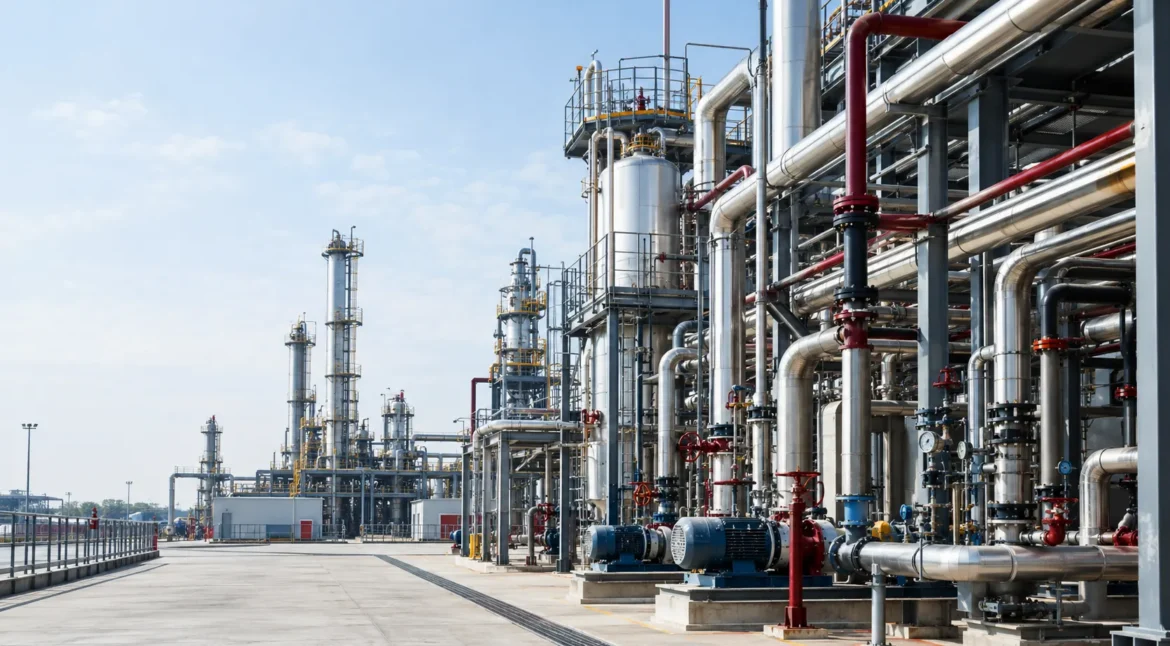
INDSAFE provides Design & Engineering Services for process plants and industrial facilities, supporting projects from early engineering definition through FEED, basic engineering, and detailed engineering.
Successful industrial projects depend on coordinated engineering across process, equipment, piping, plant layout, structures, and technical documentation. Design decisions made at one stage can directly influence downstream engineering, construction, operability, maintenance, and safety.
Our engineering capabilities include process design, PFDs and P&IDs, equipment and utility definition, plant layout, piping design, isometric drawings, General Arrangement (G.A.) drawings, structural drawings, and detailed engineering documentation, depending on the project scope and stage of development.
Our approach focuses on maintaining coordination between engineering disciplines and developing a consistent technical basis for project execution.
Our Design & Engineering Services
Process Design Engineering
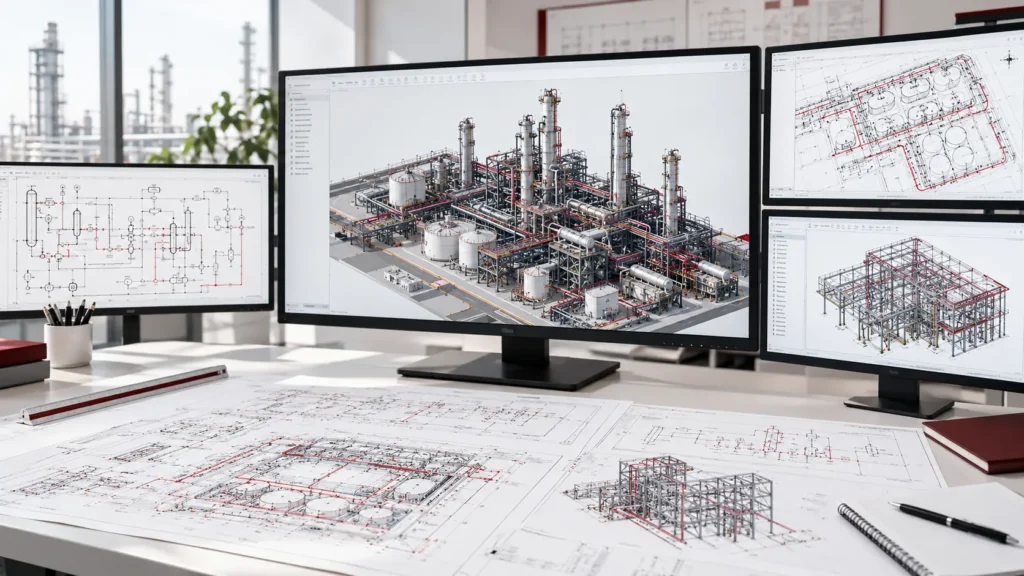
Process Design Engineering establishes the technical foundation of an industrial process and provides essential inputs for subsequent engineering activities.
Depending on project requirements, our process engineering scope can include:
- Process Design Basis
- Process Flow Diagrams (PFDs)
- Heat & Mass Balance
- Process Simulation
- Hydraulic Calculations
- Equipment Sizing
- Utility Requirements
- Process Optimization
- Debottlenecking Studies
- Process Engineering Documentation
Process design information can subsequently support equipment definition, P&ID development, piping design, plant layout, and detailed engineering.
P&ID Development & Engineering
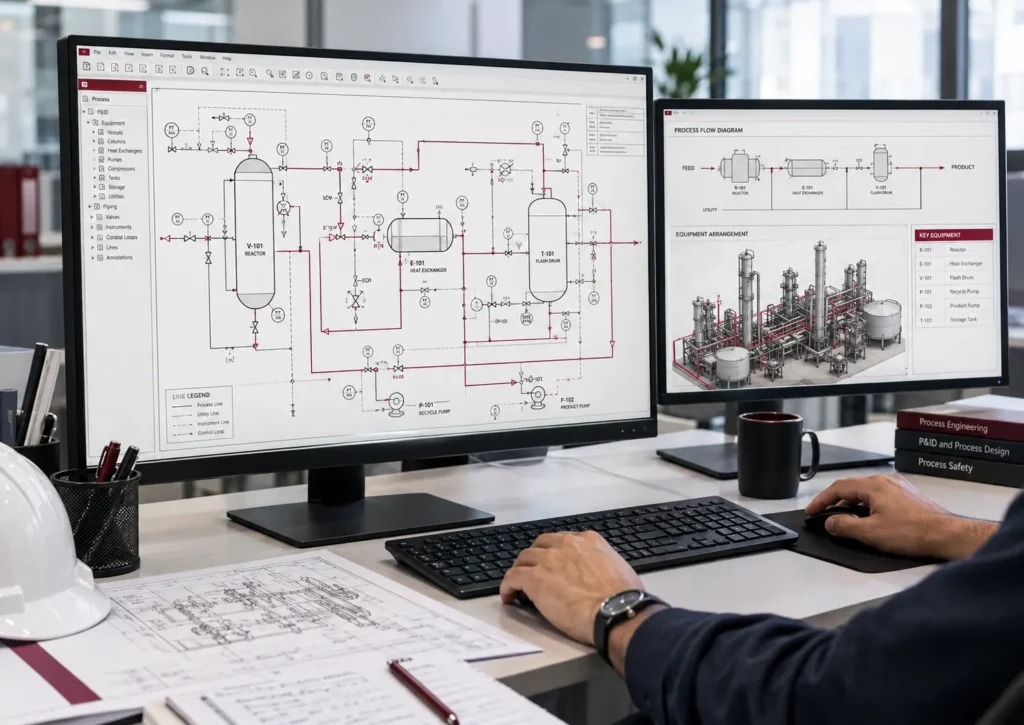
Piping & Instrumentation Diagrams (P&IDs) provide a detailed representation of process and utility systems and serve as an important interface between process engineering and downstream design disciplines.
Our P&ID engineering scope can include representation and development of:
- Process and utility systems
- Equipment and equipment connections
- Piping and valves
- Instrumentation
- Control interfaces
- Process safeguarding features
- Operating and isolation requirements
P&IDs can support detailed engineering, process safety reviews, operations, maintenance, and project documentation, according to the applicable project scope.
Plant Layout & Design
Plant Layout & Design involves developing the overall arrangement of process equipment, facilities, utilities, access areas, and supporting infrastructure within the available site or plant area.
Plant layouts are developed considering factors such as:
- Process requirements
- Equipment arrangement
- Piping requirements
- Equipment access
- Operation and maintenance
- Safety and accessibility
- Constructability
- Available space
- Future modification requirements
A coordinated plant layout helps establish a practical basis for subsequent piping, structural, and detailed engineering.
Piping Layouts
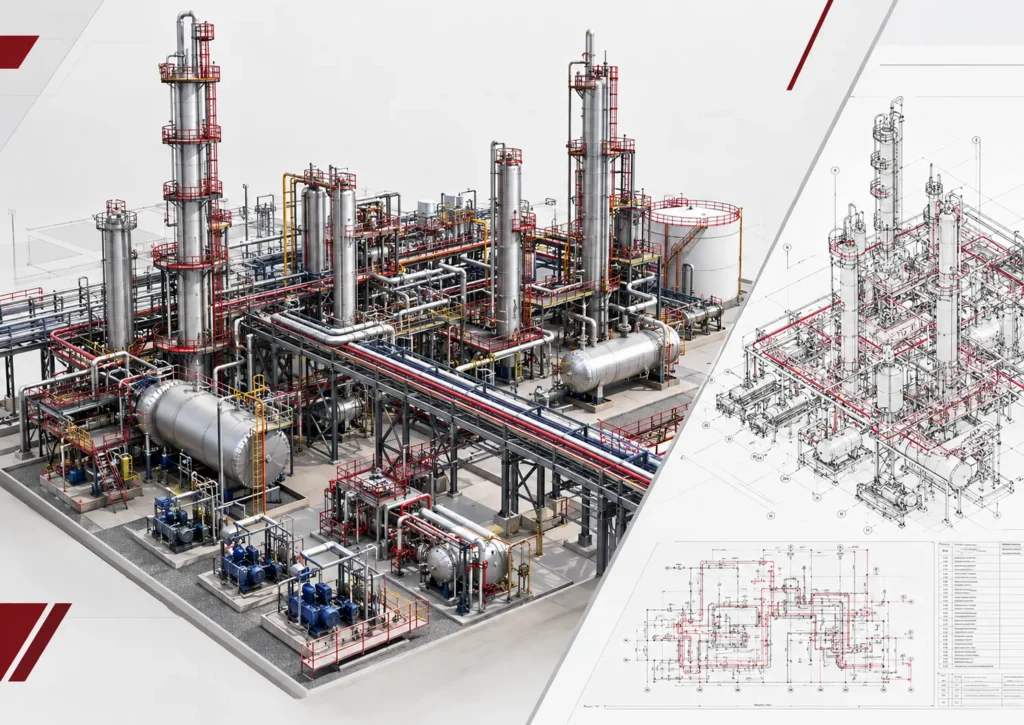
Piping layouts define the routing and arrangement of process and utility piping throughout the facility.
The engineering considers:
- Equipment connections
- Pipe routing
- Accessibility
- Maintenance requirements
- Operating requirements
- Pipe supports
- Routing constraints
- Structural interfaces
- Construction and installation requirements
Piping layouts are coordinated with equipment, plant layout, structures, and other relevant engineering disciplines.
Isometric Drawings
Isometric drawings provide detailed piping information for engineering, fabrication, construction, and installation.
Depending on the project requirements, piping isometrics can communicate:
- Pipe routing
- Dimensions
- Fittings
- Valves
- Connections
- Branches
- Piping components
- Relevant fabrication and installation information
Isometric drawings are generally developed from established piping layouts and engineering information at the appropriate stage of detailed piping engineering.
General Arrangement (G.A.) Drawings
General Arrangement drawings provide an overall representation of the arrangement, location, dimensions, and interfaces of equipment, structures, piping, or other plant components within the defined drawing scope.
G.A. drawings can support:
- Engineering coordination
- Equipment arrangement
- Plant layout development
- Structural coordination
- Piping coordination
- Construction planning
- Installation activities
The exact content and level of detail depend on the project and drawing requirements.
Structural Drawings
Structural drawings communicate the engineering arrangement and details of structures required to support plant facilities, equipment, platforms, pipe racks, and other components within the applicable project scope.
Structural engineering documentation can support:
- Equipment and pipe support arrangements
- Structural framing
- Platforms and access structures
- Pipe racks
- Structural interfaces
- Fabrication and construction requirements
Structural deliverables are coordinated with plant layout, equipment, piping, and other relevant engineering inputs.
Basic Engineering
Basic Engineering establishes the fundamental technical definition of a project before detailed engineering and execution.
Depending on project requirements, this stage may include:
- Design Basis
- Process Design Information
- Heat & Mass Balance
- PFDs
- Preliminary P&IDs
- Preliminary Equipment Definition
- Utility Requirements
- Preliminary Plant Layouts
- Engineering Design Criteria
- Other project engineering documents
Basic Engineering provides the technical foundation for further project development and FEED or detailed engineering, as applicable.
FEED Engineering
Front-End Engineering Design (FEED) develops the technical definition of a project before detailed engineering and execution.
Depending on the project scope, FEED activities may include:
- Development of engineering design basis
- Process definition
- PFDs and P&IDs
- Preliminary equipment requirements
- Utility requirements
- Preliminary layouts
- Engineering design criteria
- Project interfaces
- Technical documentation required for project definition
FEED helps establish a sufficiently developed technical basis for project planning, cost estimation, procurement strategy, detailed engineering, and execution.
Detailed Engineering
Detailed Engineering develops the established project design into the drawings, calculations, specifications, and technical documentation required for subsequent project execution.
Depending on the agreed scope, detailed engineering can include coordinated development and checking of:
- Process documentation
- Equipment information
- P&IDs
- Plant layouts
- Piping layouts
- Isometric drawings
- G.A. drawings
- Structural drawings
- Engineering calculations
- Technical specifications
- Other project engineering deliverables
Detailed Engineering is developed in accordance with applicable project requirements, design criteria, client specifications, and relevant engineering standards.
Engineering Support Across Project Stages
INDSAFE can support engineering requirements at different stages of industrial project development.
Concept & Early Engineering
Early engineering establishes the initial process concept, design basis, major equipment requirements, utilities, and preliminary plant configuration.
Basic Engineering
Basic Engineering develops the fundamental technical definition and establishes the engineering basis for subsequent project development.
Front-End Engineering Design (FEED)
FEED further develops the project definition and provides a more developed technical basis for detailed engineering, procurement planning, project execution, and cost development.
Detailed Engineering
Detailed Engineering develops the calculations, drawings, specifications, layouts, and technical documentation required for procurement, fabrication, construction, installation, and project execution, according to the agreed scope.
The exact engineering stages, sequence, and deliverables may vary depending on the project, technology, client requirements, and engineering information already available.
Key Considerations in Piping Layout Engineering
Effective piping layout engineering involves more than fitting pipes into the available space. Depending on the facility and project scope, key considerations include:
Process requirements: Maintaining consistency with approved P&IDs, line specifications and equipment connection requirements.
Accessibility: Providing practical access to valves, instruments, equipment connections and other components requiring operation or inspection.
Operation and maintenance: Considering maintainability, equipment removal requirements and access for routine servicing.
Space and routing constraints: Coordinating pipe routes with equipment, structures, platforms, cable trays and other plant services.
Safety and operability: Considering project-specific access, egress, hazardous-area and other relevant safety requirements.
Structural interfaces: Coordinating piping routes and support requirements with the responsible structural engineering discipline.
Future modifications: Considering practical routing and documentation requirements that may support subsequent plant changes.
Specific requirements and design checks are established according to the applicable codes, standards, project specifications and engineering scope. Piping stress analysis, detailed support design and specialist engineering calculations are separate activities unless expressly included in the agreed scope.
How Our Engineering Services Work Together
Industrial engineering deliverables are interconnected. Process requirements influence equipment definition; equipment affects piping and plant layout; layouts influence structures, access, supports, installation, and maintainability.
A typical engineering progression can be represented as:
Process Requirements → Basic Engineering → FEED → Process & P&ID Development → Plant & Piping Design → G.A. / Structural / Isometric Drawings → Detailed Engineering
The sequence may vary depending on the project scope and the stage at which INDSAFE becomes involved.
For example, process design establishes important requirements for PFDs, P&IDs, equipment definition, and utilities. P&IDs provide inputs for piping and plant design, while plant and piping layouts influence equipment arrangement, supports, structures, access, and routing.
These engineering inputs are subsequently developed into coordinated drawings, calculations, and documentation required for project execution.
This integrated approach helps improve consistency between engineering disciplines and identify potential interface issues earlier in the project lifecycle.
Engineering Support for New & Existing Facilities
Our Design & Engineering Services can support different types of industrial projects, including:
- New plant development
- Plant expansions
- Capacity enhancement projects
- Brownfield engineering
- Plant modifications and revamps
- Process modifications
- Debottlenecking projects
- Engineering documentation development
- Existing facility upgrades
- New equipment and system integration
Engineering scope is tailored to the existing plant information, project objectives, technical requirements, and applicable client specifications.
Engineering Coordination with Process Safety
Engineering decisions can influence process safety, operability, maintainability, accessibility, and overall facility performance.
Where applicable, engineering activities can be coordinated with process safety requirements and relevant risk or safety studies to help maintain consistency between process design and facility engineering.
This can be particularly important where engineering modifications affect process conditions, equipment arrangement, piping configuration, hazardous areas, utilities, access, or safety-critical systems.
The specific process safety studies and engineering interfaces depend on the project scope and client requirements.
Engineering Coordination
Industrial projects involve multiple interconnected engineering disciplines. Process requirements need to align with equipment, piping, plant layouts, structures, instrumentation, utilities, and other project interfaces.
Our approach focuses on coordinating the applicable engineering deliverables so that information developed at one stage can effectively support subsequent engineering and project execution.
Where project information is developed progressively, coordinated engineering documentation can also help reduce inconsistencies between drawings, layouts, calculations, and downstream deliverables.
Industries We Support
Our Design & Engineering Services can support projects across a range of industrial sectors, including:
- Chemical & Specialty Chemical
- Oil & Gas
- Petrochemical
- Pharmaceutical
- Food & Beverage
- FMCG & Manufacturing
- Power & Energy
- Industrial Manufacturing
Engineering scope and deliverables are tailored to the process, facility type, project stage, client specifications, and applicable technical requirements.
Why Integrated Design & Engineering Matters
An industrial facility cannot be effectively engineered through isolated drawings or disciplines.
Process requirements influence equipment. Equipment influences piping and layout. Layouts influence structures, access, installation, and maintainability. These interfaces ultimately affect how effectively the facility can be constructed, operated, maintained, and modified.
A coordinated engineering approach can help:
- Improve consistency between engineering disciplines
- Identify interface issues earlier
- Support constructability and maintainability
- Reduce avoidable design changes
- Improve coordination between process, piping, layout, equipment, and structural requirements
- Provide clearer technical documentation for project execution
- Establish a more consistent engineering basis throughout project development
Frequently Asked Questions
What are Design & Engineering Services?
Design & Engineering Services cover the engineering activities required to develop and document an industrial facility or process. Depending on project requirements, this can range from early process and basic engineering through FEED and detailed engineering, including PFDs, P&IDs, plant layouts, piping, isometrics, G.A. drawings, structural drawings, calculations, and other technical documentation.
What is the difference between Basic Engineering and FEED?
Basic Engineering establishes the fundamental technical definition and design basis of a project. FEED, or Front-End Engineering Design, develops the project definition further and provides a more developed technical basis for detailed engineering and execution. The exact scope and boundaries can vary according to project and client requirements.
What is the difference between FEED and Detailed Engineering?
FEED focuses on developing the project sufficiently to establish its technical and execution basis. Detailed Engineering takes the established design further into the detailed calculations, drawings, layouts, specifications, and technical documentation required for procurement, fabrication, construction, installation, and project execution, depending on the agreed scope.
How are PFDs and P&IDs related to plant design?
Process Flow Diagrams (PFDs) describe the major process flows and process relationships, while P&IDs provide a more detailed representation of process and utility systems, including equipment, piping, valves, instrumentation, and control interfaces. These documents provide important inputs for equipment definition, piping, plant layout, and subsequent engineering activities.
What is the role of piping layouts in plant design?
Piping layouts define how process and utility piping is arranged and routed within the facility. They need to account for equipment connections, accessibility, maintenance, supports, routing constraints, operating requirements, structures, and other plant interfaces.
What are G.A. drawings used for?
General Arrangement drawings provide an overall representation of the arrangement, location, dimensions, and interfaces of equipment, structures, piping, or other plant components within the defined drawing scope. They support engineering coordination, construction planning, fabrication, and installation.
When are isometric drawings prepared?
Isometric drawings are generally developed from established piping design and layout information at the appropriate stage of detailed piping engineering. They provide detailed information required for piping fabrication, construction, and installation according to project requirements.
Related Design & Engineering Services
Explore our individual engineering capabilities:
- Process Design Engineering – Process design, simulations, balances, hydraulics, equipment sizing, and process optimization.
- P&ID Development & Engineering – Piping & Instrumentation Diagram development and engineering.
- Plant Layout & Design – Overall plant arrangement and facility layout development.
- Piping Layouts – Process and utility piping arrangement and routing.
- Isometric Drawings – Detailed piping isometric documentation for fabrication and construction.
- General Arrangement Drawings – Coordinated arrangement drawings for equipment, structures, piping, and plant components.
- Structural Drawings – Structural engineering documentation within the applicable project scope.
- Basic Engineering – Fundamental engineering definition and project design basis.
- FEED Engineering – Front-End Engineering Design and project definition.
- Detailed Engineering – Detailed engineering documentation for project execution.
Discuss Your Engineering Requirements
Whether you are developing a new facility, expanding an existing plant, modifying an operating process, undertaking a brownfield project, or progressing from early engineering toward detailed design, the appropriate engineering scope depends on the project’s technical requirements and stage of development.
Contact INDSAFE to discuss your Design & Engineering requirements and identify the engineering services appropriate for your project.