

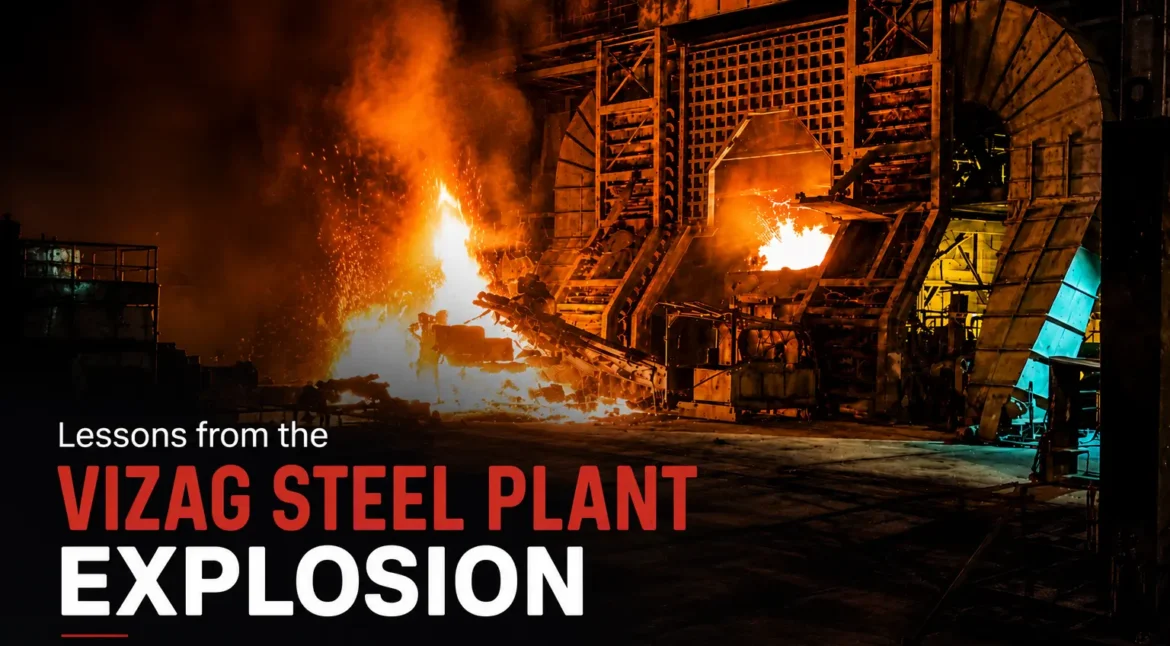
The Vizag Steel Plant Explosion on 8 June 2026 stands among the most serious industrial accidents reported in India in recent years. The incident, which occurred during casting operations at the Visakhapatnam Steel Plant (VSP), claimed nine lives and left multiple workers injured, highlighting the devastating consequences that can arise when high-energy industrial processes experience an unexpected loss of control.
While official investigations are still underway, the Vizag Steel Plant explosion has drawn significant attention from regulators, industry experts, and process safety professionals across the country. Beyond understanding what happened, industries handling hazardous materials, molten metals, and other high-risk operations must focus on an equally important question: what lessons can be learned to prevent similar incidents in the future?
This article examines the incident from a process safety perspective and explores the critical safety management principles that every industrial facility should consider.
Understanding the Incident
According to preliminary reports, the explosion occurred at approximately 4:15 PM during continuous casting operations at Caster-2 of Steel Melt Shop-1.
A ladle containing molten steel at temperatures exceeding 1,500°C was being positioned for pouring when a sudden explosion generated a massive fireball. The resulting blast damaged nearby infrastructure, ignited equipment, and exposed workers to extreme thermal energy within seconds.
Initial findings have suggested the possible involvement of entrapped gases within the molten steel. However, detailed technical investigations by expert committees will ultimately determine the exact sequence of events and contributing factors.
As with all major industrial incidents, conclusions should be based on verified investigation findings rather than speculation.
Why Molten Steel Operations Demand Exceptional Process Safety Controls
Steel manufacturing is among the most energy-intensive industrial activities in the world.
Operations routinely involve:
- Molten metal exceeding 1,500°C
- Heavy lifting systems and overhead cranes
- High-capacity electrical infrastructure
- Continuous casting systems
- Pressurised gases
- Refractory-lined vessels
- Complex metallurgical processes
Unlike many industrial hazards, molten metal incidents can escalate almost instantly. A relatively small process deviation can release enormous amounts of thermal energy capable of causing catastrophic consequences for personnel, equipment, and operations.
This is precisely why steel plants require strong process safety systems that extend beyond conventional occupational safety programs.
What Process Safety Professionals Will Be Looking At
Although the final root cause has not yet been established, process safety investigations typically examine a broad range of technical and organisational factors.
Key areas likely to be evaluated include:
Ladle Integrity and Condition
The integrity of ladles, refractory linings, slide gate systems, and associated equipment plays a critical role in molten metal handling.
Investigators typically assess:
- Refractory condition
- Maintenance history
- Inspection records
- Previous repairs
- Equipment operating limits
Even minor degradation in critical components can create conditions that increase operational risk.
Gas Management and Metallurgical Conditions
Entrapped gases within molten steel can create hazardous conditions under certain circumstances.
Process investigators may evaluate:
- Steel chemistry
- Degassing practices
- Process parameters
- Temperature control
- Operational records
Understanding the metallurgical behaviour of the molten steel is often essential in determining how abnormal conditions developed.
Operational and Procedural Controls
Major accidents rarely occur because of a single equipment failure.
Investigations frequently review:
- Standard operating procedures
- Shift handovers
- Permit systems
- Abnormal operating conditions
- Operator actions prior to the event
Effective procedures provide critical safeguards when process conditions deviate from normal operation.
Mechanical Integrity Programs
The reliability of critical assets depends on structured inspection, testing, and maintenance programs.
Mechanical Integrity assessments typically include:
- Inspection planning
- Preventive maintenance
- Condition monitoring
- Equipment fitness evaluations
- Asset lifecycle management
Weaknesses in these systems can allow hazards to develop unnoticed.
Key Process Safety Lessons for Industry
Every major industrial accident presents an opportunity for learning.
Regardless of the final investigation outcome, several important process safety principles emerge from incidents involving high-temperature operations.
Process Hazard Analysis Must Be Continually Updated
Hazards evolve over time as facilities expand, equipment ages, and operations change.
Structured methodologies such as:
- HAZOP Studies
- Process Hazard Analysis (PHA)
- What-If Analysis
- Bow-Tie Analysis
- Quantitative Risk Assessment (QRA)
help identify credible accident scenarios before they occur.
Process hazard analysis should be treated as a living process rather than a one-time compliance exercise.
Management of Change Cannot Be Overlooked
Changes in production targets, raw materials, operating practices, equipment, or maintenance strategies can introduce new risks.
A formal Management of Change (MOC) process helps organisations evaluate those risks before changes are implemented.
Many significant industrial incidents globally have involved uncontrolled or poorly assessed operational changes.
Mechanical Integrity Is a Core Process Safety Element
Equipment handling molten metals operates under severe thermal and mechanical stress.
Organisations must ensure that inspection, testing, maintenance, and reliability programs remain effective throughout the asset lifecycle.
Mechanical Integrity failures often develop gradually long before an incident occurs.
Workforce Competency Remains Essential
Technology alone cannot prevent major accidents.
Operators, supervisors, engineers, and maintenance personnel must understand:
- Process hazards
- Operating limits
- Emergency response procedures
- Abnormal situation management
- Safe work practices
Competency assurance remains one of the most important barriers against major incidents.
Emergency Preparedness Saves Lives
High-consequence incidents develop rapidly.
Facilities should maintain:
- Emergency response plans
- Evacuation procedures
- Fire protection systems
- Communication protocols
- Incident command structures
- Emergency drills
Preparedness cannot prevent every incident, but it can significantly reduce consequences.
The Role of Process Safety Management
Process Safety Management focuses on preventing catastrophic events involving hazardous materials and high-energy industrial operations.
An effective PSM framework typically includes:
- Process Hazard Analysis
- Mechanical Integrity
- Operating Procedures
- Training & Competency
- Management of Change
- Incident Investigation
- Contractor Safety Management
- Compliance Audits
- Emergency Response Planning
These systems work together to identify hazards, assess risks, and prevent loss of containment or uncontrolled energy release.
Moving Beyond Compliance
One of the most important lessons from major industrial incidents is that compliance alone does not guarantee safety.
Many organisations meet regulatory requirements yet still experience serious accidents because critical risks remain unidentified, poorly understood, or inadequately controlled.
True process safety requires:
- Leadership commitment
- Engineering discipline
- Continuous risk assessment
- Asset reliability
- Workforce engagement
- Continuous improvement
The objective is not merely regulatory compliance, it is preventing catastrophic events before they occur.
How Indsafe Supports Process Safety Excellence
Indsafe assists organisations in strengthening process safety performance through:
- Process Safety Management (PSM)
- HAZOP Studies
- Process Hazard Analysis (PHA)
- Quantitative Risk Assessment (QRA)
- Process Safety Gap Assessments
- Hazardous Area Classification (HAC)
- Fire Risk Assessments
- Safety Audits & Compliance Reviews
Our focus is on helping organisations identify risks early, strengthen safety barriers, and improve operational resilience.
Conclusion
The Vizag Steel Plant explosion is a tragedy that has deeply affected workers, families, and the wider industrial community.
While investigations continue, the incident reinforces an important reality: major industrial accidents are rarely the result of a single failure. They typically emerge from a combination of technical, operational, organisational, and management-related factors.
For industries handling hazardous materials, high temperatures, or high-energy processes, the lesson is clear, effective Process Safety Management is not optional. It is a critical business function that protects people, assets, operations, and communities.
The most meaningful tribute to those who lost their lives is ensuring that the lessons from this incident are understood, applied, and used to prevent future tragedies.