

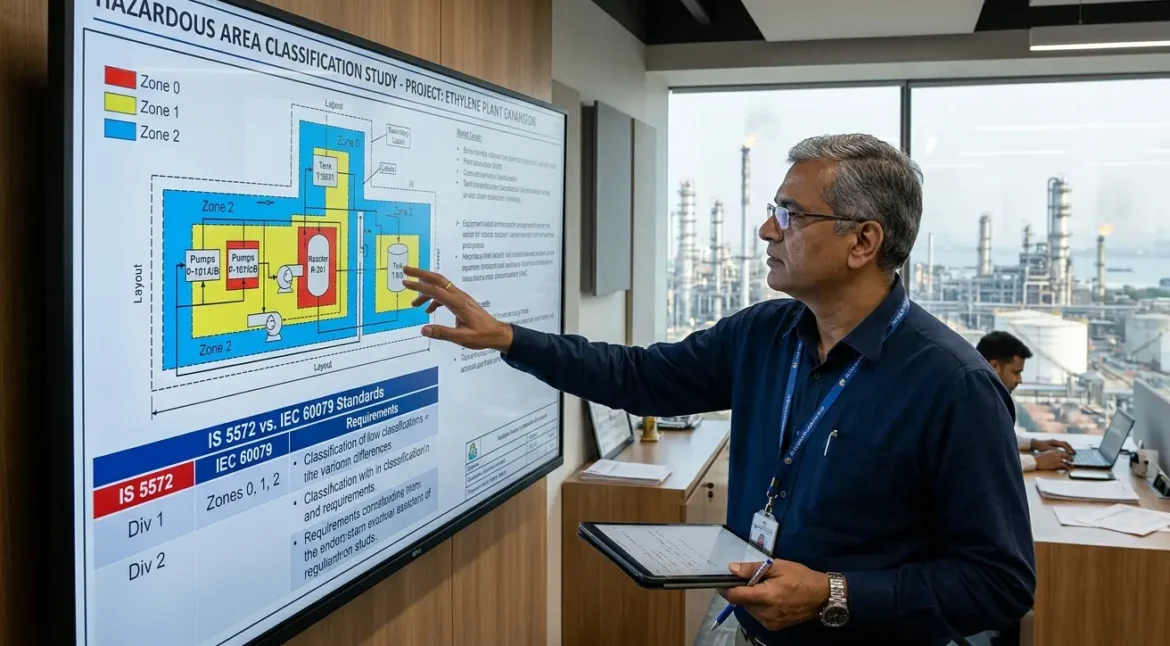
IS 5572 vs IEC 60079 for Hazardous Area Classification in India: Which Standard Should You Use?
IS 5572 vs IEC 60079 is one of the most misunderstood topics in Hazardous Area Classification (HAC) studies across Indian industries. Many organizations assume that because IEC 60079 is internationally recognized, it is sufficient for conducting Hazardous Area Classification studies in India.
However, this assumption can create significant challenges during PESO audits, Factory Inspectorate inspections, project reviews, insurance assessments, and incident investigations.
The question is not whether IEC 60079 is technically superior to IS 5572.
The real question is:
Which standard governs Hazardous Area Classification in India, and how should both standards be applied together to achieve compliance, safety, and technical defensibility?
Understanding the relationship between IS 5572 and IEC 60079 is essential for organizations involved in hazardous area studies, explosion protection, equipment selection, and process safety management.
Understanding the Purpose of Hazardous Area Classification
Hazardous Area Classification (HAC) is the process of identifying locations where flammable gases, vapors, mists, or combustible dusts may be present in quantities sufficient to create an explosive atmosphere.
The objective of HAC is to:
- Identify explosion hazards
- Determine hazardous zones
- Support equipment selection
- Prevent ignition sources
- Improve process safety
- Ensure regulatory compliance
A properly executed HAC study forms the foundation of any explosion prevention strategy.
What Is IS 5572 in Hazardous Area Classification?
IS 5572 is the Indian Standard that provides guidance for Hazardous Area Classification in locations where flammable gases and vapors may be present.
Published by the Bureau of Indian Standards (BIS), IS 5572 serves as the primary Indian code of practice for determining hazardous zones and evaluating explosion risks.
The standard is commonly referenced by:
- PESO
- Factory Inspectorates
- Insurance Companies
- Regulatory Authorities
- Engineering Consultants
- Legal Investigators
IS 5572 remains a recognized and widely accepted standard for Hazardous Area Classification in India.
What Does IS 5572 Answer?
IS 5572 primarily answers the question:
“Where can an explosive atmosphere exist?”
The standard helps determine:
- Zone 0 areas
- Zone 1 areas
- Zone 2 areas
- Extent of hazardous zones
- Release source classification
- Ventilation considerations
- Area classification boundaries
In simple terms, IS 5572 establishes where explosion hazards may occur within a facility.
What Is IEC 60079 for Hazardous Areas?
IEC 60079 is an internationally recognized series of standards covering explosive atmospheres, explosion protection concepts, equipment design, installation practices, inspection requirements, and maintenance requirements.
The IEC 60079 series forms the basis for:
- ATEX compliance
- IECEx certification
- Explosion-protected equipment
- Global hazardous area practices
Unlike IS 5572, IEC 60079 extends beyond Hazardous Area Classification and provides a complete technical framework for managing explosion risks.
What Does IEC 60079 Answer?
IEC 60079 primarily answers the question:
“How should equipment be protected in hazardous areas?”
The standard provides guidance for:
- Ex d (Flameproof) equipment
- Ex e (Increased Safety) equipment
- Ex i (Intrinsic Safety) systems
- Equipment certification
- Installation requirements
- Inspection procedures
- Maintenance practices
While IS 5572 identifies hazardous zones, IEC 60079 helps determine how equipment should be designed and protected within those zones.
IS 5572 vs IEC 60079: Understanding the Difference
One of the biggest misconceptions in industry is that IS 5572 and IEC 60079 are interchangeable standards.
They are not.
IS 5572 Focus
- Hazardous Area Classification
- Zone determination
- Release source assessment
- Regulatory compliance within India
- Statutory acceptance
IEC 60079 Focus
- Explosion protection techniques
- Equipment selection
- Equipment certification
- Installation requirements
- Inspection and maintenance
The two standards serve different purposes within the same risk management framework.
Why IEC 60079 Alone May Not Be Sufficient in India
Many Hazardous Area Classification reports prepared for Indian facilities reference IEC 60079 exclusively.
While these studies may be technically detailed, they can create compliance concerns when reviewed by:
- PESO authorities
- Factory Inspectorates
- Insurance assessors
- Regulatory agencies
- Courts following major incidents
The reason is simple.
Indian regulatory authorities generally expect Hazardous Area Classification studies to align with IS 5572.
A study prepared solely using IEC guidance may not fully satisfy the statutory expectations applicable within India.
This distinction becomes particularly important during:
- PESO licensing activities
- Regulatory audits
- Insurance evaluations
- Incident investigations
- Legal proceedings
The Correct Approach: IS 5572 and IEC 60079 Together
The debate should never be:
IS 5572 or IEC 60079?
The correct answer is:
IS 5572 and IEC 60079.
These standards are complementary, not competing.
Step 1 – Use IS 5572
Determine:
- Hazardous zones
- Release sources
- Ventilation effectiveness
- Zone boundaries
Step 2 – Apply IEC 60079
Determine:
- Suitable Ex protection concepts
- Equipment certification requirements
- Explosion protection methods
Step 3 – Apply Installation Standards
Ensure:
- Proper installation
- Inspection compliance
- Maintenance requirements
Step 4 – Verify Field Compliance
Confirm that:
- Equipment matches assigned zones
- Installation aligns with design intent
- Documentation remains consistent with the HAC study
Neither standard can fully replace the other.
IS 5572 without IEC 60079 creates hazardous zones without a clear equipment protection strategy.
IEC 60079 without IS 5572 creates technical solutions that may not satisfy Indian regulatory expectations.
The Biggest HAC Mistake Is Not Choosing the Wrong Standard
In reality, most HAC failures occur because of poor engineering application rather than incorrect standard selection.
Many studies focus only on assigning zones while ignoring critical operational factors.
Common omissions include:
- Actual release frequencies
- Ventilation effectiveness
- Maintenance activities
- Temporary releases
- Abnormal operating conditions
- Future plant modifications
A Hazardous Area Classification study should reflect how the facility actually operates, not simply how it was designed on paper.
Risks of Over-Classification
Over-classification can lead to:
- Excessive project CAPEX
- Unnecessary Ex-rated equipment
- Increased maintenance costs
- Longer procurement lead times
- Reduced operational flexibility
Good engineering does not automatically choose the most conservative solution.
It chooses the technically justified solution.
Risks of Under-Classification
Under-classification presents far greater consequences.
Potential impacts include:
- Ignition sources remaining uncontrolled
- Inappropriate equipment selection
- Fire and explosion incidents
- Regulatory non-compliance
- Insurance disputes
- Legal liability
The objective of Hazardous Area Classification is not simply to create zones.
The objective is to understand where explosive atmospheres can realistically exist and manage those risks appropriately.
Five Dangerous Assumptions That Continue to Cause Problems
Assumption 1: IEC 60079 Covers Indian Compliance
Not entirely.
While IEC 60079 provides critical technical guidance, Indian authorities continue to reference IS 5572 for Hazardous Area Classification activities.
Assumption 2: IS 5572 and IEC 60079 Are Technically Identical
They are not.
IS 5572:2009 is based on an earlier IEC framework and should not be assumed to be equivalent to later IEC revisions.
Assumption 3: IEC Standards Have No Relevance in India
Incorrect.
Many parts of the IEC 60079 series have been adopted by BIS under the IS/IEC 60079 designation.
Assumption 4: IS 5572 Is Obsolete
IS 5572 continues to remain a recognized Indian standard and remains widely referenced for Hazardous Area Classification studies.
Assumption 5: A Zone Drawing Alone Ensures Safety
A hazardous area drawing does not prevent explosions.
Proper equipment selection, installation, inspection, maintenance, and process safety controls are equally important.
Best Practices for Hazardous Area Classification in India
Organizations should ensure that Hazardous Area Classification studies:
- Follow IS 5572 requirements
- Apply relevant IEC 60079 guidance
- Consider actual operating conditions
- Evaluate release frequencies accurately
- Assess ventilation effectiveness
- Review maintenance activities
- Maintain complete engineering documentation
- Periodically review and update HAC studies
Organizations should also integrate HAC studies within a broader Process Safety Management (PSM) framework to effectively manage major accident hazards.
Conclusion
The question is not whether to use IS 5572 or IEC 60079.
Both standards play essential roles in managing explosion hazards.
IS 5572 provides the Hazardous Area Classification framework recognized within the Indian regulatory environment, while IEC 60079 provides the internationally accepted technical framework for equipment protection, installation, inspection, and maintenance.
Organizations that rely exclusively on one standard risk creating gaps in compliance, engineering design, and operational safety.
A well-executed HAC study combines regulatory requirements, engineering judgment, and international best practices to deliver technically sound and regulatorily defensible results.
A hazardous area drawing does not prevent an explosion.
A properly executed study using both IS 5572 and IEC 60079 does.
For facilities handling flammable gases, vapors, mists, or combustible dusts, Hazardous Area Classification should also be supported by appropriate ATEX assessments, Dust Explosion Risk Assessments, and Electrostatic Hazard Assessments wherever applicable.