

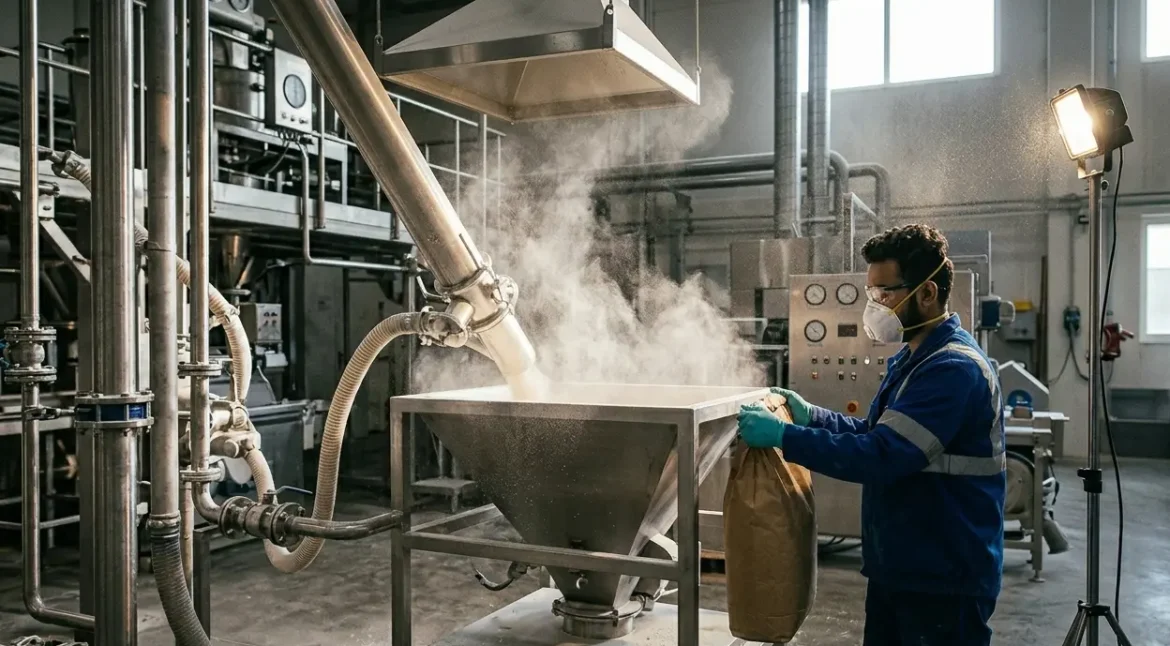
Why Particle Size Matters in Hazardous Area Classification
Hazardous area classification is a critical process for identifying locations where combustible dust atmospheres may create explosion risks. In industries handling powders, fine particulate materials, and dust-generating operations such as grinding, milling, conveying, mixing, and packaging, particle size plays a major role in determining dust cloud formation, ignition sensitivity, explosion severity, and overall combustible dust hazards.
Understanding the relationship between particle size and hazardous area classification is essential for conducting effective Dust Hazard Analysis (DHA), designing explosion protection systems, and implementing appropriate risk control measures.
What is Hazardous Area Classification for Combustible Dust?
Hazardous Area Classification (HAC) is the process of identifying locations where combustible dust atmospheres may be present and classifying those areas based on the likelihood and duration of the explosive atmosphere.
The purpose of HAC is to:
- Identify areas where combustible dust hazards exist
- Determine appropriate equipment selection requirements
- Prevent ignition of explosive dust atmospheres
- Improve plant safety and regulatory compliance
For combustible dust environments, classifications are typically assigned as:
-
Zone 20
Explosive dust atmosphere present continuously or for long periods
-
Zone 21
Explosive dust atmosphere likely during normal operation
-
Zone 22
Explosive dust atmosphere unlikely during normal operation or present only for short durations
The frequency and persistence of airborne dust clouds are heavily influenced by particle size.
Understanding the Dust Explosion Pentagon
A combustible dust explosion occurs when five elements come together:
- Combustible Dust
- Oxygen (Air)
- Ignition Source
- Dust Cloud Dispersion
- Confinement
This concept is commonly known as the Dust Explosion Pentagon.
Among these five elements, particle size plays a major role because it determines how easily a combustible dust cloud can form and how aggressively it will react when ignited.
Particle Size and Combustible Dust Explosion Risk
As particle size decreases, explosion risk increases significantly.
Fine dust particles:
- Remain suspended in air for longer periods
- Provide a larger surface area for combustion
- Require lower ignition energy
- Burn more rapidly
- Generate faster pressure rise rates
- Increase explosion severity
In simple terms, the smaller the particle, the easier it becomes to form an explosive atmosphere.
Industry Guidelines
Industry standards generally recognize:
- Dust particles below 500 microns (µm) as capable of forming combustible dust clouds
- Dust particles below 100 microns (µm) as presenting substantially higher explosion hazards
This is why facilities handling fine powders require careful evaluation during Hazardous Area Classification studies.
How Particle Size Affects Hazardous Area Classification Zones
Ultrafine Particles (<10 µm)
These particles can remain suspended for hours under turbulent conditions and may continuously form explosive dust atmospheres.
Typical HAC implication:
- Zone 20
Fine Particles (10–75 µm)
These particles may remain airborne for several minutes to hours and present a very high dust cloud formation risk.
Typical HAC implication:
- Zone 20
- Zone 21
Medium Particles (75–212 µm)
These particles remain airborne for shorter periods but still present significant combustible dust hazards.
Typical HAC implication:
- Zone 21
- Zone 22
Coarse Particles (>500 µm)
These particles settle rapidly and generally have a lower probability of forming sustained explosive atmospheres.
Typical HAC implication:
- Often unclassified
- May not require hazardous zoning depending on process conditions
Impact of Particle Size on Critical Explosion Parameters
Particle size directly influences several key dust explosibility parameters.
Minimum Ignition Energy (MIE)
Minimum Ignition Energy represents the smallest spark energy required to ignite a dust cloud.
As particle size decreases:
- MIE decreases
- Ignition becomes easier
- Electrostatic discharge becomes a more significant ignition source
Fine combustible dust particles can be ignited by electrostatic discharge, hot surfaces, mechanical sparks, electrical faults, and other common industrial ignition sources. Understanding and controlling these ignition sources is critical for preventing dust explosions and fires in hazardous areas.
Dust Deflagration Index (Kst)
Kst measures the rate of pressure rise during a dust explosion and indicates explosion severity.
Dust explosibility classes include:
- St 0 – Non-explosive
- St 1 – Weak Explosion (1–200 bar·m/s)
- St 2 – Strong Explosion (201–300 bar·m/s)
- St 3 – Very Strong Explosion (>300 bar·m/s)
Fine particles typically generate higher Kst values because combustion occurs more rapidly.
Minimum Explosible Concentration (MEC)
MEC represents the minimum airborne dust concentration capable of sustaining an explosion.
Smaller particles generally exhibit:
- Lower MEC values
- Higher explosion probability
- Greater risk during normal operations
Maximum Explosion Pressure (Pmax)
Pmax is the maximum pressure generated during a dust explosion.
Most combustible dusts produce:
- Pmax between 6 and 10 bar(g)
Fine particle fractions often generate pressure rise more rapidly, increasing the potential for equipment damage and structural failure.
High-Risk Operations Generating Fine Combustible Dust
Many industrial operations naturally generate fine dust particles capable of forming explosive atmospheres.
Common examples include:
- Grinding
- Milling
- Pulverizing
- Pneumatic Conveying
- Bag Dumping
- Powder Mixing
- Spray Drying
- Packaging and Filling Operations
Each of these processes should be evaluated through a comprehensive Dust Hazard Analysis and Hazardous Area Classification study.
Industries Frequently Exposed to Combustible Dust Hazards
Food Processing Industry
- Sugar
- Flour
- Starch
- Milk Powder
Pharmaceutical Industry
- Active Pharmaceutical Ingredients (APIs)
- Excipients
- Powder Handling Operations
Chemical Manufacturing
- Resins
- Pigments
- Dyes
- Specialty Chemicals
Wood Processing
- Sawdust
- Wood Flour
- Sanding Dust
Metal Processing
- Aluminum Dust
- Magnesium Dust
- Titanium Dust
Rubber & Polymer Manufacturing
- Carbon Black
- Polymer Powders
- Synthetic Resin Dust
Lessons from Major Combustible Dust Explosion Accidents
Imperial Sugar Refinery, USA (2008)
- 14 fatalities
- 38 injuries
Fine sugar dust accumulation triggered multiple catastrophic explosions.
West Pharmaceutical Services, USA (2003)
- 6 fatalities
Polyethylene powder accumulation resulted in a combustible dust explosion.
CTA Acoustics, USA (2003)
- 7 fatalities
Phenolic resin dust explosion caused significant loss of life and facility damage.
Hayes Lemmerz, USA (2003)
- 1 fatality
Aluminum dust explosion.
Kunshan Zhongrong Metal Products, China (2014)
- 146 fatalities
Fine aluminum dust accumulation led to one of the deadliest industrial dust explosions in recent history.
These incidents demonstrate that materials considered relatively safe in bulk form can become highly explosive when processed into fine particles.
Engineering Controls for Combustible Dust Hazards
Organizations handling combustible dust should implement comprehensive dust safety management programs that include:
- Controlling dust generation at the source
- Effective local exhaust ventilation systems
- Robust housekeeping programs
- Prevention of dust layer accumulation
- Explosion venting systems
- Explosion suppression systems
- Routine Dust Hazard Analysis (DHA)
- Periodic Hazardous Area Classification reviews
- Laboratory explosibility testing
These programs should form part of a broader Process Safety Management strategy to effectively control major accident hazards.
Testing should include:
- Minimum Ignition Energy (MIE)
- Minimum Explosible Concentration (MEC)
- Dust Deflagration Index (Kst)
- Maximum Explosion Pressure (Pmax)
Key Takeaways on Particle Size and Hazardous Area Classification
Particle size is far more than a material characteristic—it is a critical determinant of combustible dust explosion risk.
Smaller particles:
- Remain suspended longer
- Ignite more easily
- Burn more rapidly
- Generate higher explosion pressures
- Increase the likelihood of hazardous area classification requirements
Understanding particle size distribution is therefore essential for:
- Dust Hazard Analysis (DHA)
- Hazardous Area Classification (HAC)
- ATEX Assessments
- Explosion Protection Design
- Process Safety Management
Organizations that effectively manage combustible dust hazards are better positioned to prevent catastrophic incidents, protect personnel, maintain compliance, and ensure operational continuity.
Final Takeaway
A material that appears safe in bulk form may become highly explosive when processed into fine particles.
Smaller particles. Lower ignition energy. Longer suspension time. Greater explosion risk.