

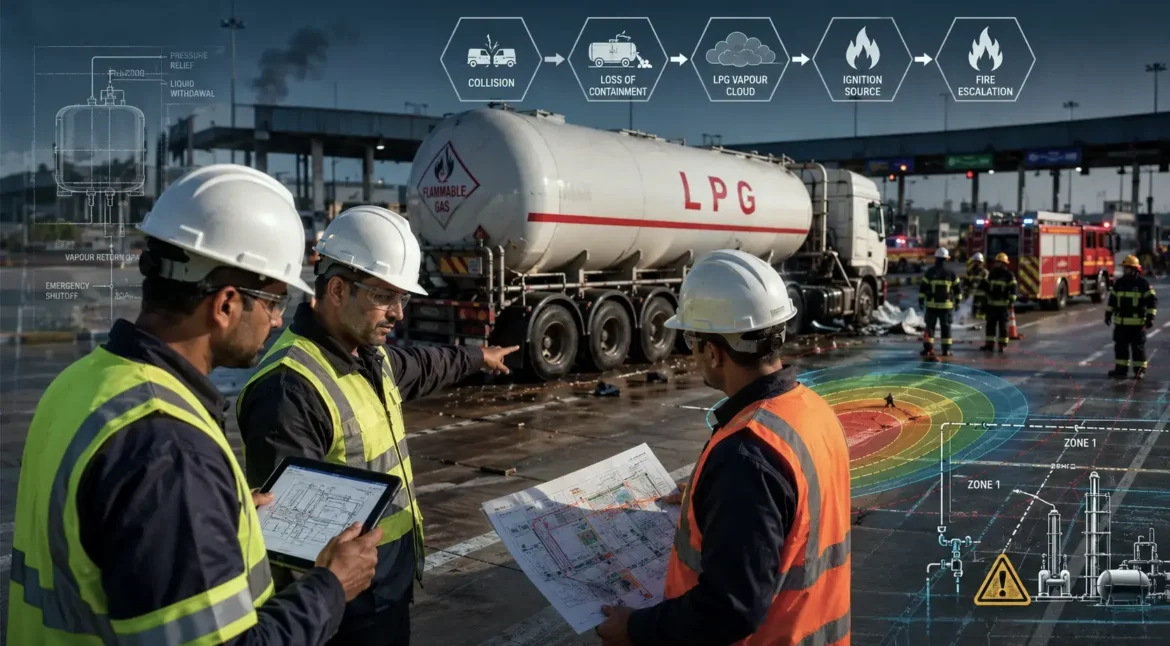
The Kaushambi LPG Tanker Incident on 26 June 2026 was more than a tragic road accident, it was a powerful reminder of how quickly hazardous material releases can escalate into catastrophic events.
An LPG tanker lost control near the Kokhraj (Sihori) Toll Plaza in Kaushambi, Uttar Pradesh, striking the divider and toll plaza infrastructure. The impact resulted in the release of Liquefied Petroleum Gas (LPG), followed by a massive fire that claimed lives, injured several people, and caused extensive damage to vehicles and surrounding property.
While the incident was widely reported as a highway accident, safety professionals viewed it differently. The real hazard was not the collision itself, but the sequence that followed – loss of containment, formation of a flammable vapour cloud, and ignition.
Understanding this sequence is essential for industries involved in the storage, transportation, handling, or processing of flammable substances. The lessons from Kaushambi extend far beyond road transportation and highlight why Process Safety Management plays a critical role in preventing major accidents.
What Happened During the Kaushambi LPG Tanker Incident?
On the morning of 26 June 2026, an LPG tanker travelling along the Prayagraj-Kanpur National Highway lost control near the Kokhraj (Sihori) Toll Plaza in Kaushambi district.
According to initial reports, the tanker struck the road divider before colliding with toll plaza infrastructure. The impact damaged the tanker and resulted in the release of LPG.
Within moments, the leaked gas spread across the toll plaza area, creating a flammable atmosphere. Shortly afterwards, the gas ignited, producing a massive fire that engulfed the tanker, nearby vehicles, and parts of the toll plaza. The incident resulted in multiple fatalities, injuries, and significant property damage.
For the general public, the accident appeared to be another unfortunate highway collision.
For process safety professionals, however, it demonstrated a familiar accident sequence:
- Vehicle collision
- Loss of containment
- Formation of a flammable vapour cloud
- Ignition
- Rapid fire escalation
This sequence has been observed in several major industrial accidents worldwide and forms the basis of many Process Safety studies.
Timeline of the Incident
| Event | Description |
| Vehicle Collision | LPG tanker loses control and collides with the divider and toll plaza. |
| Loss of Containment | LPG begins leaking from the damaged tanker. |
| Vapour Cloud Formation | Released LPG spreads across the toll plaza before ignition. |
| Ignition | The flammable vapour cloud encounters an ignition source. |
| Fire Escalation | Fire rapidly engulfs the tanker, nearby vehicles, and surrounding infrastructure. |
| Emergency Response | Firefighters, police, and emergency responders begin rescue and firefighting operations. |
The Most Critical Part Happened Before the Fire
One of the most significant observations from the incident came from CCTV footage released after the accident.
The footage showed that the fire did not occur immediately after the collision.
Instead, LPG leaked from the tanker and spread across the toll plaza. People noticed the gas release, attempted to move away, and several vehicles began turning around before the fire erupted.
Those few moments between the release of LPG and its ignition represent the most important safety lesson from the incident.
In Process Safety, major accidents often begin with a Loss of Containment (LOC) rather than an explosion or fire. Once a hazardous material escapes from its intended system, the priority shifts to preventing escalation.
If the released material does not encounter an ignition source, emergency responders may have an opportunity to isolate the area, stop the leak, or evacuate personnel.
However, once ignition occurs, the situation can escalate within seconds.
The Kaushambi incident clearly illustrates this principle:
The collision initiated the event, but the loss of containment and subsequent ignition transformed it into a major accident.
Why LPG Releases Can Escalate So Quickly
Whether LPG is transported in a road tanker or stored inside an industrial facility, its behaviour remains the same.
LPG is stored as a pressurised liquid. When containment is compromised, the sudden drop in pressure causes the liquid to rapidly expand and vaporise.
Unlike many gases, LPG vapours are heavier than air. Instead of rising immediately into the atmosphere, they tend to remain close to the ground and spread across surrounding areas, including roads, drains, trenches, and low-lying spaces.
This creates a highly flammable vapour cloud that may travel some distance before encountering an ignition source.
The Kaushambi incident demonstrates why hazardous material releases must never be underestimated.
A road accident involving LPG can quickly become a process safety event, with consequences similar to those seen in chemical plants, storage terminals, or LPG bottling facilities.
From Road Accident to Process Safety Incident
Although the Kaushambi incident occurred on a public highway, the sequence of events closely resembles the scenarios evaluated during industrial risk assessments.
Process safety professionals typically analyse incidents by asking questions such as:
- 1. How was containment lost?
- 2. What allowed the flammable atmosphere to develop?
- 3. Could the release have been controlled or isolated?
- 4. What was the likely ignition source?
- 5. Which safety barriers were available?
- 6. Could the consequences have been reduced?
These questions help shift the focus away from the accident itself and towards the engineering and operational factors that influence the severity of an incident.
This approach is fundamental to Process Safety Management, where the objective is not only to prevent failures but also to prevent those failures from escalating into major accidents.
Initial Findings: What Do We Know So Far?
As of the latest available information, the Kaushambi LPG Tanker Incident appears to have been initiated when the LPG tanker lost control near the Kokhraj (Sihori) Toll Plaza and collided with the road divider and toll plaza infrastructure.
The impact compromised the integrity of the tanker, resulting in a significant loss of LPG containment. CCTV footage and eyewitness accounts indicate that the leaked LPG spread across the toll plaza before ignition occurred. Within moments, the vapour cloud ignited, causing a massive fire that engulfed the tanker, nearby vehicles, and parts of the toll plaza.
While investigations will ultimately determine the precise sequence of events and contributing factors, the incident already highlights several well-established Process Safety principles that apply to any facility handling flammable materials.
Rather than focusing solely on the collision itself, safety professionals examine the chain of events that followed, because it is often these subsequent failures that determine the severity of an accident.
Ignition Source Control: The Difference Between a Leak and a Catastrophic Fire
One of the most important observations from the incident is that the LPG did not ignite immediately after the tanker was damaged.
This short delay demonstrates a critical concept in Process Safety: a hazardous release does not automatically result in a fire or explosion. The situation becomes catastrophic only when a flammable atmosphere encounters a sufficient ignition source.
Potential ignition sources can include:
- 1. Electrical faults
- 2. Hot vehicle surfaces
- 3. Static electricity
- 4. Open flames
- 5. Mechanical sparks
- 6. Welding or hot work
- 7. Non-certified electrical equipment
- 8. Vehicle engines or exhaust systems
This is precisely why industries handling LPG, LNG, solvents, fuels, hydrogen, and other flammable substances invest heavily in ignition source control.
Common engineering and operational safeguards include:
- 1. Flameproof (Ex) electrical equipment
- 2. Intrinsically Safe (IS) instrumentation
- 3. Static grounding and bonding systems
- 4. Spark-resistant tools
- 5. Hazardous Area Classification (HAC)
- 6. Electrical safety inspections
- 7. Preventive maintenance programmes
- 8. Permit-to-work systems for hot work and maintenance
These safeguards may appear routine during normal operations, but they become essential when abnormal situations occur. A single uncontrolled ignition source can transform a manageable gas release into a major accident within seconds.
Why Safety Barriers Matter
Every major industrial accident is rarely the result of a single failure. Instead, it is usually the outcome of multiple safeguards failing in sequence.
The Kaushambi LPG Tanker Incident reinforces one of the core principles of Process Safety:
Major accidents occur when multiple safety barriers are absent, ineffective, bypassed, damaged, or unable to prevent escalation.
Safety barriers can be broadly grouped into three categories:
Engineering Controls
These are physical systems designed to prevent or minimise hazardous events, such as:
- 1. Pressure relief systems
- 2. Fire detection and suppression systems
- 3. Gas detection systems
- 4. Emergency isolation valves
- 5. Flameproof electrical installations
- 6. Secondary containment measures
Operational Controls
These focus on maintaining safe day-to-day operations and include:
- 1. Standard Operating Procedures (SOPs)
- 2. Safe work permit systems
- 3. Preventive inspection and maintenance
- 4. Hazard identification studies
- 5. Equipment integrity programmes
- 6. Contractor safety management
Emergency Response Measures
When preventive controls fail, emergency preparedness helps reduce the consequences of an incident.
Examples include:
- 1. Emergency response plans
- 2. Firefighting systems
- 3. Evacuation procedures
- 4. Incident command structures
- 5. Mock drills and emergency exercises
- 6. Employee awareness and competency training
The effectiveness of these barriers ultimately determines whether an incident remains manageable or escalates into a large-scale emergency.
What If a Similar Incident Occurred Inside an Industrial Facility?
The Kaushambi incident occurred in an open public area, yet the consequences were severe.
Now consider a similar Loss of Containment occurring within an industrial environment, such as:
- 1. An LPG bottling plant
- 2. A chemical or petrochemical facility
- 3. A tank farm
- 4. A bulk storage terminal
- 5. A process unit
- 6. A warehouse storing flammable materials
- 7. A loading or unloading bay
- 8. An occupied control room
In these environments, the consequences could be significantly greater due to:
- 1. Higher inventories of hazardous materials
- 2. Multiple potential ignition sources
- 3. Congested plant layouts
- 4. Continuous operating equipment
- 5. Closely spaced process units
- 6. Increased potential for domino effects
This is why industries invest in systematic Process Safety studies, including:
- 1. Process Hazard Analysis (PHA)
- 2. Hazard and Operability (HAZOP) Studies
- 3. Hazardous Area Classification (HAC)
- 4. Quantitative Risk Assessment (QRA)
- 5. Emergency Preparedness Reviews
The objective of these studies is not merely to satisfy regulatory requirements but to identify hazards, evaluate risks, and implement safeguards before an incident occurs.
Key Safety Lessons from the Kaushambi LPG Tanker Incident
Every major incident provides an opportunity to strengthen safety practices. While the investigation into the Kaushambi LPG Tanker Incident may continue, several important process safety lessons are already evident.
1. Loss of Containment Is the Real Beginning of Many Major Accidents
The collision was the initiating event, but the major hazard emerged when LPG escaped from the tanker. Preventing or minimising Loss of Containment (LOC) remains one of the primary objectives of Process Safety Management, as it significantly reduces the likelihood of fire, explosion, and toxic exposure.
2. Ignition Source Control Is Critical
The delay between the LPG release and ignition demonstrated that a flammable atmosphere can exist before a fire occurs. During this period, controlling ignition sources becomes essential. Proper equipment selection, electrical safety management, static control, and Hazardous Area Classification are all designed to reduce this risk.
3. Safety Barriers Should Be Reliable and Layered
No single safeguard can eliminate every hazard. Effective risk management relies on multiple layers of protection including engineering controls, operational procedures, preventive maintenance, emergency response systems, and trained personnel to prevent escalation when abnormal conditions arise.
4. Emergency Preparedness Saves Valuable Time
Rapid emergency response, effective communication, evacuation procedures, and coordination between emergency services are critical in limiting the consequences of incidents involving hazardous materials. Regular mock drills and emergency planning help organisations respond more effectively when real emergencies occur.
5. Learning from External Incidents Strengthens Safety Culture
Organisations do not need to experience an accident themselves to improve their safety performance. Reviewing incidents from other industries provides valuable insights into potential vulnerabilities and allows businesses to strengthen their own safety systems before similar events occur.
Why These Lessons Matter Across Industries
Although the Kaushambi incident involved an LPG road tanker, the underlying process safety principles apply to a wide range of industries handling hazardous materials.
These lessons are particularly relevant for:
- 1. Oil & Gas facilities
- 2. Chemical and Petrochemical plants
- 3. LPG bottling and storage terminals
- 4. Fertiliser and Agrochemical industries
- 5. Pharmaceutical manufacturing
- 6. Paints, coatings, and solvent handling facilities
- 7. FMCG manufacturing plants
- 8. Warehouses storing flammable liquids or gases
- 9. Bulk transportation and logistics operations
Regardless of the industry, the objective remains the same: identify hazards, understand the risks, and implement effective safeguards before an incident occurs.
The Indsafe Perspective
At Indsafe Consulting & Systems, we believe that effective Process Safety begins long before an emergency.
Incidents such as the Kaushambi LPG Tanker fire reinforce an important reality, major accidents rarely result from a single failure. They typically occur when multiple safeguards fail or when hazards are not fully understood during the design, operation, maintenance, or transportation of hazardous materials.
Our approach focuses on identifying potential hazards, evaluating operational risks, and implementing practical engineering controls that reduce both the likelihood and consequences of major accidents.
Our Process Safety expertise includes:
- Process Hazard Analysis (PHA) & HAZOP Studies
- Process Safety Management (PSM)
- Hazardous Area Classification (HAC)
- Fire Risk Assessment
- Quantitative Risk Assessment (QRA)
- Electrostatic Hazard Evaluation
- Process Safety Gap Assessment
- Transportation Safety Assessment
- Emergency Preparedness & Response Planning
- Functional Safety Studies
By combining technical expertise with practical industry experience, we help organisations strengthen regulatory compliance, improve operational resilience, and protect people, assets, and the environment.
Conclusion
The Kaushambi LPG Tanker Incident serves as a powerful reminder that accidents involving hazardous materials can escalate rapidly when multiple risk factors align.
While the collision initiated the event, it was the Loss of Containment, formation of a flammable vapour cloud, and subsequent ignition that transformed it into a catastrophic fire.
For organisations handling hazardous materials, the incident reinforces the importance of:
- Maintaining equipment integrity
- Preventing Loss of Containment
- Controlling ignition sources
- Implementing Hazardous Area Classification
- Strengthening emergency preparedness
- Conducting regular Process Safety assessments
Ultimately, Process Safety is not measured by how effectively operations perform under normal conditions. It is measured by how well organisations anticipate abnormal situations, manage risk, and prevent escalation when the unexpected occurs.
Every major incident offers an opportunity to learn. The organisations that apply those lessons proactively are the ones best positioned to prevent the next major accident.
Frequently Asked Questions (FAQs)
1. What caused the Kaushambi LPG Tanker Incident?
According to preliminary reports, the tanker lost control near the Kokhraj (Sihori) Toll Plaza, resulting in a collision that caused a Loss of Containment. The released LPG formed a flammable vapour cloud, which subsequently ignited and led to a major fire.
2. Why is LPG considered hazardous?
LPG is stored as a pressurised liquid. When released, it rapidly vaporises into a highly flammable gas. Because LPG vapours are heavier than air, they tend to spread close to the ground, increasing the risk of fire or explosion if an ignition source is present.
3. What is Loss of Containment (LOC)?
Loss of Containment refers to the unintended release of hazardous substances from equipment or systems designed to contain them. It is one of the most common initiating events behind major industrial accidents involving flammable, toxic, or reactive materials.
4. How can industries reduce the risk of similar incidents?
Organisations can minimise risk by implementing Process Safety Management practices, conducting Hazard Identification (HAZID) and HAZOP Studies, performing Fire Risk Assessments and Hazardous Area Classification, maintaining equipment integrity, strengthening emergency preparedness, and providing regular employee training.
References
To understand the incident and its broader process safety implications, this article draws upon:
- Preliminary news reports and publicly available information regarding the Kaushambi LPG Tanker Incident.
- Established Process Safety Management principles.
- Industry best practices for hazardous material handling and transportation.
- Guidance from recognised engineering standards and risk management methodologies.
Continue Exploring Process Safety
If your organisation handles flammable or hazardous materials, you may also find these resources useful: