

ATEX vs Flameproof is one of the most misunderstood topics in hazardous area engineering. Many engineers, procurement teams, and maintenance professionals assume that every ATEX-certified piece of equipment is Flameproof (Ex d), but this is a common misconception.
Terms such as ATEX, Explosion Proof, Flameproof, and Ex Equipment are often used interchangeably, despite having different meanings. As a result, hazardous area equipment may be incorrectly specified, purchased, or installed, leading to compliance issues, increased project costs, and, more importantly, potential safety risks.
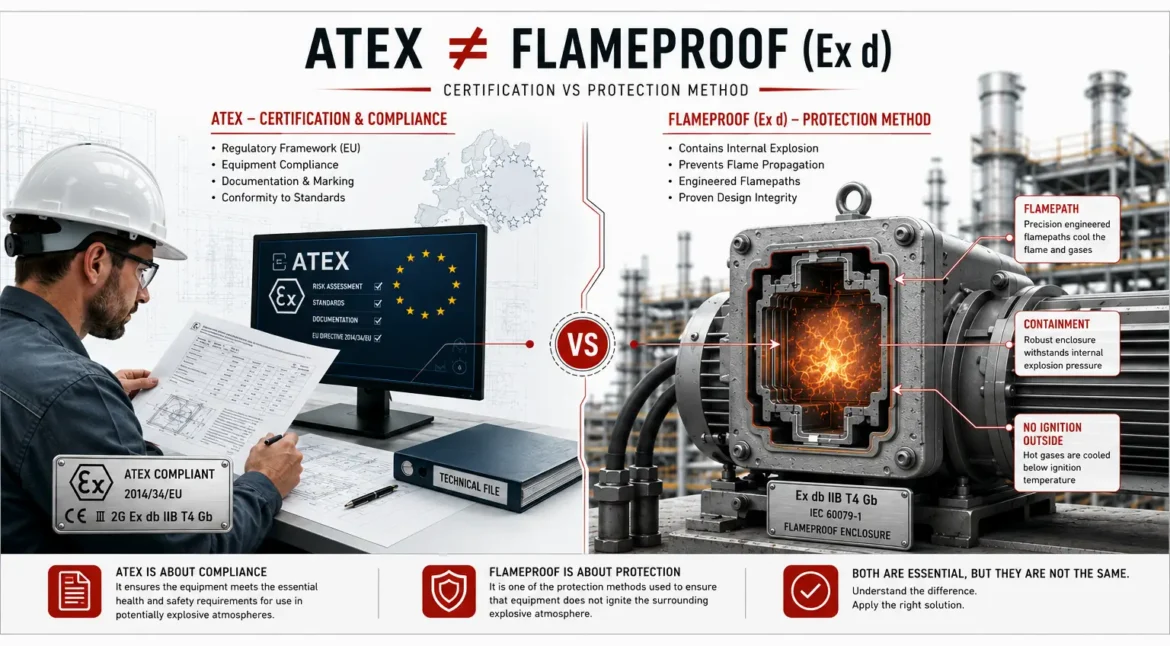
The reality is simple: ATEX is a European certification and regulatory framework, whereas Flameproof (Ex d) is just one of several explosion protection techniques defined under the IEC 60079 series of standards.
Understanding the difference between ATEX and Flameproof is essential for engineers responsible for Hazardous Area Classification (HAC), equipment selection, Electrical Safety, Process Safety, and regulatory compliance. Choosing the correct explosion protection concept is critical to ensuring equipment is suitable for the hazardous area in which it will operate.
In this article, we explain ATEX vs Flameproof, clarify the differences between ATEX certification and Flameproof protection, explore the various explosion protection techniques defined under IEC 60079, and show you how to correctly interpret Ex markings when selecting hazardous area equipment.
Quick Answer: Is ATEX the Same as Flameproof?
No. ATEX is a European regulatory framework that governs equipment intended for use in potentially explosive atmospheres, whereas Flameproof (Ex d) is one specific explosion protection technique defined under IEC 60079-1.
While many Flameproof products are ATEX certified, not every ATEX-certified product uses Flameproof protection. Equipment can achieve ATEX compliance through several protection concepts, including Ex d, Ex e, Ex ia, Ex p, Ex m, Ex q, Ex o, and Ex ec, depending on the application and hazardous area classification.
What is ATEX?
ATEX is derived from the French phrase Atmosphères Explosibles, meaning Explosive Atmospheres.
Rather than being an explosion protection method, ATEX is a European Union legislative framework that regulates equipment and protective systems intended for use in locations where explosive atmospheres may be present.
The primary legislation governing equipment is the:
ATEX Product Directive 2014/34/EU
This directive establishes the essential health and safety requirements for manufacturers designing equipment to operate safely in hazardous areas.
ATEX applies to both:
- Electrical equipment
- Non-electrical equipment
It also covers explosive atmospheres created by:
- Flammable gases
- Vapours
- Mists
- Combustible dusts
The objective of the directive is to ensure that equipment placed on the European market has been appropriately designed, manufactured, tested, and certified for safe operation within hazardous locations.
Simply put, ATEX tells users whether equipment complies with European hazardous area regulations, but it does not explain the engineering method used to prevent ignition.
What Information Does ATEX Certification Provide?
When equipment is ATEX certified, it communicates important information about where and under what conditions the equipment can be safely used.
ATEX certification identifies:
- Applicable hazardous zones
- Equipment Category
- Equipment Protection Level (EPL)
- Gas or dust application
- Regulatory compliance with European legislation
This information helps engineers determine whether the equipment is suitable for a specific hazardous location.
However, ATEX certification alone does not explain how the equipment achieves explosion protection.
What ATEX Certification Does Not Tell You
This is where many engineers make incorrect assumptions.
Seeing the words “ATEX Certified” on a catalogue or datasheet does not automatically mean the equipment is Flameproof.
Instead, the actual protection method is identified by the Ex protection code, such as:
- Ex d – Flameproof Enclosure
- Ex e – Increased Safety
- Ex ia / Ex ib / Ex ic – Intrinsic Safety
- Ex p – Pressurization
- Ex m – Encapsulation
- Ex q – Powder Filling
- Ex o – Oil Immersion
- Ex ec – Increased Safety for Zone 2 applications
Each protection concept follows a different engineering philosophy and is suitable for different hazardous areas and applications.
Understanding these protection concepts is critical for selecting equipment that complies with both safety requirements and applicable standards.
What is Flameproof (Ex d) Equipment?
Flameproof protection, designated as Ex d, is defined under IEC 60079-1.
Contrary to a common misconception, Flameproof equipment is not designed to prevent explosions from occurring inside the enclosure.
Instead, it is specifically engineered to contain an internal explosion and prevent it from igniting the surrounding hazardous atmosphere.
A Flameproof enclosure is manufactured with high mechanical strength and precisely designed flame paths.
If an explosive gas mixture inside the enclosure ignites due to sparking electrical components, the enclosure is designed to:
- Withstand the internal explosion pressure.
- Cool the escaping hot gases through engineered flame paths.
- Prevent flame transmission to the external hazardous atmosphere.
In simple terms:
Ex d allows an explosion to occur inside the enclosure but prevents it from propagating outside.
This makes Flameproof protection particularly suitable for equipment that naturally produces sparks or arcs during normal operation.
Typical applications include:
- Electric motors
- Switchgear
- Push-button stations
- Junction boxes
- Lighting fixtures
- Motor starters
- High-power electrical equipment
Because ignition sources cannot always be eliminated in these applications, Flameproof construction provides an effective means of explosion protection.
ATEX vs Flameproof: Understanding the Difference
The easiest way to understand the distinction is to think of ATEX as the rulebook and Flameproof as one method of complying with those rules.
| ATEX Certification | Flameproof (Ex d) |
| European regulatory framework | Explosion protection technique |
| Based on ATEX Directive 2014/34/EU | Defined in IEC 60079-1 |
| Specifies where equipment can be used | Explains how equipment prevents ignition |
| Covers electrical and non-electrical equipment | Primarily used for electrical equipment with internal ignition sources |
| Includes multiple protection concepts | One specific protection method |
Therefore:
ATEX answers “Where can this equipment be used?”
Whereas:
Ex d answers “How does this equipment remain safe?”
This distinction is fundamental when selecting hazardous area equipment.
Simply specifying ATEX Certified is not sufficient.
Engineers must also verify that the selected protection concept is appropriate for the hazardous area, gas group, temperature class, and operational requirements.
Common Explosion Protection Techniques Under IEC 60079
The IEC 60079 series defines multiple explosion protection techniques, each developed for specific equipment types, hazardous areas, and operational requirements. Selecting the correct protection concept depends on factors such as the hazardous zone, gas group, temperature class, and the equipment’s operating principle.
1. Flameproof Enclosure (Ex d)
Standard: IEC 60079-1
Flameproof protection allows an internal explosion to occur within a specially designed enclosure while preventing the flame from propagating to the surrounding hazardous atmosphere. Heavy-duty construction and precision-engineered flame paths contain the explosion and cool escaping gases.
Typical applications:
- Electric motors
- Switchgear
- Junction boxes
- Push-button stations
- Lighting fixtures
2. Increased Safety (Ex e)
Standard: IEC 60079-7
Instead of containing an explosion, Ex e prevents ignition by eliminating sparks, arcs, loose electrical connections, and excessive temperatures during normal operation.
Common applications:
- Terminal boxes
- Squirrel cage motors
- Lighting assemblies
- Connection enclosures
3. Intrinsic Safety (Ex ia, Ex ib, Ex ic)
Standard: IEC 60079-11
Intrinsic Safety limits electrical energy below the Minimum Ignition Energy (MIE) of the hazardous atmosphere. Even under fault conditions, the circuit cannot generate enough electrical or thermal energy to ignite a flammable mixture.
Typical applications:
- Pressure transmitters
- Temperature sensors
- Gas detectors
- PLC I/O modules
- Instrument loops
Among these, Ex ia provides the highest level of protection and is suitable for Zone 0 hazardous areas.
4. Other Protection Techniques
Depending on the application, hazardous area equipment may also use:
- Ex p (Pressurization): Uses clean air or inert gas to maintain positive pressure and prevent hazardous gases from entering the enclosure.
- Ex m (Encapsulation): Ignition-capable components are completely sealed in resin or an encapsulating compound.
- Ex q (Powder Filling): Quartz or similar powder prevents flame propagation within the enclosure.
- Ex o (Oil Immersion): Electrical components are immersed in insulating oil to isolate ignition sources.
- Ex ec (Enhanced Safety for Zone 2): Designed to prevent ignition during normal operation in less hazardous environments.
Each protection concept follows a different engineering approach and should only be selected after considering the applicable hazardous area classification.
Understanding Equipment Ex Markings
One of the most important skills for engineers working in hazardous areas is correctly interpreting Ex markings on equipment nameplates.
Consider the following marking:
II 2 G Ex d IIC T6 Gb
Each part provides specific information:
| Marking | Meaning |
| II | Surface industries (non-mining) |
| 2 | Equipment Category 2 |
| G | Suitable for gas atmospheres |
| Ex d | Flameproof protection method |
| IIC | Suitable for Hydrogen and Acetylene (most severe gas group) |
| T6 | Maximum surface temperature of 85°C |
| Gb | Equipment Protection Level suitable for Zone 1 |
Now compare it with:
II 2 G Ex ia IIB T4 Gb
Although both pieces of equipment are ATEX certified, they use completely different protection methods.
The first achieves explosion protection through Flameproof construction (Ex d), while the second relies on Intrinsic Safety (Ex ia).
This illustrates why engineers should never assume that ATEX certification automatically means Flameproof protection.
Common Mistakes When Selecting ATEX Equipment
Equipment selection errors remain one of the most common causes of non-compliance in hazardous area installations.
Some frequently observed mistakes include:
- Purchasing equipment simply because it is labelled “ATEX Certified” without reviewing the complete Ex marking.
- Assuming all explosion-protected equipment is Flameproof (Ex d).
- Selecting Ex ec equipment for Zone 1 applications where a higher level of protection is required.
- Ignoring Gas Group, Temperature Class, or Equipment Protection Level (EPL) during specification.
- Choosing equipment based solely on price rather than application suitability.
These mistakes can result in regulatory non-compliance, unnecessary project costs, operational risks, and increased maintenance challenges.
Best Practices for Selecting Hazardous Area Equipment
Proper hazardous area equipment selection should always be based on a Hazardous Area Classification (HAC) study and, where applicable, a detailed ATEX Consulting assessment. Selecting the appropriate protection concept helps ensure compliance with applicable standards while reducing the risk of ignition in explosive atmospheres.
- Review the complete Ex marking, not just the ATEX certificate.
- Confirm the hazardous area classification (Zone 0, Zone 1, or Zone 2).
- Verify the applicable Gas Group (IIA, IIB, or IIC).
- Check the required Temperature Class.
- Ensure the Equipment Protection Level (EPL) matches the hazardous area.
- Select the most appropriate explosion protection concept for the application.
- Ensure compliance with the relevant IEC 60079 standards and applicable local regulations.
Proper equipment selection should always be based on engineering requirements rather than product descriptions or marketing terminology.
Key Takeaways
Understanding the difference between ATEX certification and Flameproof (Ex d) protection is essential for anyone involved in hazardous area engineering.
The key points to remember are:
- ATEX is a European certification and regulatory framework—not an explosion protection method.
- Flameproof (Ex d) is one of several protection techniques defined under the IEC 60079 series.
- ATEX-certified equipment may use Ex d, Ex e, Ex ia, Ex p, Ex m, Ex q, Ex o, or Ex ec, depending on the application.
- Always read the complete Ex marking to understand how equipment achieves explosion protection.
- Selecting the correct protection concept requires consideration of the hazardous zone, gas group, temperature class, and Equipment Protection Level.
Frequently Asked Questions (FAQs)
1. Is ATEX the same as Flameproof?
No. ATEX is a European regulatory framework for equipment used in explosive atmospheres, while Flameproof (Ex d) is one specific explosion protection technique defined in IEC 60079-1.
2. Is every ATEX-certified equipment Flameproof?
No. ATEX-certified equipment may use several protection methods, including Ex d, Ex e, Ex ia, Ex p, Ex m, Ex q, Ex o, or Ex ec, depending on the intended application.
3. What does Ex d mean?
Ex d stands for Flameproof Enclosure. It allows an internal explosion to occur within the equipment enclosure while preventing the flame from igniting the surrounding hazardous atmosphere.
4. Why is reading the Ex marking important?
The Ex marking provides essential information about the equipment’s protection method, gas group, temperature class, and Equipment Protection Level. Reviewing the complete marking ensures the equipment is suitable for the intended hazardous area.
Conclusion
The terms ATEX and Flameproof are often used interchangeably, but they represent two very different concepts.
ATEX defines the regulatory requirements for equipment used in explosive atmospheres, whereas Flameproof (Ex d) is only one of several engineering techniques used to achieve explosion protection under the IEC 60079 standards.
Understanding this distinction enables engineers, procurement teams, inspectors, and maintenance personnel to make informed equipment selection decisions, maintain regulatory compliance, and reduce the risk of ignition in hazardous locations.
Rather than relying solely on the words “ATEX Certified,” always review the complete Ex marking, verify the hazardous area classification, and ensure the selected protection concept is appropriate for the application.
In hazardous areas, safe equipment selection is not just about compliance, it is a critical element of effective Process Safety and Electrical Safety Management.
References
- ATEX Directive 2014/34/EU
- IEC 60079-1 – Explosive Atmospheres – Flameproof Enclosures “d”
- IEC 60079-2 – Pressurized Enclosures
- IEC 60079-5 – Powder Filling “q”
- IEC 60079-6 – Oil Immersion “o”
- IEC 60079-7 – Increased Safety “e”
- IEC 60079-11 – Intrinsic Safety “i”
- IEC 60079-15 – Equipment Protection by Type of Protection “n” / Ex ec
- IEC 60079-18 – Encapsulation “m”
- IS/IEC 60079 Series (Bureau of Indian Standards)