

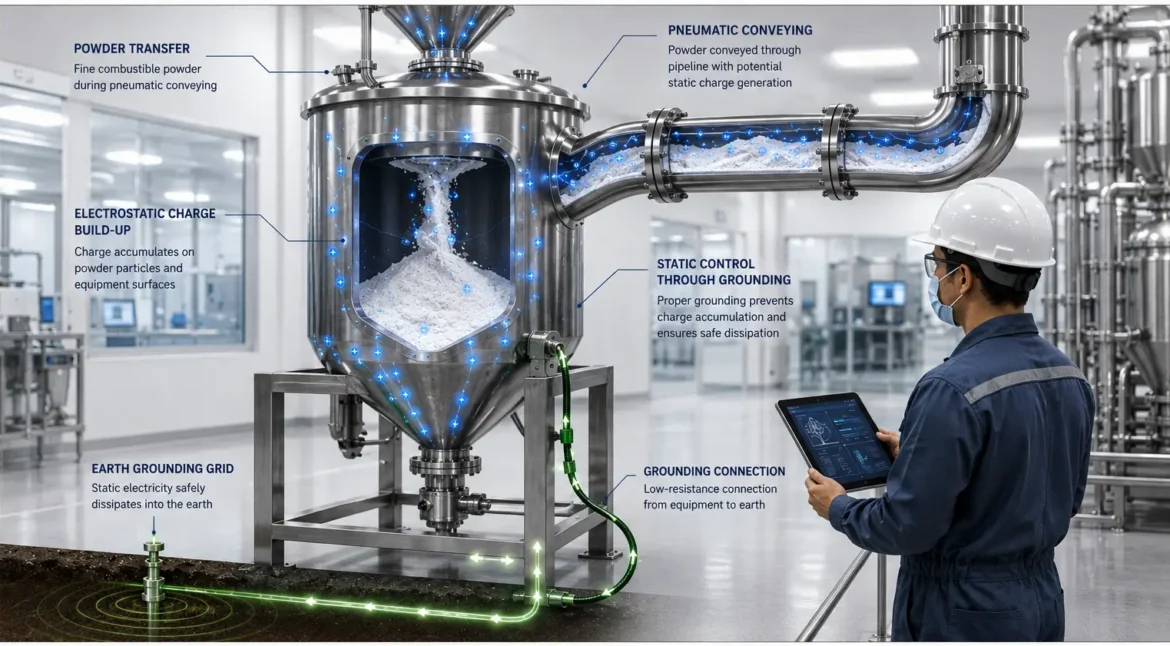
Powder handling is a routine operation across industries such as pharmaceuticals, chemicals, food processing, agriculture, metals, plastics, and battery manufacturing. Whether powders are being transferred, mixed, conveyed, milled, or packaged, these processes can generate significant electrostatic charges through normal material movement.
Under the right conditions, accumulated static electricity can become a powerful ignition source. If a combustible dust cloud is present, a single electrostatic discharge (ESD) may be sufficient to initiate a dust fire or explosion.
Despite this well-known hazard, grounding (earthing) is often treated as a simple compliance requirement rather than a critical engineering safeguard. In reality, effective grounding forms one layer of a comprehensive electrostatic hazard control strategy that also includes bonding, equipment selection, housekeeping, ignition source control, and proper process safety management.
Understanding powder handling grounding is therefore essential for engineers, plant operators, maintenance teams, and safety professionals responsible for facilities handling combustible powders.
Quick Answer
Why Is Grounding Important in Powder Handling Operations?
Grounding (earthing) provides a controlled path for electrostatic charges to safely dissipate into the earth, reducing the likelihood of electrostatic discharge (ESD).
However, grounding alone does not eliminate static electricity or prevent every dust explosion. Effective electrostatic hazard control requires a combination of grounding, bonding, appropriate equipment selection, process design, and adherence to recognised standards such as IEC TS 60079-32-1, NFPA 77, and NFPA 652.
Why Static Electricity Is a Serious Hazard in Powder Handling
Static electricity is generated whenever two materials come into contact and separate. During powder handling operations, millions of particles continuously interact with processing equipment, transfer lines, containers, filters, and operators.
Common operations capable of generating electrostatic charge include:
- Pneumatic conveying
- Powder transfer
- Mixing and blending
- Milling and grinding
- Screening
- Bag filling and emptying
- Drum charging
- Hopper discharge
- Packaging operations
As powders move through pipes, chutes, flexible hoses, or processing equipment, friction causes electrons to transfer between surfaces. This phenomenon, known as triboelectric charging, results in the accumulation of static electricity.
If the accumulated charge cannot safely dissipate, it may eventually discharge as an electrostatic spark.
Where combustible dust clouds are present, this spark can become an effective ignition source capable of initiating a dust fire or explosion.
Unlike many ignition sources, static electricity is invisible and often goes unnoticed until an incident occurs.
How Electrostatic Charges Are Generated
Electrostatic charging occurs through a process known as the triboelectric effect.
When two dissimilar materials come into contact and then separate, electrons are exchanged between their surfaces. During powder handling, this process occurs continuously as particles collide with equipment surfaces and with each other.
Several factors influence the amount of static charge generated, including:
- Powder composition
- Particle size
- Moisture content
- Material conductivity
- Flow velocity
- Equipment design
- Environmental humidity
The lower the conductivity of the material, the more likely electrostatic charges are to accumulate.
Non-conductive powders and plastic equipment components are particularly susceptible to charge build-up because they do not readily dissipate accumulated electrical energy.
This is why industries handling combustible powders must carefully evaluate electrostatic hazards as part of their overall Dust Explosion Safety strategy.
When Does Static Electricity Become Dangerous?
The presence of static electricity alone does not automatically create an explosion hazard.
For an incident to occur, several conditions must exist simultaneously.
A combustible dust cloud must be present, oxygen must be available, and the electrostatic discharge must possess sufficient energy to ignite the dust-air mixture.
This relationship is often explained using the Dust Explosion Pentagon, which identifies the five essential elements required for a dust explosion:
- Combustible dust
- Oxygen
- Dispersion of dust into a cloud
- Confinement
- Ignition source
Electrostatic discharge represents one of several potential ignition sources within this pentagon.
Although many dust explosions involve multiple contributing factors, eliminating or controlling electrostatic ignition sources significantly reduces overall risk.
Why Effective Grounding (Earthing) Matters
Grounding, also known as earthing, is one of the most effective methods for controlling electrostatic hazards involving conductive equipment.
Its primary purpose is to provide a low-resistance path that allows accumulated electrical charge to flow safely into the earth before dangerous voltage levels develop.
Properly grounded equipment helps reduce charge accumulation on:
- Metal vessels
- Storage silos
- Conveying systems
- Drums and intermediate bulk containers (IBCs)
- Powder transfer stations
- Mixers and blenders
- Process piping
By continuously dissipating accumulated charges, grounding reduces the probability of uncontrolled electrostatic discharge.
However, grounding should never be viewed as a standalone solution.
It is only one element of a broader electrostatic hazard control strategy.
Grounding Is Not the Same as Bonding
One of the most common misconceptions in industrial safety is assuming that grounding and bonding perform the same function.
Although closely related, they serve different purposes.
| Grounding (Earthing) | Bonding |
| Connects equipment to earth. | Connects conductive objects together. |
| Dissipates accumulated static charge. | Eliminates voltage differences between objects. |
| Reduces charge build-up. | Prevents sparks between connected equipment. |
| Uses an earth connection. | May not require an earth connection. |
Both grounding and bonding are essential when handling combustible powders.
Bonding prevents potential differences between conductive objects, while grounding provides a safe path for accumulated electrical charges to dissipate.
Used together, they significantly reduce the likelihood of electrostatic discharge.
Lessons from the West Pharmaceutical Dust Explosion
One of the most well-known industrial incidents involving combustible dust occurred in 2003 at the West Pharmaceutical Services facility in North Carolina, USA.
The explosion resulted from the ignition of accumulated polyethylene powder used in the manufacturing process. The incident caused multiple fatalities, extensive property damage, and significant operational disruption.
Although the investigation identified several contributing factors—including combustible dust accumulation and inadequate hazard recognition—it also reinforced an important lesson:
Major dust explosions rarely result from a single failure.
Instead, they occur when multiple safeguards are absent, ineffective, or unable to prevent escalation.
The incident highlighted the importance of comprehensive electrostatic hazard management, including effective grounding, bonding, housekeeping, ignition source control, and dust hazard analysis.
Common Grounding Mistakes in Powder Handling Facilities
Even facilities that have implemented grounding systems can remain vulnerable to electrostatic hazards if those systems are not properly designed, maintained, or verified. Some of the most common mistakes include:
- Assuming that grounding alone eliminates all electrostatic hazards.
- Failing to bond conductive equipment before grounding.
- Using damaged or corroded grounding connections.
- Relying on temporary or improvised grounding methods.
- Ignoring the grounding continuity of mobile equipment such as drums, IBCs, and transfer trolleys.
- Using non-conductive hoses or containers without evaluating electrostatic charging risks.
- Neglecting periodic inspection and testing of grounding systems.
These issues can significantly reduce the effectiveness of electrostatic hazard control and increase the likelihood of ignition during abnormal operating conditions.
Grounding systems should therefore be treated as critical safety barriers, not one-time installation activities.
Best Practices for Safe Powder Handling Operations
Managing electrostatic hazards requires a layered approach rather than reliance on a single safeguard. Facilities handling combustible powders should implement comprehensive controls that address both charge generation and potential ignition sources.
Some recommended best practices include:
- Ensure all conductive equipment is properly grounded and bonded.
- Verify grounding continuity through routine inspection and maintenance.
- Select equipment suitable for the process and hazardous area classification.
- Minimise unnecessary powder leakage and dust accumulation through good housekeeping.
- Control ignition sources such as hot surfaces, electrical faults, and mechanical sparks.
- Use conductive hoses, containers, and transfer systems where appropriate.
- Train personnel to recognise electrostatic hazards during routine operations.
- Periodically review electrostatic risks as part of Process Safety Management (PSM) and Dust Hazard Analysis (DHA).
An effective electrostatic hazard management programme should be integrated into the facility’s overall risk management strategy rather than treated as an isolated maintenance activity.
Standards and Guidance for Electrostatic Hazard Control
Several internationally recognised standards provide guidance on controlling electrostatic hazards during powder handling operations.
Some of the most widely referenced standards include:
IEC TS 60079-32-1
Provides guidance on electrostatic hazards associated with explosive atmospheres, including methods for controlling charge generation and preventing electrostatic discharge.
NFPA 77 – Recommended Practice on Static Electricity
Covers practical measures for controlling static electricity across industrial operations, including grounding, bonding, equipment design, and safe work practices.
NFPA 652 – Standard on the Fundamentals of Combustible Dust
Establishes the fundamental requirements for identifying and managing combustible dust hazards, including Dust Hazard Analysis (DHA) and ignition source control.
These standards should be considered alongside applicable national regulations and site-specific engineering requirements when designing or evaluating powder handling systems.
Frequently Asked Questions (FAQs)
1. Why is grounding important in powder handling?
Grounding safely dissipates accumulated electrostatic charges from conductive equipment, reducing the likelihood of electrostatic discharge (ESD). This helps minimise the risk of ignition when combustible dust clouds are present.
2. Does grounding eliminate static electricity completely?
No. Grounding reduces charge accumulation on conductive equipment, but it does not prevent electrostatic charging from occurring. Effective hazard control also requires bonding, proper equipment selection, housekeeping, and ignition source management.
3. What is the difference between grounding and bonding?
Grounding connects conductive equipment to earth, allowing accumulated electrical charge to dissipate safely. Bonding connects conductive objects together to eliminate differences in electrical potential, reducing the likelihood of sparking between them.
4. Can static electricity cause dust explosions?
Yes. If a combustible dust cloud is present and the electrostatic discharge has sufficient energy, static electricity can become an effective ignition source capable of initiating a dust fire or explosion.
5. Which standards cover electrostatic hazards?
Some of the most widely recognised standards include:
- IEC TS 60079-32-1
- NFPA 77
- NFPA 652
These documents provide guidance on electrostatic hazard assessment, grounding, bonding, and ignition source control.
Key Takeaways
Effective grounding (earthing) plays a vital role in reducing electrostatic hazards during powder handling operations, but it should never be viewed as the only safeguard.
Safe powder handling requires multiple layers of protection working together, including:
- Effective grounding and bonding
- Equipment suitable for the hazardous area
- Good housekeeping practices
- Control of ignition sources
- Regular inspection and maintenance
- Personnel training
- Process Safety Management
- Dust Hazard Analysis
Major industrial accidents rarely result from a single failure. They occur when multiple safety barriers are absent, ineffective, or unable to prevent escalation.
By implementing a comprehensive electrostatic hazard management programme, organisations can significantly reduce the likelihood of fires, dust explosions, and operational disruptions while improving overall process safety.
Conclusion
Static electricity is an inherent part of powder handling operations, but the risks associated with electrostatic discharge can be effectively managed through sound engineering practices.
Grounding (earthing) provides a controlled path for accumulated electrical charges to dissipate safely. However, it is only one element of an effective electrostatic hazard control strategy.
Facilities handling combustible powders should combine grounding with bonding, appropriate equipment selection, good housekeeping, ignition source control, and regular hazard assessments to minimise the risk of dust fires and explosions.
Ultimately, safe powder handling is not achieved through compliance alone—it requires understanding how electrostatic hazards develop and implementing multiple layers of protection before an incident occurs.
The Indsafe Perspective
At Indsafe Consulting & Systems, we help organisations identify and manage electrostatic hazards through Dust Hazard Analysis (DHA), Hazardous Area Classification (HAC), ATEX Consulting, Electrical Safety Assessments, Fire Risk Assessments, and Process Safety Studies.
Our objective is to help industries handling combustible powders establish effective engineering controls, reduce ignition risks, and strengthen overall process safety performance before an incident occurs.
References
- IEC TS 60079-32-1 – Explosive Atmospheres – Electrostatic Hazards, Guidance
- NFPA 77 – Recommended Practice on Static Electricity
- NFPA 652 – Standard on the Fundamentals of Combustible Dust
- CCPS – Guidelines for Safe Handling of Powders and Bulk Solids
- OSHA – Combustible Dust National Emphasis Program
- HSE (UK) – Electrostatic Hazards in Powder Handling