
Let us understand how we can help you
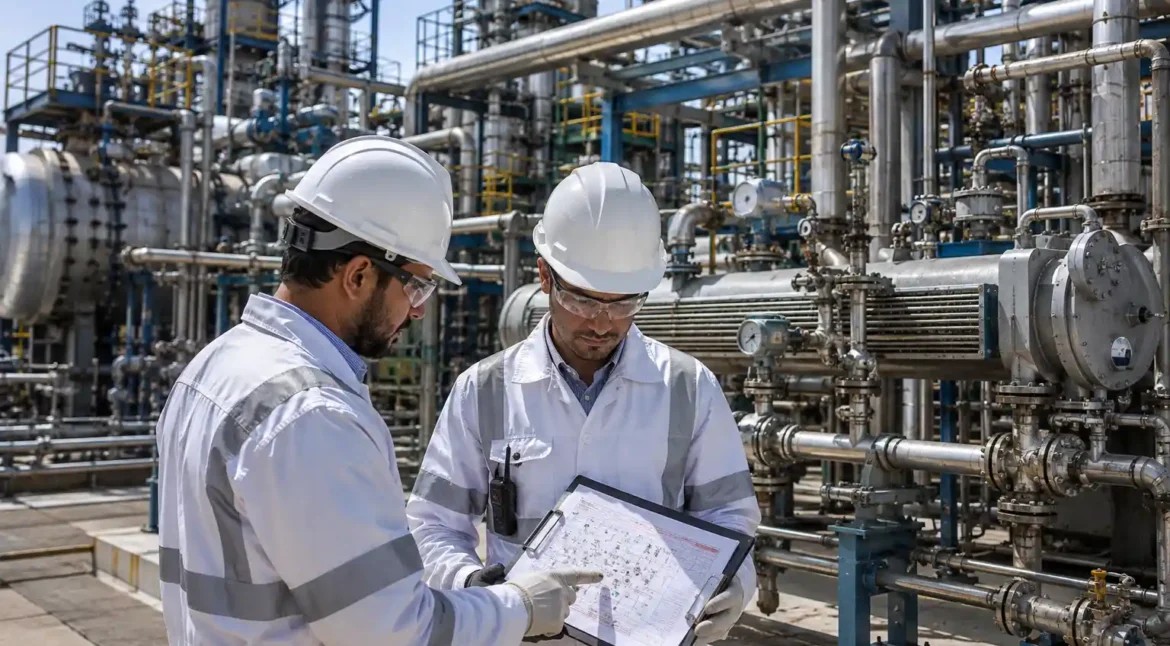
Chemical reaction hazards are among the most significant contributors to major process safety incidents across the chemical, petrochemical, pharmaceutical, and manufacturing industries. Uncontrolled or unexpected chemical reactions can generate excessive heat, pressure, flammable vapours, toxic gases, or explosive conditions, leading to equipment damage, production losses, environmental releases, and serious harm to personnel.
At INDSAFE, we provide comprehensive Chemical Reaction Hazard Assessment Services to help organizations identify reactive chemical hazards, evaluate potential consequences, verify existing safeguards, and implement practical risk reduction measures. Our assessments support safer process design, regulatory compliance, and reliable plant operations throughout the facility lifecycle.
What is a Chemical Reaction Hazard Assessment?
A Chemical Reaction Hazard Assessment (CRHA) is a systematic engineering study that evaluates the potential hazards associated with chemical reactions occurring during manufacturing, storage, transportation, or handling of hazardous substances.
The assessment examines how process conditions, reaction kinetics, chemical incompatibilities, operating deviations, contamination, equipment failures, or human errors may initiate hazardous reactions capable of causing:
- Fire and explosion
- Thermal runaway
- Toxic or flammable gas release
- Rapid pressure generation
- Vessel or pipeline overpressure
- Chemical decomposition
- Equipment damage
- Environmental impact
- Process interruptions and production losses
By understanding these hazards before they occur, organizations can implement engineering and administrative controls that significantly reduce operational risk.
Common Chemical Reaction Hazards
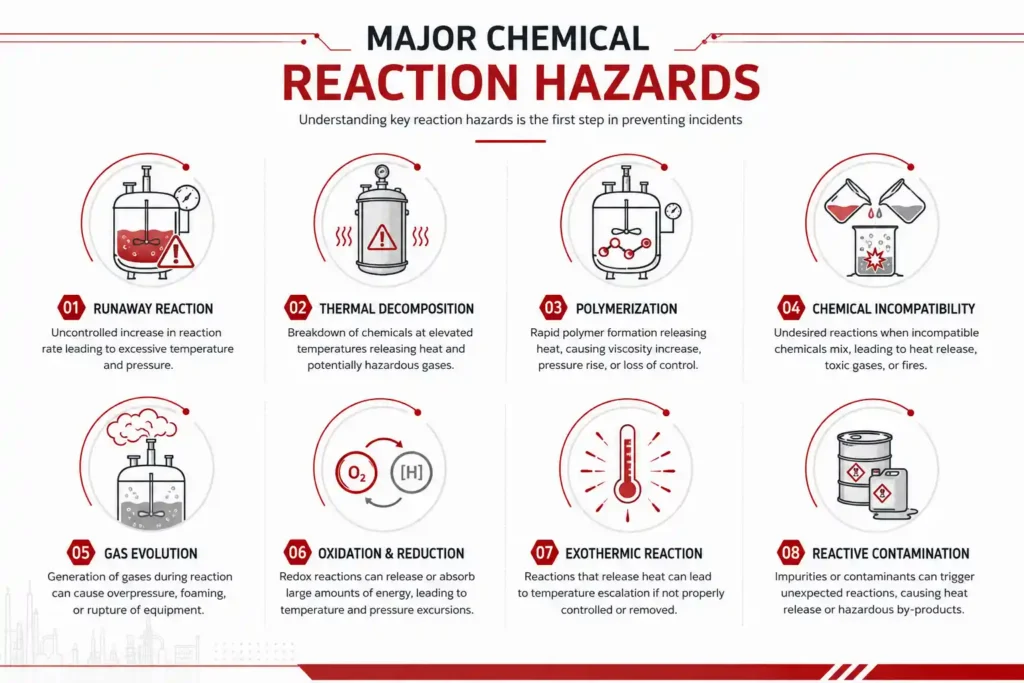
Every chemical process behaves differently. Our assessments evaluate a wide range of reaction hazards, including:
Runaway Reactions
Uncontrolled heat generation accelerates reaction rates, resulting in rapidly increasing temperatures and pressures that may exceed equipment design limits.
Exothermic & Endothermic Reactions
Assessment of heat generation or heat absorption during chemical reactions to ensure process stability under both normal and abnormal operating conditions.
Thermal Decomposition
Evaluation of chemicals that may decompose at elevated temperatures, producing hazardous decomposition products, excessive pressure, or flammable atmospheres.
Polymerization Hazards
Identification of uncontrolled polymerization resulting from inhibitor depletion, contamination, temperature excursions, or process deviations.
Chemical Incompatibility
Assessment of incompatible chemical interactions that may generate violent reactions, toxic gases, fires, or explosions during storage, transfer, or processing.
Oxidation & Reduction Reactions
Evaluation of highly reactive oxidizers and reducing agents that may significantly increase fire or explosion potential.
Gas-Evolving Reactions
Analysis of reactions capable of producing large quantities of gas, leading to pressure build-up, vessel rupture, or emergency relief system activation.
Reactive Contamination
Assessment of unintended contaminants that may initiate hazardous reactions or destabilize otherwise controlled processes.
Industries We Support
Our Chemical Reaction Hazard Assessment services support organizations across a wide range of industries, including:
- Chemical Manufacturing
- Petrochemical Facilities
- Oil & Gas
- Pharmaceutical Manufacturing
- Specialty Chemicals
- Paints & Coatings
- Fertilizer Plants
- Battery Manufacturing
- Food & Beverage Processing
- Hydrogen & Alternative Energy
- Research & Pilot Plants
- Fine Chemicals & Agrochemicals
Our Chemical Reaction Hazard Assessment Methodology
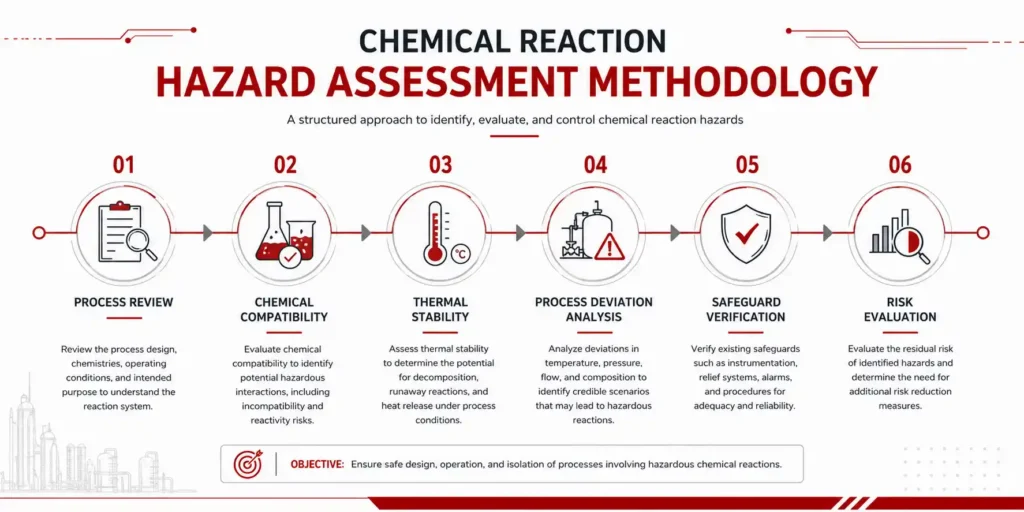
Our approach combines process safety engineering principles with practical industrial experience to identify credible reaction hazards and recommend effective safeguards.
Our assessment typically includes:
Process & Reaction Chemistry Review
Understanding process chemistry, reaction pathways, operating conditions, and material properties.
Chemical Compatibility Evaluation
Identification of incompatible materials that could result in hazardous reactions during storage, transfer, maintenance, or process operations.
Thermal Stability Assessment
Evaluation of decomposition temperatures, reaction energetics, heat generation, cooling requirements, and thermal runaway potential.
Process Deviation Analysis
Assessment of abnormal operating conditions such as:
- Loss of cooling
- Loss of agitation
- Incorrect dosing
- Utility failures
- Instrument malfunction
- Human error
- Contamination events
- Temperature or pressure excursions
Safeguard Verification
Review of existing engineering and administrative controls, including:
- Instrumented protection systems
- Pressure relief systems
- Emergency shutdown systems
- Interlocks
- Operating procedures
- Alarm management
- Process monitoring
Risk Evaluation & Recommendations
Development of practical recommendations based on the hierarchy of controls, including inherently safer design principles, engineering improvements, procedural enhancements, and additional layers of protection where required.
Integration with Process Safety Studies
Chemical Reaction Hazard Assessments are most effective when integrated into a broader Process Safety Management (PSM) framework. Depending on project requirements, our specialists can combine CRHA with:
- Process Hazard Analysis (PHA)
- HAZOP Studies
- Layers of Protection Analysis (LOPA)
- Quantitative Risk Assessment (QRA)
- Hazardous Area Classification (HAC)
- Dust Explosion Hazard Assessment (DHA)
- Process Safety Management (PSM) Implementation
This integrated approach provides a more comprehensive understanding of process risks while supporting informed engineering and operational decisions.
Applicable Standards & Engineering Practices
Our assessments are performed using recognized process safety engineering principles and, where applicable, align with internationally accepted guidance, including:
- CCPS (Center for Chemical Process Safety) guidance on reactive chemical hazards and process safety
- AIChE process safety methodologies
- OSHA Process Safety Management (29 CFR 1910.119)
- Applicable API recommended practices
- Relevant NFPA guidance
- Industry-specific engineering standards and client requirements
The scope and methodology of each assessment are tailored to the specific process, reaction chemistry, and regulatory obligations of the facility
WHY CHOOSE INDSAFE?
Organizations choose INDSAFE because we combine technical expertise with practical engineering solutions that improve safety without compromising operational performance.
Our team delivers:
- Experienced process safety engineering expertise
- Risk-based and practical recommendations
- Compliance-focused assessments aligned with international good practices
- Integration with existing process safety studies
- Support for both greenfield and brownfield facilities
- Engineering solutions designed to enhance process reliability and reduce operational risk
Frequently Asked Questions
What is a Chemical Reaction Hazard Assessment?
A Chemical Reaction Hazard Assessment is a structured engineering study that identifies and evaluates hazards arising from chemical reactions, including runaway reactions, decomposition, incompatibility, and pressure-generating events.
When should a Chemical Reaction Hazard Assessment be performed?
It is recommended during new process design, process modifications (Management of Change), introduction of new chemicals, scale-up activities, incident investigations, and periodic process safety reviews.
Which industries require Chemical Reaction Hazard Assessments?
Industries handling reactive or hazardous chemicals such as chemical manufacturing, petrochemicals, pharmaceuticals, oil & gas, specialty chemicals, fertilizers, and battery manufacturing can benefit from these assessments.
How does a Chemical Reaction Hazard Assessment differ from a HAZOP?
A HAZOP evaluates process deviations across the entire process, while a Chemical Reaction Hazard Assessment focuses specifically on hazards associated with the chemistry of reactions, including reaction kinetics, thermal stability, incompatibility, and runaway reaction potential. The two studies are often complementary.
Ready to Assess Your Reactive Chemical Risks?
Connect with Indsafe for expert MSIHC Audit & Compliance Services in India and ensure your organization meets statutory obligations while strengthening process safety performance and protection against major accident hazards.