

Let us understand how we can help you

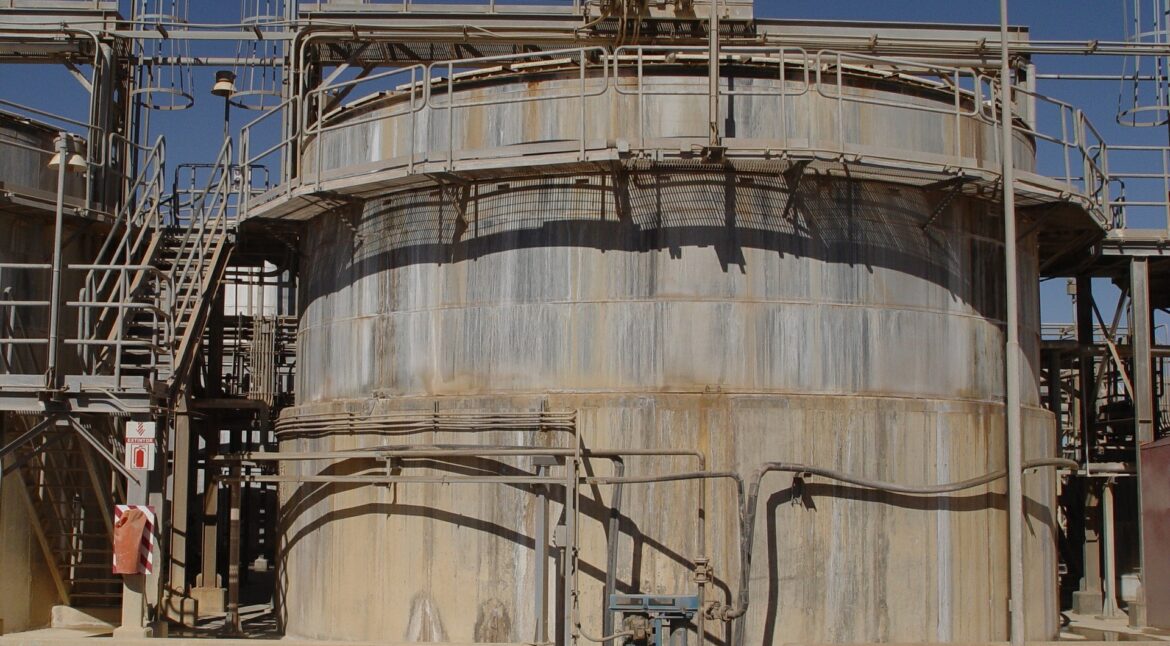
INDSAFE provides Quantitative Risk Assessment (QRA) services to systematically evaluate major accident hazards, model potential consequences, estimate event frequencies, and characterize risk for industrial facilities and operations.
QRA combines hazard identification, frequency analysis and consequence modelling to provide a quantitative understanding of risk. The results can support risk-based decision-making, facility design, emergency planning, risk reduction measures and other process safety activities.
QRA can be applied to new projects, existing facilities, plant modifications and other situations where quantitative risk information is required, depending on the objectives and scope of the assessment.
What is Quantitative Risk Assessment (QRA)?
Quantitative Risk Assessment (QRA) is a systematic process used to estimate the risk associated with defined hazardous scenarios by combining the likelihood or frequency of events with the potential consequences of those events.
For major accident hazards, QRA may consider scenarios such as:
- Flammable material releases
- Toxic material releases
- Pool fires
- Jet fires
- Vapour cloud explosions
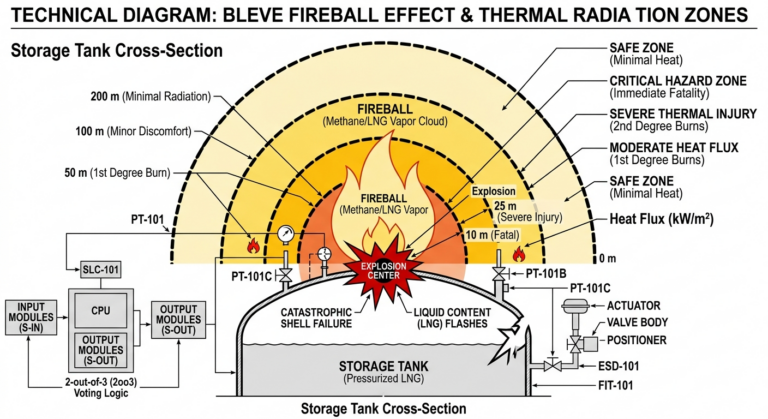
- Fireballs/BLEVE scenarios
- Unignited gas or vapour dispersion
- Other credible major accident scenarios relevant to the facility
Depending on the study scope, consequence modelling can estimate effects such as thermal radiation, explosion overpressure and toxic exposure.
The resulting information can then be used to characterize measures such as individual risk and societal risk, where applicable.
Objectives of QRA Study
The objectives of a QRA depend on the facility and assessment scope, but commonly include:
- Identifying and evaluating major accident scenarios
- Estimating the frequency or likelihood of relevant hazardous events
- Quantifying potential consequences of selected scenarios
- Characterizing individual and/or societal risk where applicable
- Identifying major contributors to overall risk
- Supporting risk-reduction decisions
- Supporting facility layout and siting decisions
- Supporting emergency planning and preparedness
- Providing quantitative input for engineering and process-safety decisions
- Supporting applicable regulatory or project requirements
QRA is therefore not simply a calculation of consequence distances. It brings together scenario development, frequency estimation, consequence modelling and risk evaluation.
Our QRA Methodology
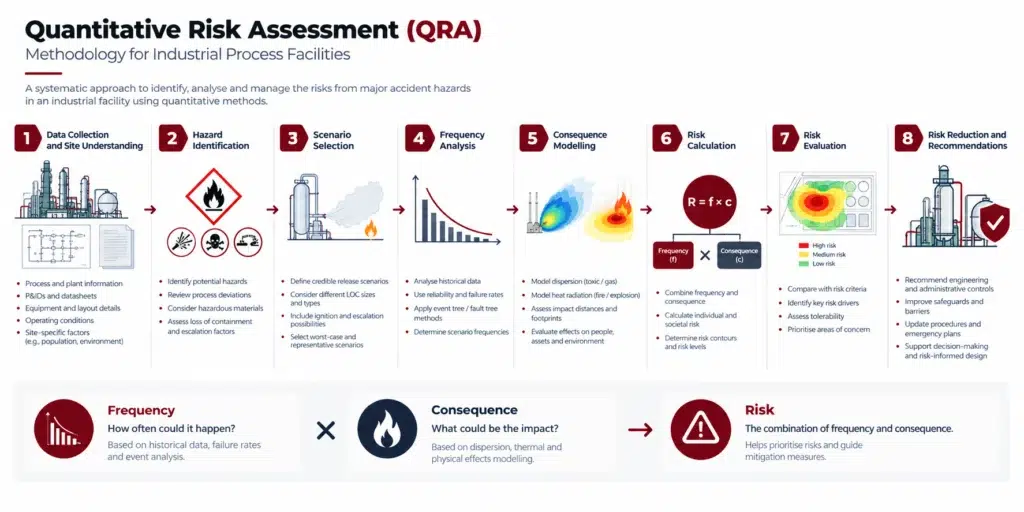
A QRA methodology is developed according to the facility, hazardous materials, study objectives, available data and applicable requirements.
A typical assessment may include the following stages:
Data Collection → Hazard Identification → Scenario Selection → Frequency Analysis → Consequence Modelling → Risk Calculation → Risk Evaluation → Recommendations
The exact methodology and level of detail may vary from one assessment to another.
Step 1: Data Collection and Site Understanding
The first stage is to establish a clear understanding of the facility, process, inventories, equipment and surrounding environment.
Depending on the study scope, inputs may include:
- Site layout
- Process Flow Diagrams (PFDs)
- Piping and Instrumentation Diagrams (P&IDs)
- Process conditions
- Equipment information
- Material inventories
- Storage capacities
- Operating conditions
- Pipeline and transfer information
- Relief-system information
- Meteorological data
- Population or occupancy information
- Surrounding land use
- Building and enclosure information
- Emergency response information
- Existing safety and mitigation systems
For existing facilities, a site visit may also be conducted where required to understand actual site conditions and verify relevant information.
The quality and completeness of input data can have a significant effect on the assessment results.
Step 2: Hazard Identification and Scenario Selection
Potential hazardous events are identified based on the process, materials, equipment, operating conditions and study objectives.
Existing studies such as HAZOP, HAZID, What-If analysis or other process hazard assessments may provide important inputs for scenario identification.
However, QRA scenario development should be based on the objectives and boundaries of the QRA rather than assuming that every HAZOP finding automatically becomes a QRA scenario.
Typical major accident scenarios may include:
- Loss of containment from process equipment
- Pipeline or piping failure
- Flange or connection leakage
- Storage tank release
- Vessel release
- Loading/unloading incidents
- Transfer-line failures
- Toxic releases
- Flammable gas or liquid releases
- Other credible scenarios relevant to the facility
The selected scenarios are then developed for further frequency and consequence analysis.
Step 3: Frequency and Likelihood Analysis
The frequency of relevant hazardous events is estimated using appropriate failure-frequency data, initiating-event frequencies, release-frequency information, historical data, engineering models and/or recognised industry sources, depending on the methodology.
The analysis may consider:
- Equipment failure
- Pipe and pipeline failure
- Valve and flange leakage
- Vessel or tank failure
- Human or operational factors where relevant
- Ignition probabilities
- Other scenario-specific event probabilities
The selected data sources and assumptions should be documented because uncertainty in frequency data can influence the resulting risk estimates.
QRA results should therefore be interpreted in the context of the assumptions, data quality and modelling methodology used in the assessment.
Step 4: Consequence Analysis
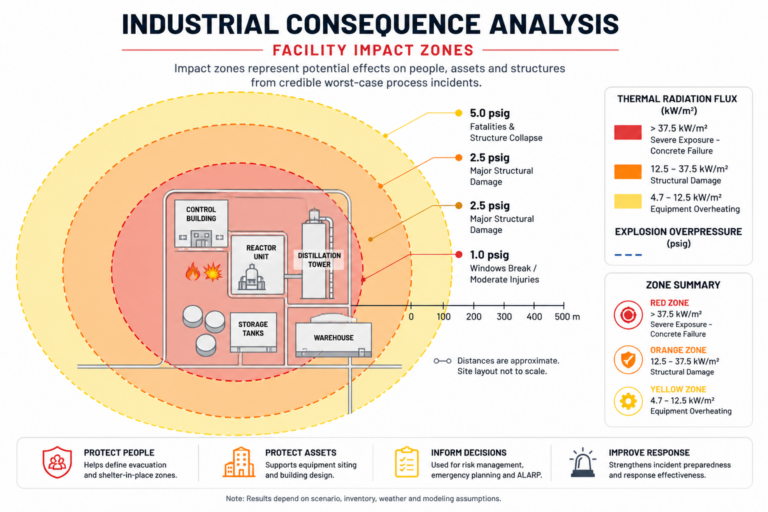
For selected scenarios, consequence modelling is used to estimate the physical effects of potential releases and hazardous events.
Depending on the scenario, consequence analysis may include:
Dispersion Modelling
Estimation of the movement and concentration of released gases, vapours or toxic substances under defined atmospheric and release conditions.
Thermal Radiation
Assessment of thermal radiation effects from scenarios such as:
- Pool fires
- Jet fires
- Fireballs/BLEVE scenarios
Explosion Modelling
Assessment of potential explosion effects and overpressure for applicable vapour cloud or other explosion scenarios.
Toxic Exposure
Assessment of toxic concentration and exposure distances for relevant hazardous releases.
Software such as DNV PHAST may be used for consequence modelling where appropriate to the study scope and methodology.
For enclosed or indoor facilities, additional considerations such as ventilation and HVAC air-change characteristics may be relevant to the modelling.
Step 5: Risk Calculation
Once scenario frequencies and consequence results have been developed, they are combined to characterize risk.
Depending on the assessment objectives, QRA may evaluate:
Individual Risk
Individual risk represents the risk to a hypothetical individual at a particular location, based on the defined hazardous scenarios and exposure assumptions.
Results may be presented as risk contours showing how estimated risk varies across the site and surrounding area.
Societal Risk
Societal risk considers the relationship between the frequency of accidents and the number of people potentially affected.
It may be represented using an F-N curve, which describes the frequency of accidents involving different numbers of fatalities or affected people, depending on the methodology and study scope.
The appropriate risk metrics depend on the purpose and requirements of the assessment.
Step 6: Risk Evaluation
The QRA results are reviewed to understand:
- Major contributors to overall risk
- Dominant accident scenarios
- High-risk locations
- Areas affected by thermal radiation
- Areas affected by explosion overpressure
- Toxic exposure zones
- Population or occupancy exposure
- Potential risk-reduction opportunities
Where defined risk criteria or acceptance criteria are applicable, the calculated results can be compared with those criteria.
The interpretation should clearly distinguish between calculated results, modelling assumptions and the criteria used for decision-making.
Step 7: Recommendations and Risk Reduction
Based on the QRA findings, practical risk-reduction measures may be identified.
Depending on the scenarios and facility, recommendations may address:
- Process design
- Equipment selection
- Inventory reduction
- Isolation systems
- Detection systems
- Emergency shutdown systems
- Fire and gas detection
- Passive or active fire protection
- Layout and separation distances
- Ventilation
- Emergency response
- Operating procedures
- Inspection and maintenance
- Emergency planning
- Other engineering or administrative controls
The recommendations should be proportionate to the identified scenarios and aligned with the objectives of the assessment.
Typical QRA Scenarios
Depending on the facility and materials involved, QRA may evaluate scenarios such as:
Pool Fire
A flammable liquid release forms a pool and subsequently ignites, producing thermal radiation.
Jet Fire
A pressurized flammable release ignites and produces a directional flame and associated thermal radiation.
Vapour Cloud Explosion
A flammable vapour cloud forms following a release and subsequently ignites under conditions capable of producing explosion effects.
Fireball / BLEVE
Certain pressurized or liquefied flammable inventories can produce fireball scenarios under specific failure conditions.
Unignited Gas Dispersion
A released gas or vapour disperses without immediate ignition. The resulting concentration field can be evaluated against relevant concentration criteria.
Toxic Release
A hazardous or toxic material is released and dispersion is modelled to estimate concentrations and potential exposure zones.
Not every scenario is applicable to every facility. Scenario selection should reflect the actual process, materials, equipment and assessment objectives.
QRA Outputs and Deliverables
Depending on the agreed scope, a QRA study may provide:
- Hazard and scenario register
- Release scenario definition
- Frequency/failure data and assumptions
- Consequence modelling results
- Thermal radiation contours
- Overpressure contours
- Toxic dispersion contours
- Risk contours
- Individual risk results
- Societal risk / F-N analysis where applicable
- Major risk contributors
- Risk evaluation
- Risk-reduction recommendations
- QRA report
- Supporting modelling files or calculations where included in the agreed scope
The final deliverables depend on the project requirements and assessment methodology.
Where QRA is Used
QRA can support a range of engineering and process-safety decisions, including:
Facility Layout and Siting
Risk contours and consequence zones can provide quantitative information for evaluating equipment locations, occupied buildings and surrounding areas.
Emergency Planning
Consequence and risk information can support emergency response planning and identification of areas potentially affected by major accident scenarios.
Risk Reduction
QRA can help identify scenarios that contribute significantly to overall risk and support evaluation of potential mitigation measures.
Project Development
QRA can provide quantitative risk information during the development or modification of industrial facilities.
Existing Facility Assessment
For operating facilities, QRA can support review of existing risk profiles and potential risk-reduction opportunities.
Regulatory and Project Requirements
Where applicable, QRA can provide quantitative information required by project specifications, regulatory frameworks or other defined assessment criteria.
QRA and Other Process Safety Studies
QRA is part of a broader process safety and risk-assessment framework. It is not a replacement for every other hazard-analysis technique.
QRA and HAZOP
HAZOP systematically examines process deviations from design intent and identifies causes, consequences and safeguards.
QRA quantitatively evaluates selected hazardous scenarios using frequency and consequence analysis.
HAZOP findings may therefore provide useful inputs to QRA, but not every HAZOP deviation necessarily needs to become a QRA scenario.
[Explore HAZOP Study Services → Click Here]
QRA and HAZID
HAZID provides broader hazard identification at the project, facility, system or activity level.
It can help identify scenarios that may subsequently require more detailed analysis.
[Read more about HAZID → Click Here]
QRA and LOPA
LOPA is a semi-quantitative method used to evaluate selected hazardous scenarios and the effectiveness and independence of protection layers.
QRA and LOPA address risk using different approaches and levels of quantification.
QRA and SIL Assessment
SIL assessment addresses the required performance of safety instrumented functions for specific hazardous scenarios.
QRA results may provide useful information for broader risk assessment, while SIL determination requires a suitable functional-safety methodology and scenario-specific analysis.
[Explore Functional Safety & SIL Studies → Click Here]
These studies are therefore complementary rather than interchangeable, and the appropriate combination depends on the facility, hazards and assessment objectives.
Industries We Serve
QRA can be applied across a wide range of process and industrial facilities, subject to the characteristics and requirements of the project.
INDSAFE provides QRA services for applications including:
- Oil & Gas
- Chemicals and Petrochemicals
- Pharmaceuticals
- Manufacturing
- Food & Beverage
- FMCG
- Power and Energy
- Other process and industrial facilities
The scope of the assessment is adapted to the process, hazardous materials, facility configuration and objectives of the study.
Why Choose Indsafe for QRA?
INDSAFE approaches QRA as an engineering and process-safety assessment rather than simply a software-based modelling exercise.
Our QRA methodology focuses on:
- Understanding the facility and process
- Identifying credible major accident scenarios
- Selecting appropriate modelling assumptions
- Applying suitable frequency and consequence data
- Quantifying relevant risk measures
- Identifying dominant risk contributors
- Developing practical risk-reduction recommendations
Where appropriate, specialised consequence-modelling software such as DNV PHAST may be used as part of the technical assessment.
The specific tools, data sources, modelling assumptions and methodology are selected according to the requirements and scope of each project.
Common QRA Challenges
A meaningful QRA depends on more than running consequence models.
Poor Input Data
Incomplete process information, inventories, equipment data or meteorological information can affect the quality of the assessment.
Inappropriate Scenario Selection
Including every conceivable event or excluding relevant major accident scenarios can distort the purpose of the assessment.
Unclear Frequency Data
Failure frequencies and probability assumptions need to be selected carefully and documented.
Over-Reliance on Software
Software can perform complex calculations, but the quality of a QRA also depends on scenario definition, engineering judgement, data selection and interpretation.
Ignoring Uncertainty
QRA results contain uncertainty associated with frequency data, assumptions, models and input information. These limitations should be recognised when interpreting the results.
Treating QRA as a One-Number Answer
Risk is often better understood through scenario-specific results, risk contours, F-N relationships and identification of dominant contributors rather than a single headline value.
Frequently Asked Questions About QRA
What is QRA?
QRA stands for Quantitative Risk Assessment. It is a systematic approach for estimating risk by combining the likelihood or frequency of hazardous events with the consequences associated with those events.
What is the difference between QRA and HAZOP?
HAZOP is a structured qualitative hazard and operability study that examines deviations from design intent. QRA uses quantitative frequency and consequence analysis to characterize risk for selected scenarios.
Does QRA always require a HAZOP?
No. HAZOP can provide valuable input for scenario identification, but whether a HAZOP is required depends on the facility, project stage, hazards and objectives of the QRA.
What is individual risk in QRA?
Individual risk represents the estimated risk to an individual at a particular location under defined assumptions. It is commonly represented using risk contours.
What is societal risk?
Societal risk considers the frequency of accidents in relation to the number of people potentially affected. An F-N curve is one common way of representing societal risk.
What software is used for QRA?
Consequence modelling and QRA may involve specialised software such as DNV PHAST, depending on the study methodology and requirements. Software selection should follow the assessment objectives rather than being treated as the defining feature of QRA.
What information is required for QRA?
Typical inputs include process and equipment information, PFDs, P&IDs, inventories, operating conditions, site layout, meteorological information, population/occupancy information and relevant safety-system data.
What scenarios are considered in QRA?
Depending on the facility, scenarios may include pool fires, jet fires, vapour cloud explosions, fireballs/BLEVEs, unignited dispersion and toxic releases, as well as other credible major accident scenarios.
What are the outputs of a QRA?
Typical outputs include scenario frequencies, consequence distances, thermal radiation and overpressure results, dispersion results, risk contours, societal-risk analysis where applicable, identification of major risk contributors and risk-reduction recommendations.
Can QRA be performed for an existing plant?
Yes. QRA can be applied to both new and existing facilities, provided the assessment has appropriate information about the actual facility, operations, inventories, surrounding population and other relevant conditions.
When should a QRA be conducted?
QRA may be appropriate during project development, facility siting and layout decisions, major modifications, existing-facility risk assessment, emergency planning or other situations where quantitative risk information is required.
Technical References
The specific references and methodologies used for a QRA should be selected according to the facility, jurisdiction, industry and study objectives.
Relevant technical sources may include:
- Recognised process-safety and risk-assessment guidance
- Applicable industry standards and regulatory requirements
- Established consequence-modelling methodologies
- Appropriate equipment failure and incident-frequency data sources
- Project-specific risk criteria and acceptance criteria where applicable
The selected data sources, assumptions, models and criteria should be documented within the QRA methodology and final report.
Discuss Your QRA Requirements with INDSAFE
Whether you are developing a new industrial facility, evaluating an existing plant, assessing a modification, or reviewing major accident risk, a properly scoped QRA can provide quantitative information to support engineering and process-safety decisions.
Contact INDSAFE to discuss your QRA requirements, facility details and the appropriate risk-assessment methodology for your project.