

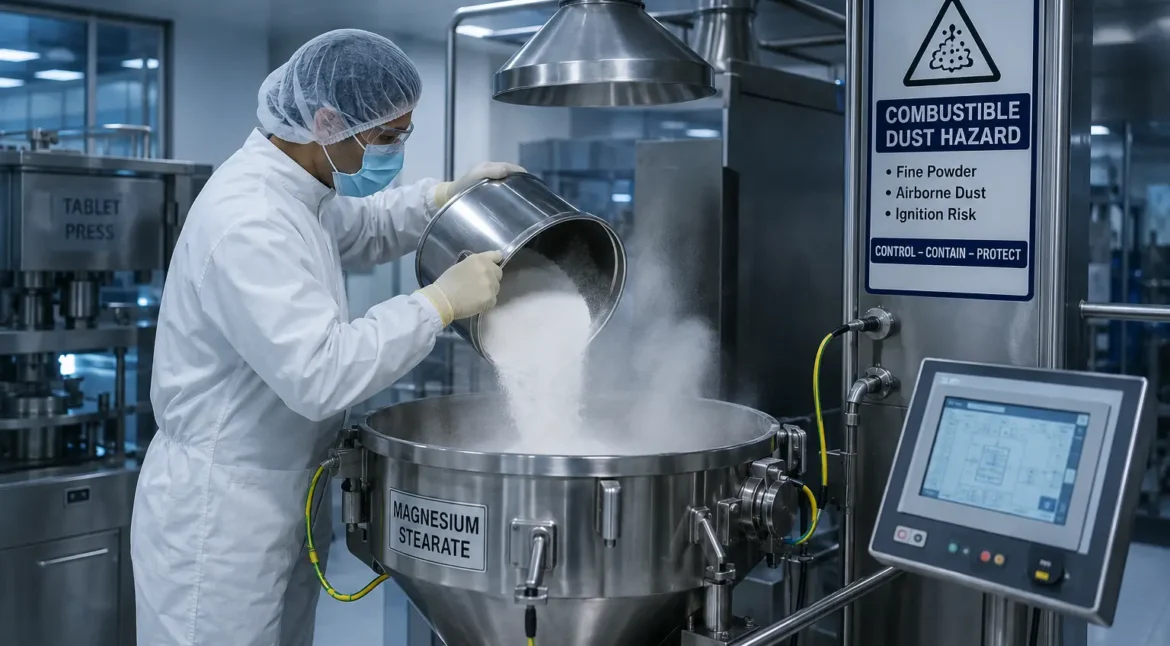
Magnesium Stearate Dust Explosion is a topic that receives far less attention than it deserves in pharmaceutical manufacturing. Magnesium Stearate is one of the most widely used excipients, commonly added as a lubricant during tablet compression and capsule production to reduce friction, improve powder flow, and prevent materials from sticking to punches and dies.
Because it is used in relatively small quantities, Magnesium Stearate is often regarded as a routine processing material rather than a significant safety concern. However, this perception can lead to one of the most overlooked hazards in pharmaceutical facilities—combustible dust explosions.
Like many fine organic powders, Magnesium Stearate can become hazardous when dispersed into the air under the right conditions. During routine operations such as bag dumping, powder transfer, vibro sifting, blending, and tablet compression, fine airborne particles may form an explosive dust cloud. If that cloud encounters an ignition source, even a relatively small static discharge can be sufficient to initiate a dust explosion.
Several industries have learned that combustible dust incidents rarely occur because a material is “highly dangerous” in normal storage. They occur because ordinary powders are handled in ways that create the conditions necessary for an explosion.
Understanding these conditions is an essential part of Process Safety Management (PSM) and combustible dust risk reduction. Facilities handling pharmaceutical powders should evaluate not only the chemical properties of materials but also how those materials behave during processing, storage, conveying, and housekeeping activities.
If your facility handles combustible powders, our article on Dust Explosion Safety provides a broader understanding of combustible dust hazards and preventive strategies before exploring this specific material.
Quick Answer
Can Magnesium Stearate Dust Explosion Occur?
Yes.
Although Magnesium Stearate is widely used as a pharmaceutical lubricant, it is also a combustible organic powder. When fine particles become suspended in air, they can form an explosive dust cloud capable of igniting in the presence of an ignition source.
The likelihood of an explosion depends on several factors, including:
- Particle size
- Dust concentration
- Oxygen availability
- Ignition energy
- Degree of confinement
The material itself is not inherently dangerous while resting inside a sealed container. The hazard develops during processing operations where dust becomes airborne.
This is why pharmaceutical facilities handling Magnesium Stearate should incorporate combustible dust risk assessment, housekeeping, ignition source control, and engineering safeguards into their overall safety management systems.
What is Magnesium Stearate?
Magnesium Stearate is the magnesium salt of stearic acid and is one of the most commonly used pharmaceutical excipients worldwide.
Its primary purpose is to act as a lubricant during tablet and capsule manufacturing by reducing friction between powders and production equipment. This improves manufacturing efficiency, prevents sticking, and helps achieve consistent tablet quality.
Although it is generally considered chemically stable, its physical characteristics introduce an entirely different type of risk.
Magnesium Stearate is an extremely fine powder, with a typical median particle size ranging between 3 and 10 micrometres (μm).
To understand how small these particles are:
| Material | Typical Particle Size |
| Magnesium Stearate | 3–10 μm |
| Human Hair | 50–100 μm |
| Fine Sand | ~90 μm |
Particles this small remain suspended in air much longer than coarse powders. During handling operations, they can quickly disperse and form airborne dust clouds capable of supporting combustion under suitable conditions.
This behaviour is common among many pharmaceutical ingredients and excipients, which is why combustible dust hazards are increasingly recognised across pharmaceutical manufacturing worldwide.
Why Fine Powders Present a Greater Explosion Risk
One of the most important factors influencing combustible dust behaviour is particle size.
As particles become smaller, their total surface area increases dramatically. More exposed surface means oxygen can react with the material much more rapidly once ignition occurs.
Imagine the difference between burning a solid wooden block and sawdust. Both are made from the same material, yet sawdust ignites much more readily because thousands of tiny particles expose significantly more surface to oxygen.
Magnesium Stearate behaves in a similar manner.
Its extremely fine particle size allows it to:
- disperse rapidly into surrounding air,
- remain airborne for longer periods,
- mix efficiently with oxygen,
- ignite more easily when exposed to sufficient ignition energy,
- generate faster flame propagation than larger particles.
During pharmaceutical production, this behaviour is most noticeable whenever powders are poured, transferred, blended, sieved, or pneumatically conveyed.
The hazard is therefore not simply the presence of Magnesium Stearate—it is how the material is handled.
For facilities processing combustible powders alongside flammable vapours or gases, a comprehensive Hazardous Area Classification (HAC) study can help identify locations where ignition risks require additional engineering controls and suitable Ex-certified equipment.
Why Magnesium Stearate Becomes Hazardous During Manufacturing
In pharmaceutical production, Magnesium Stearate is rarely handled in isolation.
It moves through multiple process steps involving mechanical handling, equipment movement, airflow, and operator interaction.
Examples include:
- Bag emptying stations
- Intermediate bulk container (IBC) charging
- Vibro sifters
- Ribbon blenders
- Bin blenders
- Tablet press feed hoppers
- Powder transfer systems
- Dust extraction systems
Each of these operations can generate airborne dust if suitable containment and extraction measures are not implemented.
When fine particles become suspended in air, the situation changes completely.
Instead of resting safely inside a container, the material becomes part of an explosive atmosphere that may be ignited by a surprisingly small ignition source.
This is why pharmaceutical manufacturers invest in:
- Local exhaust ventilation
- Dust collection systems
- Grounding and bonding
- Static electricity control
- Equipment maintenance
- Housekeeping programmes
- Dust Hazard Analysis (DHA)
These controls work together to prevent the conditions necessary for a combustible dust explosion.
How Does a Magnesium Stearate Dust Explosion Occur?
A dust explosion does not occur simply because combustible dust is present.
For an explosion to happen, five conditions must exist simultaneously. These conditions are commonly illustrated using the Dust Explosion Pentagon, one of the most fundamental concepts in combustible dust safety.
Unlike the traditional fire triangle, which requires only fuel, oxygen, and heat, dust explosions require two additional elements—dust dispersion and confinement.
If even one element is removed, the explosion cannot occur.
The Dust Explosion Pentagon consists of:
1. Combustible Dust
Magnesium Stearate is an organic combustible powder capable of supporting rapid combustion when dispersed into air.
Its fine particle size significantly increases its explosion potential compared with larger granular materials.
2. Oxygen
Atmospheric air naturally supplies the oxygen required to sustain combustion.
Since pharmaceutical processing occurs under normal atmospheric conditions, oxygen is generally always present.
3. Dust Dispersion
Dust resting on equipment surfaces usually presents a lower immediate explosion risk than dust suspended in air.
During routine operations such as powder transfer, blending, bag dumping, or vibro sifting, Magnesium Stearate particles can become dispersed, creating an explosive dust cloud.
4. Confinement
An explosion becomes significantly more destructive when it occurs inside enclosed equipment.
Examples include:
- Blenders
- Dust collectors
- Conveying systems
- Silos
- Process vessels
- Tablet press feed systems
Confinement allows pressure to build rapidly, increasing the severity of the explosion.
5. Ignition Source
Once the previous four conditions exist, only a suitable ignition source is needed.
Even relatively low-energy ignition sources may initiate combustion under favourable conditions.
Common Ignition Sources in Pharmaceutical Facilities
One of the biggest misconceptions surrounding combustible dust incidents is that ignition requires a large flame.
In reality, many dust explosions begin with everyday industrial ignition sources that often go unnoticed.
Common examples include:
Static Electricity
Static charge generated during powder transfer, pneumatic conveying, bag handling, or operator movement can discharge suddenly and ignite combustible dust.
This is why proper Grounding and Bonding practices are considered essential for powder handling operations. Our article on Grounding in Powder Handling Operations explains how electrostatic charge develops and how effective earthing helps reduce ignition risk.
Mechanical Sparks
Metal-to-metal contact caused by damaged equipment, foreign objects, or poorly maintained machinery may produce sparks capable of igniting dust clouds.
Electrical Equipment
Faulty motors, switchgear, damaged wiring, overloaded circuits, or short circuits may become ignition sources if equipment is not suitable for the operating environment.
Where combustible dust or flammable atmospheres are present, selecting appropriate explosion-protected equipment is equally important. Learn more in our guide explaining ATEX vs Flameproof: Understanding the Difference.
Hot Surfaces
Bearings, motors, heaters, dryers, and mechanical equipment may develop elevated surface temperatures capable of igniting combustible dust.
Routine inspection and preventive maintenance help minimise this risk.
Open Flames
Although pharmaceutical facilities generally prohibit smoking and open flames, maintenance activities such as welding or cutting require careful permit controls to prevent ignition.
High-Risk Operations Involving Magnesium Stearate
Not every manufacturing activity presents the same level of risk.
Certain operations are particularly susceptible to dust cloud formation because they disturb or transfer fine powders.
These include:
Bag Dumping
Opening and emptying bags can release significant quantities of airborne dust, particularly when performed without local exhaust ventilation.
Powder Transfer
Whether manual or pneumatic, powder transfer can disperse fine particles into surrounding air.
Vibro Sifting
Sifting separates agglomerated particles and generates additional airborne dust due to vibration and material movement.
Blending and Mixing
Ribbon blenders, V-blenders, and bin blenders continuously agitate powders, increasing dispersion inside processing equipment.
Tablet Compression Feeding
Powder movement into tablet presses may release dust near feed hoppers and transfer points if containment is inadequate.
Dust Collection Systems
Dust collectors deserve particular attention.
While they remove airborne dust from production areas, they also concentrate combustible dust inside confined equipment.
Without appropriate explosion protection measures such as explosion venting, isolation, or suppression, dust collectors themselves can become locations where secondary explosions originate.
Preventing a Magnesium Stearate Dust Explosion in Pharmaceutical Manufacturing
While Magnesium Stearate can present a combustible dust hazard under certain conditions, the good news is that the risk can be effectively managed through a combination of engineering controls, safe operating practices, and ongoing risk assessment.
Rather than relying on a single safety measure, pharmaceutical facilities should adopt a layered approach that prevents dust cloud formation, eliminates ignition sources, and minimises the consequences should an incident occur.
1. Conduct a Dust Hazard Analysis (DHA)
Every facility handling combustible powders should begin by understanding where dust explosion hazards exist.
A Dust Hazard Analysis (DHA) systematically identifies operations where combustible dust may accumulate, become airborne, or encounter potential ignition sources. It also evaluates whether existing safeguards are adequate and recommends additional controls where necessary.
A DHA typically examines:
- Materials handled and their explosibility characteristics
- Powder handling processes
- Dust generation points
- Potential ignition sources
- Existing engineering controls
- Housekeeping practices
- Emergency response arrangements
Understanding where the hazards exist is the first step toward preventing a dust explosion.
2. Control Dust at the Source
Dust clouds cannot explode if they are prevented from forming.
The most effective strategy is to minimise airborne dust during routine operations through:
- Local exhaust ventilation (LEV)
- Enclosed powder transfer systems
- Proper dust extraction units
- Controlled bag dumping stations
- Well-designed transfer equipment
Capturing dust as close as possible to the source not only improves product quality but also significantly reduces explosion risk.
3. Prevent Static Electricity
Electrostatic discharge is one of the most common ignition sources in powder handling operations.
During powder movement, friction between particles, equipment surfaces, flexible hoses, and containers can generate significant static charges.
Facilities should therefore implement appropriate electrostatic control measures, including:
- Proper grounding (earthing) of equipment
- Bonding between conductive components
- Anti-static hoses
- Conductive flooring where appropriate
- Static-dissipative containers
- Operator awareness and training
These controls help safely dissipate accumulated electrical charges before they become an ignition source.
If your facility regularly handles combustible powders, understanding Grounding and Bonding principles is equally important for reducing electrostatic hazards during powder transfer operations.
4. Maintain Good Housekeeping
Housekeeping is often underestimated, yet it remains one of the most effective combustible dust control measures.
Even a thin layer of combustible dust deposited on equipment, beams, lighting fixtures, or cable trays can contribute to a secondary dust explosion if disturbed during an initial event.
Good housekeeping practices include:
- Routine cleaning schedules
- Vacuum systems suitable for combustible dust
- Avoiding compressed air for dust removal
- Prompt removal of powder spillages
- Regular inspection of hidden dust accumulation areas
The objective is to prevent combustible dust from building up over time.
5. Protect Dust Collection Systems
Dust collectors deserve special attention because they intentionally collect combustible dust in confined spaces.
Without adequate protection, they can become the origin of a primary explosion that may propagate into connected process equipment.
Depending on the process and applicable standards, explosion protection measures may include:
- Explosion venting
- Explosion suppression systems
- Explosion isolation devices
- Spark detection systems
- Proper equipment spacing
Selecting appropriate protection measures should always be based on a formal engineering assessment and recognised industry standards.
6. Select Suitable Equipment for Hazardous Areas
Where combustible dust or flammable atmospheres are present, equipment selection becomes a critical part of explosion prevention.
Electrical equipment should be suitable for the hazardous area in which it operates and selected according to the applicable standards and Hazardous Area Classification (HAC) study.
Many organisations mistakenly assume that all explosion-protected equipment provides the same level of protection.
In reality, different protection concepts are designed for different applications.
Our article on ATEX vs Flameproof – Understanding the Difference explains how explosion protection methods vary and why selecting the correct equipment is essential for hazardous environments.
Frequently Asked Questions About Magnesium Stearate Dust Explosion
1. Is Magnesium Stearate classified as a combustible dust?
Yes.
Magnesium Stearate is generally recognised as a combustible organic powder. When dispersed into the air under suitable conditions, it can support combustion and contribute to a dust explosion.
2. Does storing Magnesium Stearate automatically create an explosion hazard?
Not necessarily.
The highest risk occurs during handling and processing activities where fine particles become airborne. Proper storage, housekeeping, and handling practices significantly reduce the likelihood of dust cloud formation.
3. Can static electricity ignite Magnesium Stearate?
Yes.
Fine combustible dust clouds may be ignited by electrostatic discharge if sufficient ignition energy is available. This is why grounding, bonding, and static control measures are essential during powder handling operations.
4. Which pharmaceutical operations present the highest risk?
Common higher-risk activities include:
- Bag dumping
- Powder transfer
- Vibro sifting
- Blending
- Mixing
- Tablet press feeding
- Dust collection
These operations are more likely to generate airborne dust clouds than routine storage.
5. Is Magnesium Stearate the only combustible pharmaceutical powder?
No.
Many pharmaceutical powders and excipients can exhibit combustible dust characteristics depending on particle size, moisture content, and processing conditions.
Every facility should evaluate the explosibility characteristics of the powders it handles rather than assuming they are non-hazardous.
Key Takeaways on Magnesium Stearate Dust Explosion Hazards
- Magnesium Stearate is widely used as a pharmaceutical lubricant but can also present a combustible dust hazard.
- Extremely fine particle size increases its ability to form explosive dust clouds.
- Dust explosions require all five elements of the Dust Explosion Pentagon to be present simultaneously.
- Static electricity, hot surfaces, electrical faults, and mechanical sparks are common ignition sources.
- Operations such as powder transfer, blending, vibro sifting, and bag dumping require particular attention.
- Dust Hazard Analysis (DHA), grounding and bonding, dust extraction, housekeeping, and explosion protection systems are essential components of effective risk management.
- Understanding material behaviour is just as important as understanding chemical composition when managing combustible dust hazards.
Preventing Magnesium Stearate Dust Explosion Risks: Final Thoughts
Magnesium Stearate is indispensable in pharmaceutical manufacturing, but its widespread use should not lead to complacency.
Like many fine organic powders, it behaves differently once dispersed into the air. Under the right conditions, a routine production activity can create an explosive atmosphere capable of igniting from relatively small ignition sources.
Preventing dust explosions is therefore not about eliminating the material—it is about understanding how it behaves during processing and implementing appropriate engineering controls, operational procedures, and maintenance practices.
Facilities that recognise combustible dust as a process safety issue rather than simply a housekeeping concern are far better positioned to protect people, equipment, and business continuity.
The Indsafe Perspective
At Indsafe Consulting & Systems, we help organisations identify and manage combustible dust hazards through practical, standards-based engineering solutions.
Our services include Dust Hazard Analysis (DHA), Process Safety Studies, Hazardous Area Classification (HAC), ATEX Consulting, Electrostatic Hazard Evaluation, Fire Risk Assessment, and Process Safety Management (PSM), helping industries understand material behaviour, evaluate explosion risks, and implement effective safeguards before an incident occurs.
Combustible dust incidents are preventable when hazards are identified early, risks are properly assessed, and engineering controls are designed with safety in mind.
Understanding the properties of materials such as Magnesium Stearate is not simply about regulatory compliance—it is about protecting people, maintaining operational reliability, and preventing avoidable incidents before they occur.
References
- NFPA 652 – Standard on the Fundamentals of Combustible Dust
- NFPA 654 – Standard for the Prevention of Fire and Dust Explosions
- IEC 60079 Series – Explosive Atmospheres
- CCPS – Guidelines for Safe Handling of Powders and Bulk Solids
- OSHA Combustible Dust National Emphasis Program
- Relevant Magnesium Stearate Safety Data Sheets (SDS) from manufacturers