

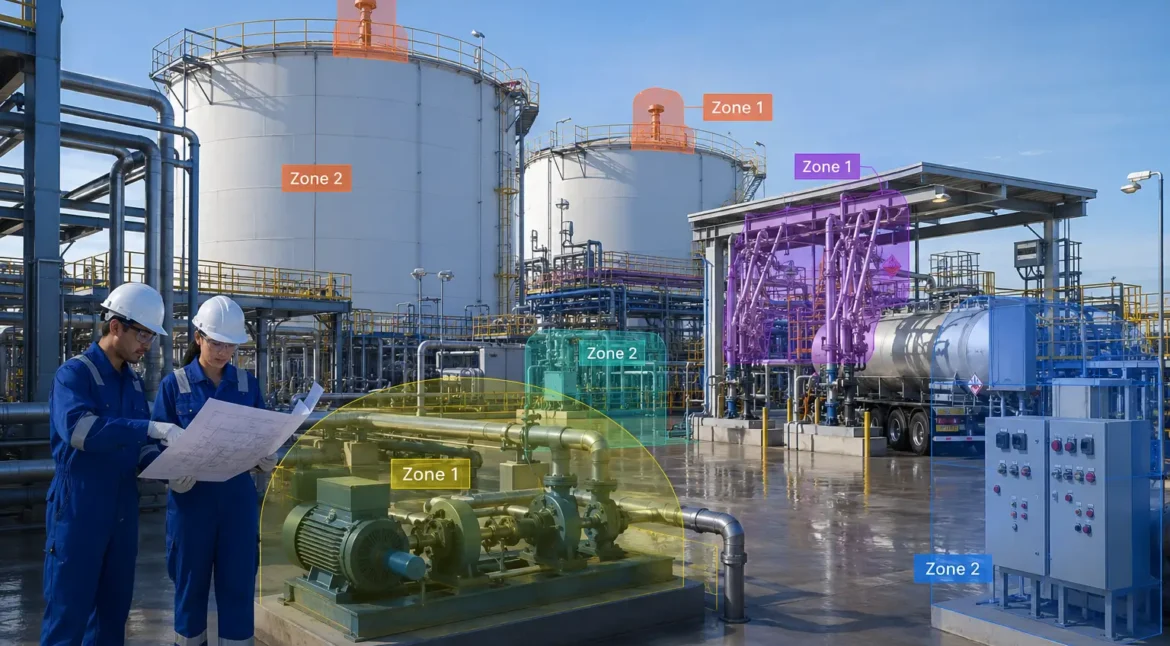
Hazardous Area Classification (HAC) is one of the most important engineering studies for industries handling flammable gases, vapours, mists, or combustible dusts. By identifying locations where explosive atmospheres may occur, Hazardous Area Classification helps engineers select appropriate equipment, implement effective ignition source controls, and design safer industrial facilities. Whether in oil & gas, chemical processing, pharmaceutical manufacturing, or food processing, Hazardous Area Classification forms the foundation of explosion prevention and regulatory compliance.
Industrial facilities handling flammable gases, vapours, combustible dusts, or explosive atmospheres face risks that extend far beyond routine operational hazards. A minor leak, equipment malfunction, or ignition source can rapidly escalate into a fire or explosion if appropriate preventive measures are not in place.
This is where Hazardous Area Classification (HAC) becomes one of the most critical engineering studies in industrial safety.
Hazardous Area Classification is a systematic process used to identify locations where explosive atmospheres may occur and determine the likelihood of their presence during normal or abnormal operating conditions. The study provides the technical foundation for selecting suitable electrical equipment, designing safe installations, implementing ignition source control measures, and complying with internationally recognised safety standards.
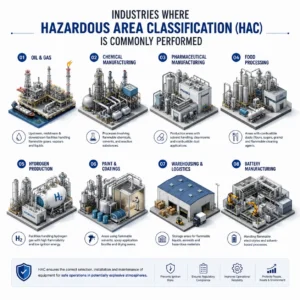
Industries such as oil & gas, chemical processing, pharmaceuticals, food manufacturing, paints and coatings, hydrogen production, warehouses, and fuel storage facilities routinely conduct Hazardous Area Classification studies to reduce explosion risks and improve operational safety.
Without proper classification, facilities may unknowingly install unsuitable equipment inside hazardous locations, increasing the possibility of ignition, regulatory non-compliance, equipment damage, and serious incidents.
Understanding Hazardous Area Classification is therefore essential for plant owners, project engineers, electrical engineers, HSE professionals, consultants, and anyone responsible for designing or operating facilities where flammable materials are handled.
In this blog, we explain:
- What Hazardous Area Classification is
- Why it is important
- Applicable standards and regulations
- Hazardous gas and dust zones
- Factors considered during classification
- Common industry mistakes
- Best practices for safer facility design
Quick Answer: What is Hazardous Area Classification?
Hazardous Area Classification (HAC) is the process of identifying and classifying locations where flammable gases, vapours, mists, or combustible dusts may create explosive atmospheres.
The purpose of Hazardous Area Classification is to determine:
- Where hazardous atmospheres may exist
- How often they may occur
- How long they may remain present
- Which explosion-protected equipment is suitable for each location
The results of a Hazardous Area Classification study form the basis for selecting appropriate Ex-certified equipment, implementing ignition source controls, improving process safety, and ensuring compliance with standards such as IEC 60079, IS/IEC 60079, and ATEX requirements.
How Hazardous Area Classification Works
Hazardous Area Classification is a structured engineering assessment that evaluates the likelihood of an explosive atmosphere being present within an industrial facility.
The study considers the properties of hazardous materials, operating conditions, process equipment, ventilation, release scenarios, and potential ignition sources before dividing the facility into different hazardous zones.
Rather than assuming an entire facility is hazardous, HAC identifies specific areas where explosive atmospheres are likely to occur.
For example:
- Around storage tanks
- Near pump seals
- Loading and unloading stations
- Compressor areas
- Tank vents
- Mixing vessels
- Solvent handling rooms
- Dust collection systems
- Powder transfer stations
Each location is evaluated based on the probability and duration of hazardous atmosphere formation.
This approach allows engineers to select equipment appropriate for the actual level of risk instead of applying unnecessary or insufficient safety measures.
Hazardous Area Classification is therefore both a risk reduction tool and a design engineering study.
Why is Hazardous Area Classification Important?
One of the most common misconceptions is that hazardous areas are only found inside oil refineries or petrochemical complexes.
In reality, explosive atmospheres can develop anywhere flammable substances are stored, processed, transported, or handled.
Examples include:
- Pharmaceutical manufacturing
- Food processing plants
- Paint manufacturing
- Chemical industries
- Hydrogen facilities
- LPG bottling plants
- Warehouses storing flammable liquids
- Battery manufacturing
- Fuel dispensing stations
Whenever a flammable material is released into the atmosphere and mixes with oxygen in the presence of an ignition source, an explosion may occur.
Hazardous Area Classification helps prevent this scenario by identifying areas where ignition sources must be controlled.
The study supports safer decisions regarding:
- Electrical equipment selection
- Instrumentation
- Cable routing
- Mechanical equipment
- Static electricity control
- Ventilation design
- Fire protection systems
- Maintenance planning
Ultimately, the objective is not simply regulatory compliance, it is preventing incidents before they occur.
Objectives of Hazardous Area Classification
A properly executed Hazardous Area Classification study serves several important objectives.
1. Identify Potential Explosion Hazards
The study identifies locations where flammable atmospheres may exist during normal operations, abnormal conditions, maintenance activities, or equipment failures.
2. Support Safe Equipment Selection
Different hazardous zones require different types of explosion-protected equipment.
Selecting equipment based on Hazardous Area Classification helps ensure compatibility between the operating environment and the equipment’s protection concept.
If you’re unfamiliar with different explosion protection methods, our guide on ATEX vs Flameproof: Understanding the Difference explains why ATEX certification and Flameproof protection are not the same.
3. Improve Process Safety
Hazardous Area Classification forms part of a broader Process Safety Management strategy.
It helps engineers understand where ignition sources should be eliminated or controlled through engineering safeguards.
4. Meet Regulatory Requirements
Many industrial standards require Hazardous Area Classification before facility design or modification.
Examples include:
- IEC 60079 Series
- IS/IEC 60079
- ATEX Directive
- OISD Guidelines
- PESO requirements
- Industry-specific engineering practices
5. Reduce Project Costs
Proper classification avoids both extremes:
- Under-protection, which increases risk.
- Over-specification, which unnecessarily increases project costs.
Correctly defining hazardous zones allows equipment to be selected according to actual risk rather than assumptions.
Industries Where Hazardous Area Classification is Required
Although Hazardous Area Classification is strongly associated with the oil and gas industry, many other industries also require HAC studies due to the presence of flammable gases, vapours, or combustible dust.
1. Oil & Gas Industry
Crude oil production, refining, LPG handling, LNG terminals, compressor stations, and fuel storage facilities all involve flammable hydrocarbons capable of forming explosive atmospheres.
Hazardous Area Classification is fundamental during both facility design and plant modifications.
2. Chemical Manufacturing
Chemical plants frequently handle solvents, alcohols, hydrocarbons, acids, and volatile chemicals.
Storage tanks, reactors, transfer pumps, loading stations, and process equipment often require hazardous area assessments.
3. Pharmaceutical Manufacturing
Many pharmaceutical facilities use flammable solvents such as ethanol, IPA, acetone, and methanol during manufacturing.
Additionally, combustible pharmaceutical powders may introduce dust explosion hazards.
Our article on Magnesium Stearate Dust Explosion explains how fine pharmaceutical powders can become combustible when dispersed into air.
4. Food Processing Industry
Combustible dust generated from flour, sugar, starch, cocoa, milk powder, spices, and other organic materials may create explosive dust atmospheres inside processing facilities.
Dust Hazard Analysis often complements Hazardous Area Classification in these environments.
5. Paints, Coatings and Solvent Industries
Mixing, filling, storage, and transfer operations routinely involve flammable solvents capable of generating explosive vapour clouds.
6. Hydrogen Production Facilities
Hydrogen presents unique hazards because of its extremely wide flammable range and very low ignition energy.
Proper Hazardous Area Classification is essential for hydrogen production, storage, compression, and dispensing facilities.
7. Warehouses and Logistics Facilities
Warehouses storing flammable liquids, aerosols, gases, paints, or chemical products may require Hazardous Area Classification around storage and handling areas.
8. Battery Manufacturing
Lithium battery manufacturing and charging operations increasingly involve hydrogen generation, solvent handling, and other processes requiring explosion risk assessment.
Standards Governing Hazardous Area Classification
Hazardous Area Classification is not based on assumptions or company preferences.
It follows internationally recognised engineering standards developed through decades of research, testing, and industrial experience.
These standards provide consistent methods for assessing hazardous locations, classifying zones, and selecting suitable equipment.
1. IEC 60079 Series
The IEC 60079 series is the primary international standard governing explosive atmospheres.
It provides guidance on:
- Hazardous Area Classification
- Explosion protection techniques
- Equipment selection
- Installation requirements
- Inspection and maintenance
- Equipment testing
Many countries adopt IEC 60079 directly or publish national versions based on these standards.
2. IS/IEC 60079
In India, the Bureau of Indian Standards publishes the IS/IEC 60079 series.
These standards align closely with IEC requirements while supporting Indian industrial applications.
Facilities operating in India frequently reference IS/IEC 60079 during project execution, audits, and compliance assessments.
3. ATEX Directive
Within the European Union, Hazardous Area Classification is closely associated with the ATEX Directive.
ATEX governs equipment intended for use in potentially explosive atmospheres and establishes requirements for manufacturers supplying equipment to the European market.
Although ATEX certification applies primarily within Europe, many multinational organisations adopt ATEX-certified equipment globally.
4. OISD Guidelines
Oil Industry Safety Directorate (OISD) standards provide additional guidance for petroleum installations throughout India.
Many refinery and oil marketing projects reference OISD requirements alongside IEC standards.
5. PESO Requirements
The Petroleum and Explosives Safety Organisation (PESO) regulates facilities involving petroleum products, compressed gases, explosives, and other hazardous materials in India.
Hazardous Area Classification often supports approvals involving fuel storage, LPG installations, and related facilities.
Hazardous Area Classification Zones for Gases and Vapours
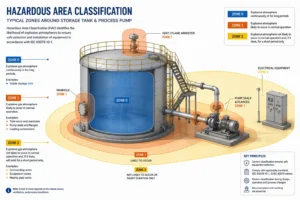
One of the primary outcomes of a Hazardous Area Classification study is dividing the facility into different hazardous zones.
These zones indicate how frequently an explosive atmosphere is expected to occur.
Zone 0
Zone 0 represents the highest level of risk.
An explosive gas atmosphere is present continuously, for long periods, or frequently during normal operation.
Typical examples include:
- Inside storage tanks
- Process vessels
- Certain enclosed process equipment
Only equipment specifically designed for Zone 0 applications may be installed in these areas.
Zone 1
Zone 1 includes locations where explosive atmospheres are likely to occur during normal operating conditions but not continuously.
Examples include:
- Around pump seals
- Loading arms
- Tank vents
- Sampling points
- Process connections
Many industrial facilities contain Zone 1 areas around equipment handling flammable liquids or gases.
Zone 2
Zone 2 represents locations where explosive atmospheres are unlikely during normal operation and, if they occur, persist only for a short period.
Examples include:
- Areas surrounding Zone 1
- Well-ventilated outdoor process areas
- Secondary containment regions
Although Zone 2 presents a lower probability of explosive atmospheres, appropriate equipment selection remains essential.
Hazardous Area Classification Zones for Combustible Dust
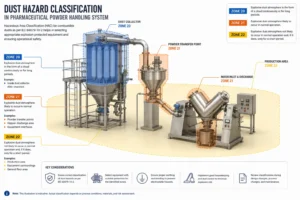
Combustible dust requires a different classification system.
Instead of Zone 0-2, dust hazards are classified as:
Zone 20
An explosive dust atmosphere is continuously present or exists for extended periods inside equipment.
Examples:
- Dust collectors
- Silos
- Powder conveying systems
Zone 21
Combustible dust clouds are likely to occur occasionally during normal operations.
Examples:
- Powder filling stations
- Milling equipment
- Mixing operations
Zone 22
Combustible dust clouds are not expected during normal operations but may occur infrequently and only for short durations.
Typical examples include areas adjacent to powder processing equipment.
Our guide on Magnesium Stearate Dust Explosion explores how combustible pharmaceutical powders can generate hazardous dust atmospheres requiring careful engineering controls.
Gas Groups Used in Hazardous Area Classification
Not all flammable gases behave the same way.
Hazardous Area Classification also considers the type of gas present.
Gas Groups include:
- IIA – Propane and similar gases
- IIB – Ethylene
- IIC – Hydrogen and Acetylene (highest explosion risk)
Equipment approved for IIC applications can generally be used for IIB and IIA gases, but the reverse is not always true.
Temperature Classes in Hazardous Area Classification
Electrical equipment may generate heat during operation.
Hazardous Area Classification therefore considers the maximum surface temperature that equipment can reach.
Common temperature classes include:
| Temperature Class | Maximum Surface Temperature |
|---|---|
| T1 | 450°C |
| T2 | 300°C |
| T3 | 200°C |
| T4 | 135°C |
| T5 | 100°C |
| T6 | 85°C |
Equipment must always have a maximum surface temperature lower than the auto-ignition temperature of the hazardous substance present.
Factors Considered During Hazardous Area Classification
A Hazardous Area Classification study evaluates multiple engineering parameters before assigning hazardous zones.
These include:
- Properties of the hazardous material
- Flash point and auto-ignition temperature
- Release grade (continuous, primary, or secondary)
- Ventilation effectiveness
- Quantity of material handled
- Operating pressure and temperature
- Equipment layout
- Building configuration
- Dispersion characteristics
- Potential ignition sources
- Existing engineering safeguards
Rather than relying on a single factor, engineers assess how these variables interact to determine the probability and extent of explosive atmospheres.
Common Mistakes in Hazardous Area Classification
Even well-designed industrial facilities can become vulnerable if Hazardous Area Classification is carried out incorrectly or not updated as operations change. Many incidents occur not because standards are unavailable, but because hazards are underestimated or assumptions are made during equipment selection and facility modifications.
Some of the most common mistakes include:
1. Assuming Every Flammable Area Requires the Same Equipment
One of the biggest misconceptions is that all hazardous locations require Flameproof (Ex d) equipment.
In reality, the required protection method depends on the hazardous zone, gas group, temperature class, and the nature of the process. Depending on the application, protection concepts such as Ex e (Increased Safety), Ex ia (Intrinsic Safety), Ex p (Pressurization), or Ex m (Encapsulation) may be more appropriate.
To understand these protection methods in detail, read our guide on ATEX vs Flameproof: Understanding the Difference.
2. Ignoring Changes to the Process
Hazardous Area Classification is not a one-time exercise.
Changes such as:
- New equipment installation
- Process modifications
- Increased production capacity
- Additional storage tanks
- Changes in ventilation
- Introduction of new chemicals
may significantly alter hazardous zones.
Whenever plant modifications are made, the Hazardous Area Classification study should be reviewed and updated.
3. Overlooking Combustible Dust Hazards
Many facilities focus only on flammable gases and vapours while overlooking combustible dust.
Industries handling powders such as flour, starch, sugar, pharmaceutical ingredients, metal dusts, wood dust, or polymers should also evaluate dust explosion hazards.
Dust zones (Zone 20, Zone 21, and Zone 22) require the same level of engineering attention as gas hazardous areas.
Our article on Magnesium Stearate Dust Explosion explains how even routine pharmaceutical powders can create explosive dust clouds under certain operating conditions.
4. Selecting Equipment Based Only on Cost
Explosion-protected equipment should never be selected solely on price.
Engineers must verify:
- Hazardous Zone
- Gas Group
- Temperature Class
- Equipment Protection Level (EPL)
- Protection Concept
- Applicable Standards
Installing unsuitable equipment may increase both safety risks and long-term maintenance costs.
5. Ignoring Ventilation Conditions
Ventilation has a significant influence on hazardous area extent.
Natural or mechanical ventilation can reduce the accumulation of flammable atmospheres, while poor ventilation may increase the size of hazardous zones.
A proper Hazardous Area Classification study always evaluates ventilation effectiveness rather than assuming ideal operating conditions.
Benefits of Conducting a Hazardous Area Classification Study
A professionally conducted Hazardous Area Classification study provides benefits beyond regulatory compliance.
1. Improves Personnel Safety
By identifying locations where explosive atmospheres may occur, facilities can implement appropriate engineering controls and significantly reduce the likelihood of fires and explosions.
2. Supports Correct Equipment Selection
Hazardous Area Classification ensures that electrical and mechanical equipment is suitable for the environment in which it operates, reducing the risk of ignition.
3. Helps Meet Regulatory Requirements
Many national and international standards require Hazardous Area Classification as part of facility design, commissioning, audits, and inspections.
Compliance with standards such as IEC 60079 and IS/IEC 60079 demonstrates a structured approach to explosion risk management.
4. Reduces Downtime and Maintenance Costs
Properly selected equipment generally experiences fewer failures and requires less corrective maintenance.
Avoiding equipment replacement due to incorrect specification also reduces project costs.
5. Supports Insurance and Risk Management
Insurance providers and corporate risk managers often review Hazardous Area Classification documentation as part of industrial risk assessments.
Accurate classification demonstrates that explosion hazards have been systematically evaluated and addressed.
6. Strengthens Overall Process Safety
Hazardous Area Classification works alongside other process safety studies such as:
- HAZOP
- LOPA
- QRA
- Fire Risk Assessment
- Dust Hazard Analysis
- Process Safety Management (PSM)
Together, these studies create a comprehensive approach to industrial risk reduction.
Best Practices for Hazardous Area Classification
To maximise the effectiveness of a Hazardous Area Classification study, organisations should follow these best practices:
- Conduct Hazardous Area Classification during the design stage of new facilities.
- Revalidate the study whenever significant process changes occur.
- Select equipment based on hazardous zone, gas group, temperature class, and Equipment Protection Level (EPL).
- Evaluate both flammable gas and combustible dust hazards where applicable.
- Consider ventilation, release scenarios, and operating conditions rather than relying on assumptions.
- Maintain up-to-date Hazardous Area Classification drawings and documentation.
- Train engineering, maintenance, and operations personnel to understand hazardous zone requirements.
- Integrate Hazardous Area Classification with broader Process Safety Management initiatives.
Hazardous Area Classification FAQs
1. What is Hazardous Area Classification (HAC)?
Hazardous Area Classification is the process of identifying locations where flammable gases, vapours, mists, or combustible dusts may create explosive atmospheres. It helps determine the appropriate explosion-protected equipment and engineering controls required for safe operation.
2. Why is Hazardous Area Classification important?
Hazardous Area Classification helps prevent fires and explosions by identifying hazardous locations, supporting safe equipment selection, and ensuring compliance with recognised safety standards.
3. Which industries require Hazardous Area Classification?
Industries including oil & gas, chemical manufacturing, pharmaceutical production, food processing, paint manufacturing, hydrogen facilities, fuel storage terminals, battery manufacturing, and warehouses handling flammable materials commonly require Hazardous Area Classification studies.
4. What is the difference between Zone 0, Zone 1, and Zone 2?
Zone 0 is an area where an explosive gas atmosphere is present continuously or for long periods.
Zone 1 is an area where explosive atmospheres are likely to occur during normal operations.
Zone 2 is an area where explosive atmospheres are unlikely during normal operation and, if they occur, exist only for a short duration.
5. What are Zone 20, Zone 21, and Zone 22?
These zones are used for combustible dust hazards.
- Zone 20: Dust atmosphere present continuously or frequently.
- Zone 21: Dust atmosphere likely during normal operations.
- Zone 22: Dust atmosphere unlikely during normal operations but possible for short periods.
6. Which standard governs Hazardous Area Classification?
The primary international standard is the IEC 60079 series. In India, the IS/IEC 60079 series is widely followed alongside applicable PESO and OISD requirements.
7. Is Hazardous Area Classification mandatory?
The requirement depends on applicable regulations and the nature of the facility. However, facilities handling flammable gases, vapours, or combustible dusts are generally expected to perform Hazardous Area Classification as part of safe engineering design and regulatory compliance.
8. How often should a Hazardous Area Classification study be reviewed?
The study should be reviewed whenever significant modifications are made to the facility, such as process changes, equipment replacement, layout changes, or the introduction of new hazardous materials.
9. Can combustible dust create hazardous areas?
Yes. Fine combustible dusts can form explosive atmospheres when dispersed in air. Dust-producing industries should evaluate both gas and dust explosion hazards.
10. Who should perform a Hazardous Area Classification study?
Hazardous Area Classification should be conducted by competent professionals with expertise in hazardous area engineering, applicable standards, process safety, and explosion protection.
Conclusion
Hazardous Area Classification is far more than a regulatory requirement, it is a fundamental engineering study that supports safer facility design, reliable equipment selection, and effective explosion risk management.
By identifying where explosive atmospheres may occur and understanding the level of risk associated with each location, organisations can implement appropriate engineering controls, select suitable Ex-certified equipment, and reduce the likelihood of catastrophic incidents.
Whether your facility handles flammable gases, vapours, or combustible dusts, Hazardous Area Classification provides the technical foundation for protecting people, assets, and business continuity.
As industrial processes evolve and new technologies emerge, regularly reviewing Hazardous Area Classification studies remains an essential part of maintaining a safe and compliant workplace.
How Indsafe Can Help
At Indsafe Consulting & Systems, we provide comprehensive Hazardous Area Classification (HAC) studies tailored to the unique risks of industrial facilities. Our team supports organisations across sectors including oil & gas, chemicals, pharmaceuticals, manufacturing, warehouses, and energy by delivering practical, standards-based solutions aligned with IEC 60079, IS/IEC 60079, and applicable industry guidelines.
Our expertise extends beyond Hazardous Area Classification to include Process Safety Studies, Dust Hazard Analysis (DHA), Fire Safety, Electrical Safety, Structural Safety, and Sustainability & Environment, helping organisations build safer, more resilient operations.
If you’re planning a new facility, modifying an existing plant, or reviewing compliance requirements, a professionally executed Hazardous Area Classification study is an important step toward reducing explosion risks and strengthening process safety.
References
- IEC 60079 Series – Explosive Atmospheres
- IS/IEC 60079 Series – Bureau of Indian Standards (BIS)
- ATEX Directive 2014/34/EU
- NFPA 497 – Recommended Practice for the Classification of Flammable Liquids, Gases, or Vapours
- NFPA 499 – Recommended Practice for the Classification of Combustible Dusts
- OISD Guidelines (Applicable Standards)
- PESO (Petroleum and Explosives Safety Organisation) Guidelines