

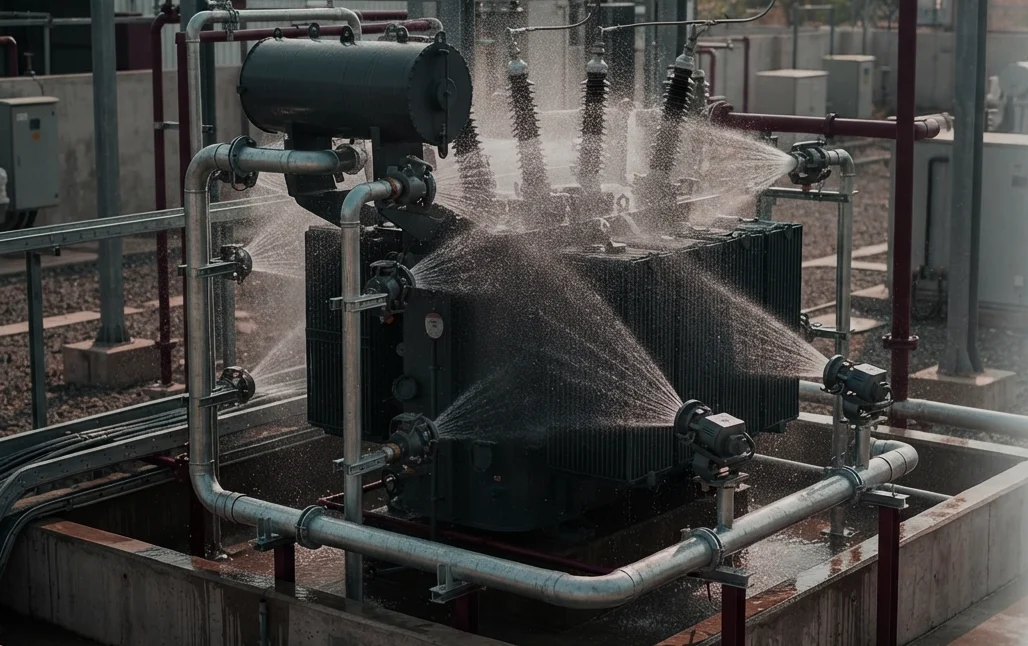
MVWS & HVWS systems are fixed water-based fire protection systems used for specific industrial hazards where conventional sprinkler protection may not provide the required protection objective, spray characteristics or equipment coverage.
These systems are commonly considered for applications involving transformers, oil-filled electrical equipment, process equipment, flammable-liquid hazards and other industrial installations where rapid cooling, exposure protection, fire control or suppression is required.
The selection between MVWS & HVWS systems is not simply a matter of choosing a “medium-pressure” or “high-pressure” system. It depends on the hazard, protection objective, equipment geometry, water application requirements, nozzle/projector characteristics, hydraulic design and applicable standards.
In India, IS 15325:2003 provides a code of practice for the design and installation of fixed automatic high and medium velocity water spray systems. Depending on the project, hazard and governing requirements, other applicable standards, codes, client specifications and insurer requirements may also need to be considered.
What Is an MVWS System?
A Medium Velocity Water Spray (MVWS) system is a fixed fire protection system designed to discharge water through specially selected spray nozzles over a defined hazard or equipment area.
Depending on the design basis, MVWS can be used to provide:
- Equipment cooling
- Fire control
- Exposure protection
- Protection against fire propagation
- Protection of specific industrial equipment and process hazards
Unlike conventional sprinkler systems, water spray systems are generally engineered around the specific hazard and protection objective rather than treating the entire area as a conventional sprinkler-protected compartment.
The system may incorporate open spray nozzles, a deluge valve arrangement, detection and actuation systems, dedicated piping and hydraulic calculations based on the protected equipment and applicable design criteria.
How Does an MVWS System Work?
A typical MVWS arrangement operates through a coordinated sequence:
Fire detection or actuation signal
↓
Deluge valve operates
↓
Fire water enters the spray-piping network
↓
Water discharges through selected spray nozzles
↓
Defined equipment/hazard receives the designed water spray
↓
Cooling, fire control and/or exposure protection is achieved
The exact arrangement depends on the hazard analysis, system philosophy and applicable design requirements.
For automatic systems, detection and actuation are particularly important because water is generally discharged through the open spray nozzles once the deluge arrangement is actuated.
Where Is MVWS Used?
MVWS systems may be considered for applications such as:
Transformer and Electrical Equipment Protection
Oil-filled transformers and other electrical equipment can present significant fire and exposure hazards. A properly engineered water spray system can provide cooling and help limit fire exposure to the protected equipment and surrounding assets.
Process Equipment
Process plants may contain equipment handling flammable or combustible materials. Fixed water spray can be used where equipment cooling or exposure protection forms part of the overall fire protection strategy.
Industrial Facilities
MVWS may be considered for selected industrial hazards where a specifically engineered water spray arrangement is more appropriate than conventional sprinkler protection.
The actual application should always be determined through hazard assessment and the applicable design basis rather than by applying MVWS generically to every industrial area.
What Is an HVWS System?
A High Velocity Water Spray (HVWS) system is a fixed water spray fire protection arrangement engineered for specific high-hazard applications where the characteristics of the water discharge and the protection objective require a high-velocity spray arrangement.
HVWS systems are commonly associated with applications involving:
- Oil-filled transformers
- Oil-filled electrical equipment
- Certain flammable-liquid hazards
- High-hazard industrial equipment
- Specific process installations requiring dedicated water spray protection
The system is normally designed around the characteristics of the protected equipment, expected fire scenario, required water application and applicable design criteria.
It is therefore important not to define HVWS simply as “a high-pressure sprinkler system.” It is a specialised water spray protection arrangement with application-specific engineering requirements.
How Does an HVWS System Work?
A typical HVWS arrangement may operate through:
Fire detection / actuation
↓
Deluge valve activation
↓
Water flow into the HVWS piping network
↓
Discharge through selected projectors/nozzles
↓
Water spray reaches the protected equipment/hazard
↓
Fire control, suppression and/or equipment cooling
The exact arrangement depends on the hazard, equipment configuration, detection philosophy, water supply and governing design criteria.
MVWS vs HVWS: What Is the Difference?
MVWS and HVWS should not be differentiated only by pressure. The more meaningful distinction is the type of spray arrangement, discharge characteristics, hazard and protection objective for which the system is engineered.
| Parameter | MVWS | HVWS |
|---|---|---|
| Full form | Medium Velocity Water Spray | High Velocity Water Spray |
| Primary purpose | Cooling, exposure protection and/or fire control for defined hazards | Fire control/suppression and cooling for specific high-hazard applications |
| Discharge arrangement | Specially selected water spray nozzles | High-velocity water spray projectors/nozzles selected for the application |
| Typical applications | Industrial equipment, transformers and selected process hazards | Transformers, oil-filled equipment and selected high-hazard applications |
| System actuation | Often integrated with a deluge arrangement | Often integrated with a deluge arrangement |
| Design basis | Hazard- and equipment-specific | Hazard- and equipment-specific |
| Hydraulic design | Based on required coverage, discharge and system demand | Based on required coverage, discharge and system demand |
| Selection criteria | Protection objective, hazard, geometry, nozzle characteristics and applicable requirements | Protection objective, hazard, geometry, projector/nozzle characteristics and applicable requirements |
Important: MVWS is not automatically “better” or “weaker” than HVWS. The appropriate system depends on the hazard and the required protection objective.
MVWS/HVWS vs Conventional Sprinkler Systems
MVWS/HVWS systems and conventional sprinkler systems are both water-based fire protection systems, but they are not interchangeable.
A conventional sprinkler system is generally designed to protect an occupancy or defined area using listed sprinklers and an appropriate sprinkler design basis.
A water spray system, on the other hand, is often designed around a specific hazard, equipment item or exposure scenario.
Key differences may include:
| Feature | Conventional Sprinkler | MVWS/HVWS |
|---|---|---|
| Protection philosophy | Area/occupancy-based protection | Hazard/equipment-specific protection |
| Discharge devices | Sprinkler heads | Special water spray nozzles/projectors |
| Typical actuation | Individual sprinkler operation in many systems | Often open nozzles controlled through a deluge arrangement |
| Coverage | Defined sprinkler-protected area | Defined equipment/hazard geometry |
| Typical industrial use | Buildings, warehouses and occupancies | Transformers, process equipment and selected high-hazard applications |
| Design approach | Sprinkler hazard classification and hydraulic design | Hazard-specific water spray and hydraulic design |
The choice between the two should therefore be made on the basis of the fire scenario and protection objective—not simply because one system appears more powerful than the other.
MVWS/HVWS and Deluge Systems: What Is the Difference?
This distinction is important because the terms are sometimes used interchangeably.
MVWS and HVWS describe water spray system arrangements and their discharge characteristics, while “deluge” describes a system actuation arrangement in which water can be released to a network of open nozzles/projectors when the deluge valve is actuated.
A deluge system can therefore be used as part of a water spray protection arrangement.
A typical arrangement may include:
- Fire-water supply
- Deluge valve
- Detection/actuation system
- Open spray nozzles or projectors
- Distribution piping
- Isolation and control valves
- Alarm and monitoring arrangements
- Drainage provisions
The final configuration should be established through the project’s fire protection philosophy and engineering design.
Main Components of an MVWS/HVWS System
A typical fixed water spray system may include the following major components:
1. Fire-Water Supply
The system requires an adequately designed and reliable fire-water source capable of meeting the required flow and pressure demand.
2. Fire-Water Pumps
Fire pumps provide the required flow and pressure for the system in accordance with the project design basis.
3. Deluge Valve
Where a deluge arrangement is used, the deluge valve controls the release of water into the open-nozzle spray network.
4. Detection and Actuation System
Detection may be integrated with the fire and gas detection or fire alarm philosophy to initiate system actuation where automatic operation is required.
5. Spray Nozzles / Projectors
These are selected based on the required discharge characteristics, coverage, installation geometry and application.
6. Distribution Piping
The piping network distributes water from the deluge valve to the spray devices and is hydraulically designed for the required system demand.
7. Valves and Accessories
Isolation valves, strainers, gauges, drains, test arrangements and other accessories may be incorporated as required by the design.
8. Alarm and Monitoring
Water flow, valve position and system status may be monitored through suitable alarm and control arrangements.
9. Drainage
Drainage should be considered where large quantities of water may be discharged during system operation or testing.
How Is an MVWS/HVWS System Designed?
A reliable system should begin with hazard identification and a clearly defined protection objective, rather than simply selecting nozzles and piping.
Key design considerations include:
Hazard Identification
Identify the material, equipment and process conditions that could contribute to a fire.
Fire Scenario
Consider credible fire scenarios such as hydrocarbon fires, equipment fires, pool fires or exposure scenarios, where relevant to the facility.
Protection Objective
Determine whether the system is intended primarily for:
- Cooling
- Fire control
- Fire suppression
- Exposure protection
- Prevention of fire propagation
- Protection of critical equipment
Equipment Geometry
The dimensions, orientation, obstructions and configuration of the protected equipment influence spray-device selection and layout.
Nozzle / Projector Selection
Spray devices should be selected based on the required discharge characteristics and the design conditions.
Spray Coverage
The arrangement should provide the required coverage of the defined protected surfaces or hazard.
Hydraulic Calculations
Hydraulic calculations determine system flow, pressure requirements, pipe sizing and water demand for the design case.
Fire-Water Demand
The water supply must be capable of supporting the applicable design demand while considering other simultaneous fire-water requirements where required by the project philosophy.
Detection and Actuation
The detection and actuation philosophy should be coordinated with the protected hazard and the overall fire and gas system.
Drainage and Run-Off
The consequences of water discharge should be considered, particularly in areas containing electrical equipment, hydrocarbons or environmentally sensitive materials.
Inspection, Testing and Maintenance
The system should be designed and maintained so that critical components can be inspected, tested and kept operational.
MVWS/HVWS for Transformer Fire Protection
Transformer protection is one of the important applications where fixed water spray systems may be considered.
Oil-filled transformers can present a combination of:
- Electrical energy
- Combustible insulating oil
- High operating temperatures
- Potential oil leakage
- Fire exposure to adjacent equipment
- Risk of escalation to nearby assets
A properly engineered water spray system can form part of the overall transformer fire protection strategy.
The design may need to consider:
- Transformer dimensions and configuration
- Oil containment and drainage
- Adjacent equipment
- Spray-device positioning
- Required water application
- Detection and actuation
- Fire-water availability
- Electrical safety considerations
- Hydraulic calculations
- Applicable standards and project specifications
Water spray protection should not be designed in isolation. It should form part of the facility’s broader fire protection and emergency response philosophy.
Industrial Applications of MVWS & HVWS Systems
Depending on the hazard and design requirements, fixed water spray systems may be considered in:
Oil & Gas Facilities
For selected process equipment, hydrocarbon hazards and critical equipment requiring exposure protection or fire control.
Petrochemical Plants
For process equipment and other defined high-hazard installations.
Power Plants
For transformers and other equipment where fixed water spray protection is required.
Chemical Plants
For selected process equipment and hazardous installations.
Pharmaceutical Facilities
For defined equipment and industrial hazards where water spray protection forms part of the fire protection philosophy.
Manufacturing Facilities
For specific equipment or process hazards requiring engineered water spray protection.
The appropriate application should always be determined through project-specific hazard assessment and engineering requirements.
Applicable Standards and Design References
The governing requirements for an MVWS/HVWS system depend on the location, hazard, client requirements and applicable regulatory framework.
IS 15325:2003
IS 15325:2003 — Design and Installation of Fixed Automatic High and Medium Velocity Water Spray System – Code of Practice is a key Indian reference for fixed automatic high- and medium-velocity water spray systems.
NFPA 15
NFPA 15 – Standard for Water Spray Fixed Systems for Fire Protection is an important international reference for fixed water spray systems.
Other standards and requirements may become relevant depending on the hazard and facility. These can include:
- Applicable Indian Standards
- National Building Code requirements, where applicable
- Relevant NFPA standards
- Fire and life-safety regulations
- Client engineering specifications
- Insurer requirements
- Authority Having Jurisdiction (AHJ) requirements
- Equipment manufacturer requirements
The applicable edition and project-specific requirements should always be verified during engineering. Standards should not be treated as interchangeable or applied without considering the specific hazard and design basis.
Why Professional MVWS/HVWS Engineering Matters
An MVWS or HVWS system is more than a network of pipes and spray nozzles.
An effective design requires coordination between:
Hazard Assessment → Fire Scenario → Protection Philosophy → Spray-Device Selection → Hydraulic Design → Detection & Actuation → Fire-Water Supply → Installation → Testing & Commissioning
Errors in hazard identification, nozzle positioning, hydraulic calculations, water supply or system actuation can affect the effectiveness of the protection system.
For this reason, engineering should be carried out by personnel with appropriate fire protection and industrial safety experience and should be reviewed against the applicable standards and project requirements.
INDSAFE MVWS & HVWS Fire Protection Engineering
INDSAFE provides engineering-led fire protection and risk management solutions for industrial facilities.
Our fire protection capabilities include High and Medium Velocity Water Spray System design, deluge fire system design, fire protection system engineering and related industrial fire safety services. INDSAFE’s existing fire-system design offering specifically identifies MVWS/HVWS and deluge system design as part of its capabilities.
Our approach can include:
- Hazard and fire-risk assessment
- Fire protection philosophy
- MVWS/HVWS system design
- Deluge system design
- Hydraulic calculations
- Equipment and nozzle/projector selection
- Fire-water demand assessment
- Piping network design
- Detection and actuation integration
- Design review and engineering documentation
- Testing and commissioning support
- Fire protection system adequacy assessment
For projects involving transformers, process equipment, oil & gas facilities, chemical plants, pharmaceutical facilities or other industrial hazards, the appropriate protection strategy should be established based on the specific fire scenarios and project requirements.
Need MVWS or HVWS fire protection engineering for an industrial facility? Contact INDSAFE for a project-specific assessment and design approach.
Frequently Asked Questions
What is an MVWS system?
An MVWS (Medium Velocity Water Spray) system is a fixed water-based fire protection system that uses specially selected spray nozzles to distribute water over a defined hazard or equipment area for purposes such as cooling, fire control and exposure protection.
What is an HVWS system?
An HVWS (High Velocity Water Spray) system is a specialised fixed water spray arrangement designed for specific high-hazard applications where the discharge characteristics and protection objective require a high-velocity water spray arrangement.
What is the difference between MVWS and HVWS?
The difference is not simply pressure. MVWS and HVWS are selected based on the hazard, protection objective, spray-device characteristics, equipment geometry, hydraulic requirements and applicable design criteria.
Is MVWS the same as a sprinkler system?
No. Conventional sprinkler systems are generally designed for area or occupancy protection, whereas MVWS systems are typically engineered around specific hazards, equipment or exposure scenarios.
Is MVWS a deluge system?
Not necessarily. MVWS describes a type of water spray protection arrangement, while deluge describes an actuation arrangement in which water can be released through a network of open nozzles when the deluge valve operates.
Where are MVWS systems used?
MVWS systems may be used for selected industrial applications including transformer protection, process equipment and other defined hazards requiring cooling, fire control or exposure protection.
Where are HVWS systems used?
HVWS systems may be used for selected high-hazard industrial applications, including certain transformer, oil-filled equipment and flammable-liquid fire protection applications.
Which standard is used for MVWS and HVWS systems in India?
IS 15325:2003 is a key Indian code of practice covering the design and installation of fixed automatic high- and medium-velocity water spray systems. Other standards, regulations and project-specific requirements may also apply.
Are MVWS and HVWS systems suitable for transformer protection?
They can be used for transformer fire protection where required by the hazard assessment and applicable design basis. The system should be engineered according to the transformer configuration, fire scenario, water application requirements and relevant standards.
How is an MVWS/HVWS system designed?
The design typically considers the hazard, fire scenario, protection objective, equipment geometry, spray-device selection, coverage, hydraulic calculations, fire-water demand, detection and actuation, drainage and applicable standards.
Does every industrial facility require an MVWS or HVWS system?
No. The need for a fixed water spray system depends on the facility’s hazards, equipment, fire scenarios, applicable regulations, standards, client requirements and overall fire protection philosophy.
Conclusion
MVWS and HVWS systems provide specialised water-based fire protection for industrial hazards where protection must be engineered around specific equipment, fire scenarios and performance objectives.
The most effective approach is not to select a system based solely on its name or perceived discharge intensity. Instead, the protection strategy should begin with hazard identification and fire-scenario analysis, followed by appropriate system selection, hydraulic design, detection and actuation, installation, testing and maintenance.
For industrial facilities, integrating MVWS/HVWS engineering with the wider fire protection and risk management strategy can help protect critical equipment, reduce the potential for fire escalation and improve overall facility resilience.
INDSAFE supports industrial clients with fire protection engineering and risk management solutions, including MVWS/HVWS and deluge system design.