

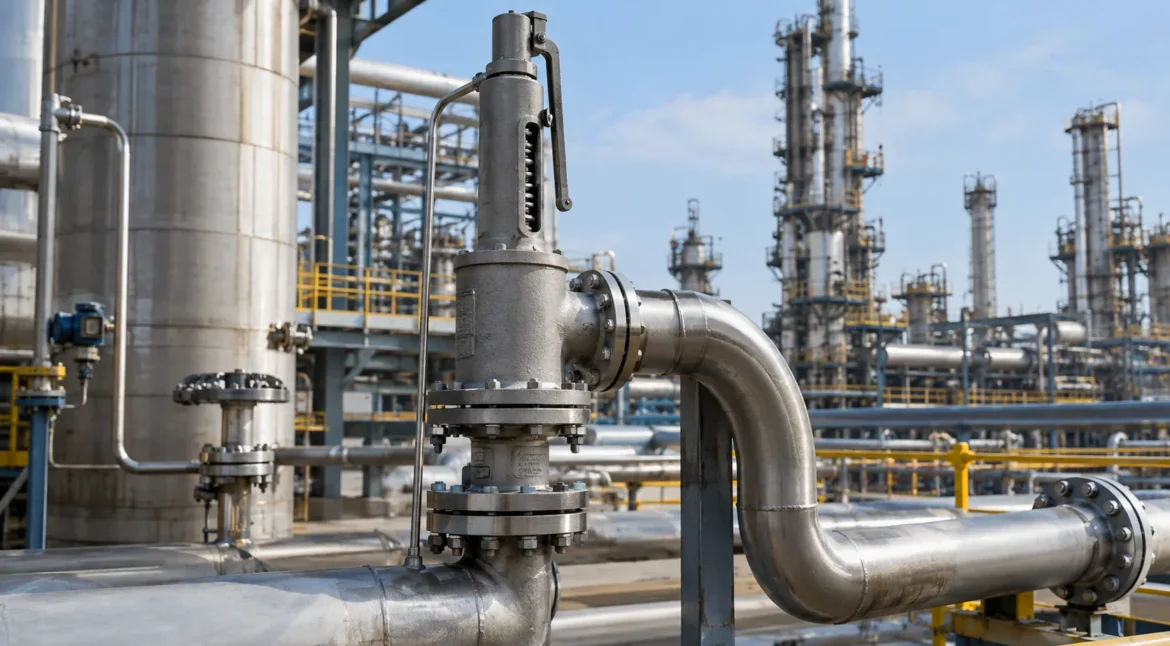
Pressure safety valves (PSVs) are essential safeguards against overpressure in process plants. However, selecting a suitable valve involves more than determining the required relief capacity and set pressure. The pressure acting at the valve outlet can also influence its opening characteristics, discharge capacity and operational stability. This outlet pressure is known as PSV backpressure. It becomes particularly important when a pressure safety valve discharges into a common relief header, flare system or other downstream piping network.
If backpressure is not properly evaluated, the selected valve may not perform as intended under the applicable relieving conditions. Engineers must therefore consider the complete pressure-relief system, including the valve, inlet piping, discharge piping and disposal system.
This article explains the types of PSV backpressure, how they affect valve performance, the differences between conventional and balanced pressure safety valves, and the key considerations for relief system design.
What Is Backpressure in a Pressure Safety Valve?
PSV backpressure is the pressure present at the outlet of a pressure safety valve. It may exist before the valve opens, develop as fluid flows through the discharge piping, or result from a combination of both conditions.
Backpressure is important because pressure acting on the valve’s outlet side can affect the forces acting on the valve disc and influence its operating characteristics.
The impact depends on several factors, including:
- Whether the valve is conventional, balanced-bellows or pilot-operated.
- Whether the backpressure is constant or variable.
- The magnitude of the pressure developed during relief.
- The physical properties and relieving conditions of the fluid.
- The design of the discharge piping and common relief header.
- The manufacturer’s performance limits and applicable design requirements.
Backpressure should therefore be evaluated as part of the overall pressure-relief system design, rather than as an isolated valve parameter.
Types of PSV Backpressure
PSV backpressure is generally classified into two main types: superimposed backpressure and built-up backpressure.
1. Superimposed Backpressure
Superimposed backpressure is the pressure already present at the pressure safety valve outlet when the valve is required to open.
It can be constant or variable.
Constant superimposed backpressure remains substantially unchanged under the relevant operating and relieving conditions. For example, a valve discharging into a system maintained at a relatively stable pressure may experience constant superimposed backpressure.
Variable superimposed backpressure changes with operating conditions. This can occur when the valve discharges into a common relief header whose pressure varies as other relief devices discharge or as the downstream system conditions change.
In conventional spring-loaded valves, superimposed backpressure can affect the opening pressure. Where the backpressure is variable, the effect can also vary over time.
Balanced pressure safety valves or suitable pilot-operated designs may be considered when variable superimposed backpressure presents an unacceptable performance concern. The final selection must be based on the actual operating conditions and the manufacturer’s guidance.
2. Built-Up Backpressure
Built-up backpressure is the pressure that develops at the valve outlet after the valve opens, due to fluid flow through the discharge piping and downstream system.
It is influenced by factors such as:
- Discharge pipe diameter and length.
- Pipe fittings, bends, reducers and other flow restrictions.
- Relief flow rate and fluid properties.
- Discharge system configuration.
- Pressure losses through the common relief header and disposal system.
- Simultaneous discharge from other pressure-relief devices.
As the relieving flow increases, pressure losses in the discharge system can cause built-up backpressure to rise.
Excessive built-up backpressure can interfere with valve lift, reduce discharge capacity or contribute to unstable operation, depending on the valve design and service conditions.
Superimposed vs Built-Up Backpressure
| Parameter | Superimposed backpressure | Built-up backpressure |
|---|---|---|
| Meaning | Pressure present at the outlet when the valve is required to open | Additional pressure developed due to flow after the valve opens |
| Main cause | Existing downstream system pressure | Pressure losses in discharge piping and downstream equipment |
| When evaluated | Before and at the onset of relieving | During the relieving event |
| Important consideration | May affect opening pressure, particularly in conventional valves | May affect lift, capacity and stability |
| Engineering evaluation | Determine the relevant downstream pressure conditions | Calculate pressure losses under the required relieving scenarios |
The total backpressure during relief is the combination of superimposed and built-up backpressure, evaluated consistently at the valve outlet for the relevant scenario.
How Does PSV Backpressure Affect Valve Performance?
The effect of backpressure depends on the valve construction, the type of backpressure and the operating conditions. Four important considerations are opening pressure, relief capacity, stability and reseating behaviour.
1. Opening Pressure
In a conventional spring-loaded pressure safety valve, superimposed backpressure can increase the pressure required to open the valve if the effect has not been appropriately accounted for.
Where superimposed backpressure is constant, an appropriate adjustment to the cold differential test pressure may be possible, subject to the valve design, applicable requirements and manufacturer guidance.
Variable superimposed backpressure requires particular attention because the pressure at which the valve opens may change with downstream conditions.
2. Relief Capacity
Backpressure can affect the amount of fluid a pressure safety valve can discharge at the required relieving conditions.
For balanced spring-loaded valves, elevated backpressure can still influence lift and capacity. Applicable backpressure correction factors and manufacturer performance data must be considered during sizing.
The effect on pilot-operated valves depends on their design and operating characteristics. Engineers should not assume that backpressure has no effect under every condition.
The required relieving capacity must be verified using the appropriate sizing method, fluid properties, relieving pressure and applicable correction factors.
3. Valve Stability
Excessive built-up backpressure can contribute to unstable valve operation.
Two terms commonly associated with this behaviour are:
- Chatter: Rapid repeated movement of the valve disc that involves contact with the seat during cycling.
- Flutter: Oscillatory movement of the valve disc without the repeated seat contact characteristic of chatter.
Such behaviour can affect valve performance and may damage the valve seat, internal components or connected piping.
Backpressure is not the only possible cause of instability. Inlet pressure losses, valve sizing, operating conditions and other system characteristics must also be examined when investigating unstable operation.
4. Reseating and Blowdown
Backpressure may also influence the pressure at which a valve closes after relieving.
The effect depends on the valve design and the interaction between outlet pressure, spring forces and other operating characteristics. For example, backpressure-related changes in opening and closing behaviour may affect blowdown in a balanced-bellows valve.
Engineers should evaluate the complete operating behaviour rather than considering the opening pressure alone.
Conventional vs Balanced-Bellows vs Pilot-Operated PSVs
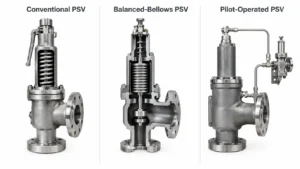
Different pressure safety valve designs respond differently to outlet pressure. Understanding their characteristics helps engineers identify appropriate options for a given application.
Conventional Pressure Safety Valves
Conventional spring-loaded PSVs are often suitable where the outlet pressure conditions are compatible with the valve’s design limitations.
Their performance can be affected by superimposed backpressure, particularly when it varies. Built-up backpressure can also affect stability and capacity.
Conventional valves may be appropriate for some common-header applications, but their suitability must be demonstrated through an evaluation of the actual backpressure and relieving conditions.
Balanced-Bellows Pressure Safety Valves
Balanced-bellows PSVs use a bellows arrangement to reduce the influence of backpressure on the valve’s opening characteristics.
They may be considered where variable superimposed backpressure or higher built-up backpressure makes a conventional valve unsuitable.
However, a balanced-bellows valve is not immune to all backpressure effects. Capacity, stability, allowable backpressure, bellows integrity and bonnet venting arrangements must be evaluated in accordance with the valve design and manufacturer requirements.
Where the bonnet vent must be routed to a safe location, the vent arrangement must not introduce pressure that compromises the intended balancing function.
Pilot-Operated Pressure Safety Valves
Pilot-operated PSVs use a pilot mechanism to control the main valve’s operation. Depending on the design, they can offer advantages in applications involving particular pressure conditions or operating requirements.
Their suitability depends on the pilot configuration, fluid service, operating conditions, discharge pressure and manufacturer limitations.
A pilot-operated design should not be selected solely because the system has high backpressure. The complete valve and relief-system performance must be checked.
How Should Engineers Choose Between These Designs?
Valve selection should consider more than the nominal backpressure percentage. The assessment should include:
- Maximum and minimum superimposed backpressure.
- Calculated built-up and total backpressure for each relevant relief scenario.
- Required relieving capacity and applicable correction factors.
- Set pressure and permitted accumulation.
- Fluid phase, composition and relieving conditions.
- Valve-specific performance limitations.
- Maintenance, inspection and reliability requirements.
- Applicable codes, standards and manufacturer recommendations.
There is no single valve type that is automatically suitable for every high-backpressure application.
How to Evaluate PSV Backpressure During Relief System Design
A systematic engineering assessment helps determine whether the selected valve and discharge system can perform as required.
Step 1: Identify the Overpressure Scenarios
Determine the credible overpressure scenarios that the pressure-relief device must address. These may include blocked outlet, equipment failure, external fire exposure, control failure or other applicable scenarios, depending on the process.
Establish the required relieving rate and conditions for each relevant case.
Step 2: Establish Downstream Pressure Conditions
Identify the pressure expected at the valve outlet before opening and during relief.
For valves connected to a common relief header, consider whether other pressure-relief devices may discharge simultaneously and how this could influence header pressure.
The analysis should use appropriate, defensible assumptions for each scenario.
Step 3: Calculate Discharge System Pressure Losses
Evaluate the pressure drop through the valve discharge piping and downstream system under the required relieving conditions.
The analysis may need to account for pipe geometry, fittings, fluid properties, flow regime, header configuration and disposal system characteristics.
For complex networks or multiple simultaneous relief cases, a more detailed relief-header hydraulic analysis may be necessary.
Step 4: Determine Total Backpressure
Combine the relevant superimposed and built-up backpressure components to establish the total outlet pressure for each scenario.
Check the resulting values against the allowable limits and performance characteristics of the proposed valve.
Do not rely on normal operating pressure alone when the pressure during a relief event may be substantially different.
Step 5: Verify Valve Sizing and Selection
Confirm that the valve can provide the required relieving capacity at the applicable relieving conditions.
Consider any required backpressure correction factors, opening-pressure adjustments, capacity limitations or other design-specific provisions.
Use the applicable edition of the relevant standards and the valve manufacturer’s certified or approved performance data as required.
Step 6: Review the Complete Installation
The assessment should also consider the valve inlet and outlet piping, support arrangements, drainage, potential reaction forces, vibration and other installation requirements where applicable.
A valve that is correctly selected in isolation may still perform poorly if the connected system is inadequately designed.
Common PSV Backpressure Assessment Mistakes
Several mistakes can undermine pressure-relief system reliability.
1. Considering only normal operating pressure
The pressure in a relief header may change significantly during an actual relieving event. Relevant relief scenarios must be assessed.
2. Treating total backpressure as a fixed percentage for every valve
Allowable backpressure depends on valve construction, service, relieving conditions and manufacturer limitations. A single percentage should not be applied universally.
3. Ignoring simultaneous relief cases
Where several devices discharge into a common header, the combined relieving load can influence downstream pressure. Appropriate scenarios must be established and evaluated.
4. Assuming a balanced valve eliminates every backpressure concern
Balanced designs reduce certain effects but can still have capacity, stability or other operating limitations.
5. Using preliminary sizing assumptions as final verification
Preliminary calculations should not replace the detailed sizing and performance checks required for the application. Manufacturer data and the applicable design basis should be used for final verification.
6. Evaluating the valve without checking the discharge system
Pressure losses, header interactions and downstream disposal arrangements can influence overall performance. The valve and connected piping must be assessed as a system.
When Is a Detailed Pressure Relief System Study Required?
A detailed assessment may be warranted when:
- Multiple PSVs discharge into a common relief or flare header.
- Superimposed backpressure varies significantly with operating conditions.
- Calculated built-up backpressure approaches or exceeds the valve’s permitted limit.
- The proposed valve type or capacity changes during a plant modification.
- Relief-header pressure losses are uncertain or inadequately documented.
- Unstable valve operation, repeated leakage or chatter has been observed.
- New equipment or process changes affect the existing relief load.
- The consequences of inadequate overpressure protection require a more comprehensive engineering review.
Depending on the situation, the work may include relief-load assessment, PSV sizing and selection review, discharge piping pressure-drop calculations, flare-header hydraulic analysis and verification against applicable design requirements.
The objective is to confirm that the pressure-relief device and its associated system can protect the equipment under the relevant overpressure scenarios.
Frequently Asked Questions About PSV Backpressure
What is the difference between superimposed and built-up backpressure?
Superimposed backpressure is the pressure already present at the PSV outlet when the valve is required to open. Built-up backpressure develops because of flow through the discharge piping and downstream system after the valve opens.
Why is backpressure important in PSV sizing?
Backpressure can affect opening characteristics, discharge capacity and operational stability. It must be evaluated to verify that the selected valve can meet the required relieving duty under the applicable conditions.
Can a conventional PSV be used with a common relief header?
Yes, in some applications. Suitability depends on the magnitude and variability of superimposed backpressure, built-up backpressure, valve design, relieving conditions and applicable requirements. A common-header connection does not automatically make a conventional valve unsuitable, but the relevant pressure conditions must be assessed.
Does a balanced-bellows PSV eliminate backpressure effects?
No. A balanced-bellows design reduces certain effects of backpressure on valve operation, but other effects, including potential capacity limitations and design-specific operating constraints, still require evaluation.
How is built-up backpressure calculated?
It is determined by analysing pressure losses through the discharge piping and downstream system at the relevant relieving flow and fluid conditions. The calculation may need to include pipe lengths, fittings, fluid properties and the interaction of connected relief devices.
Which standards are relevant to PSV backpressure?
API Standard 520 Part I addresses pressure-relieving device sizing and selection, while API Standard 521 provides guidance for pressure-relieving and depressurizing systems. The applicable editions, other relevant codes and the manufacturer’s requirements should be confirmed for the specific facility and application.
Conclusion
PSV backpressure is an important consideration in pressure safety valve sizing, selection and relief-system design. Both superimposed and built-up backpressure can influence valve performance, but the effects depend on the valve construction, fluid service and downstream system conditions.
Reliable design requires a scenario-based assessment of outlet pressures, discharge-system pressure losses, valve capacity and stability. Selecting a conventional, balanced-bellows or pilot-operated valve should follow from that engineering evaluation rather than from a generic backpressure limit.
For process plants, a documented review of the complete pressure-relief system can help identify design constraints, verify valve suitability and support dependable overpressure protection.
Need support with pressure-relief system engineering?
INDSAFE provides process safety and engineering consultancy services for industrial facilities. Contact our team to discuss your facility’s process safety requirements and determine the appropriate scope of engineering assessment.