

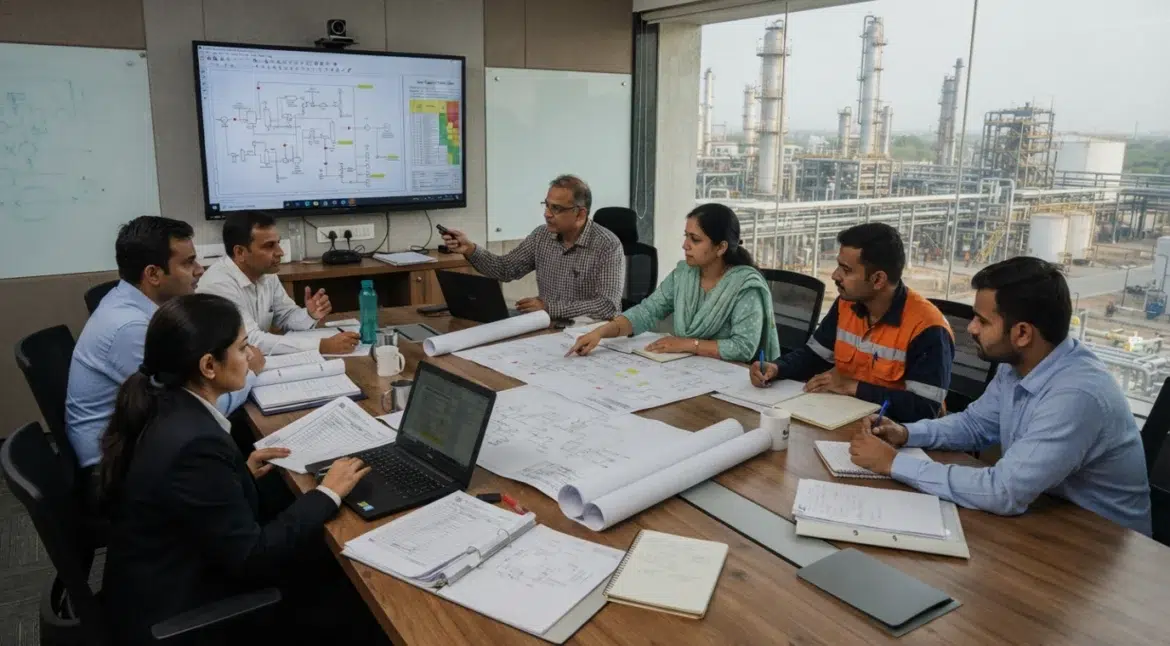
A HAZID study is an important process safety activity used to identify potential hazards and credible hazardous scenarios before they develop into design, operational or safety problems.
A process plant can be designed exactly as the drawings show and still contain significant hazards. A facility may handle flammable hydrocarbons, toxic chemicals, high pressure, high temperature, reactive materials, rotating equipment and complex operating procedures. The challenge is not simply recognizing that these hazards exist. The challenge is understanding how they could lead to unwanted events and whether appropriate safeguards are available to prevent or control those scenarios.
HAZID, short for Hazard Identification Study, is a structured process used to identify potential hazards and credible hazardous scenarios associated with a facility, process, project, activity or system. A HAZID study is commonly performed during the early stages of a project, when its findings can influence design decisions. It can also be conducted during modifications, commissioning, operations and decommissioning.
A HAZID study can help a multidisciplinary project team identify significant hazards, review existing safeguards, identify areas where additional controls may be required, and determine which scenarios require further assessment through studies such as HAZOP, QRA, LOPA or functional safety analysis.
Planning a HAZID study for a new facility, expansion or process modification?
INDSAFE can support the study scope, multidisciplinary workshop, hazard identification, safeguard review, recommendations and documentation.
What Is HAZID?
A Hazard Identification Study, or HAZID, is a structured multidisciplinary review used to identify potential hazards, credible accident scenarios, consequences and existing or required safeguards associated with a project, facility, process, system or activity.
The emphasis is on identifying hazards and scenarios that could have meaningful consequences and determining whether they require further assessment or risk reduction.
A HAZID is therefore more than a brainstorming session.
A useful study asks questions such as:
- What hazards are present?
- What could cause an unwanted event?
- What could happen if the event occurs?
- Who or what could be affected?
- What safeguards already exist?
- Are those safeguards appropriate for the scenario?
- Does the scenario require further analysis?
- What actions should be carried forward into engineering or operations?
The exact HAZID methodology can vary according to the organization, industry, project phase, facility complexity and objectives of the study. There is no single universal HAZID worksheet or guideword set that should be applied identically to every project.
This is an important distinction because a HAZID for an offshore facility, chemical plant, storage terminal, utility system or construction activity may need to consider very different hazard categories.
CCPS describes Hazard Identification and Risk Analysis as a core process safety activity and recognizes that different techniques and levels of analysis may be appropriate depending on the purpose, life cycle stage and complexity of the facility.
Why Is HAZID Important in Process Safety?
Consider two project teams.
The first team identifies during FEED that a hazardous inventory could potentially affect a normally occupied building. At this stage, the plot plan is still being developed.
The second team discovers the same issue after construction is substantially complete.
The underlying hazard may be the same. The engineering consequences of discovering it are not.
During an early design stage, the team may still have options involving equipment location, building separation, orientation, ventilation, drainage, access, detection and emergency response arrangements.
Later in the project, changing those decisions may involve significant redesign, cost and schedule implications.
This is one of the reasons early hazard identification is valuable.
A HAZID can help identify:
- Major accident hazards
- Loss of containment scenarios
- Fire and explosion hazards
- Toxic release scenarios
- High pressure and high temperature hazards
- Reactive chemical hazards
- Utility failure scenarios
- Equipment and mechanical hazards
- Human and operational hazards
- Maintenance and intervention hazards
- SIMOPS hazards
- External and natural hazards
- Emergency response challenges
- Hazards associated with temporary or abnormal conditions
The purpose is not to eliminate every conceivable hazard from a project. That would neither be realistic nor technically useful.
The purpose is to develop a structured understanding of credible hazards and their potential consequences, and to identify where risk controls or additional studies are required.
When Should a HAZID Study Be Conducted?
HAZID is often associated with early project development, but hazard identification should not be treated as a one-time activity.
The appropriate timing depends on the facility, project life cycle and objectives.
HAZID During Concept Design
At the conceptual stage, a HAZID can help identify major hazards before fundamental design decisions are fixed.
The available engineering information may be limited, so the study generally focuses on broad hazards and credible scenarios rather than detailed process deviations.
Questions may include:
- What hazardous materials will be handled?
- What major release scenarios are credible?
- Are there significant fire or explosion hazards?
- Could hazardous releases affect people outside the process area?
- Are there major layout or siting concerns?
- What additional studies will be needed?
HAZID During FEED
FEED usually provides more information about the process configuration, equipment, layout, utilities and operating philosophy.
The HAZID can therefore examine the developing design in greater detail.
Findings at this stage can potentially influence:
- Equipment layout
- Building location
- Separation distances
- Drainage
- Fire protection
- Detection systems
- Emergency shutdown philosophy
- Access and escape
- Ventilation
- Utility arrangements
HAZID During Detailed Engineering
Additional hazard reviews may be appropriate as the design becomes more defined.
This can be particularly relevant where:
- The design has changed significantly
- New equipment has been introduced
- Hazardous inventories have changed
- Interfaces between systems have become clearer
- Earlier assumptions are no longer valid
HAZID During Construction and Commissioning
Construction and commissioning can create temporary hazardous conditions that do not exist during normal operation.
Examples include:
- Temporary connections
- Temporary equipment
- Pressure testing
- Chemical introduction
- Energization
- Equipment preservation and reinstatement
- Temporary bypasses
- Construction and commissioning occurring simultaneously
A project may therefore require additional hazard identification for these activities.
HAZID for Existing Facilities
Existing facilities may require hazard identification when undergoing:
- Major modifications
- Capacity expansion
- New raw materials
- Process changes
- New operating conditions
- Significant equipment replacement
- New interfaces with adjacent facilities
Management of Change processes may also identify the need for additional hazard assessment.
HAZID During Decommissioning
Decommissioning changes the hazard profile of a facility.
Equipment that is no longer operating may still contain:
- Residual chemicals
- Stored pressure
- Contaminants
- Electrical energy
- Mechanical energy
- Flammable or toxic residues
Dismantling, cutting, lifting and temporary arrangements can introduce additional hazards.
For this reason, hazard identification should be considered across the facility life cycle rather than as an isolated design activity.
Need help determining the right process safety study for your project?
HAZID, HAZOP, QRA, LOPA and SIL studies address different questions. INDSAFE can help define the appropriate assessment based on the project stage, process and risk profile.
[Talk to a Process Safety Specialist]
What Does a HAZID Study Cover?
The scope should be tailored to the project.
A generic checklist can be useful for prompting discussion, but relying on a checklist alone can cause important project-specific hazards to be overlooked.
Typical HAZID categories include the following.
Process and Chemical Hazards
The team may consider hazards associated with:
- Flammable substances
- Toxic substances
- Corrosive materials
- Reactive chemicals
- High pressure
- High temperature
- Low temperature
- Unstable materials
- Hazardous inventories
- Chemical incompatibility
The nature of the process should determine which hazards receive attention.
Loss of Containment
Loss of containment is a fundamental concern in many process industries.
Potential causes can include:
- Pipe failure
- Valve failure
- Flange leakage
- Equipment failure
- Corrosion
- Erosion
- Mechanical damage
- Overpressure
- Human error during maintenance
- Incorrect connection or isolation
The resulting consequence may depend on the material, release rate, operating conditions, ignition sources, location and available safeguards.
Fire and Explosion
Where flammable materials are present, HAZID may consider scenarios such as:
- Pool fires
- Jet fires
- Flash fires
- Vapour cloud explosions
- Boiling liquid expansion events where applicable
- Secondary escalation to nearby equipment
The HAZID may identify the need for more detailed fire, explosion or consequence assessment rather than attempting to perform all such analyses during the workshop itself.
Toxic Releases
Toxic releases may result from equipment failure, piping failure, accidental mixing, process upsets or other credible initiating events.
The team may consider:
- Source of the release
- Potential affected areas
- Occupied buildings
- Detection
- Isolation
- Ventilation
- Emergency response
- Potential requirement for dispersion modelling
Where necessary, detailed toxic dispersion analysis can subsequently be performed.
Utility Failure
Utilities can be safety critical even though they may not directly form part of the process.
The HAZID may consider loss of:
- Electrical power
- Instrument air
- Cooling water
- Heating medium
- Nitrogen
- Ventilation
- Firewater
- Communication
- Control systems
The important question is not simply whether a utility can fail.
It is:
What happens to the process when it fails?
A loss of cooling, for example, could be insignificant in one process and highly consequential in another.
Human and Operational Hazards
A technically sound design can still present significant risk if operating and maintenance activities are not considered.
HAZID may examine:
- Startup
- Shutdown
- Normal operation
- Manual intervention
- Sampling
- Draining
- Venting
- Isolation
- Maintenance
- Permit to work activities
- Line breaking
- Loading and unloading
- Access
- Emergency actions
Human factors should therefore be considered as part of the overall hazard picture rather than added as an afterthought.
SIMOPS
SIMOPS means simultaneous operations.
Different activities taking place at the same time can interact in ways that create hazards.
For example, construction work may occur near a live process area while maintenance activities are taking place.
Potential interactions may involve:
- Hot work
- Lifting
- Hydrocarbon handling
- Vehicle movement
- Electrical work
- Commissioning
- Process operations
The HAZID can identify these interfaces and determine whether additional controls or dedicated assessments are necessary.
External and Natural Hazards
Depending on location and facility type, the assessment may consider:
- Earthquake
- Flood
- Lightning
- High winds
- Extreme temperatures
- Nearby industrial incidents
- Transportation incidents
- External fires
- Other site-specific natural or external events
The assessment should be based on the actual site and project context rather than automatically applying every possible external hazard.
How Is a HAZID Study Conducted?
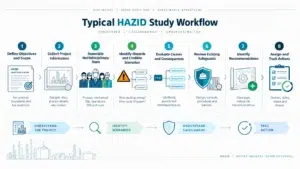
Although the exact procedure varies, a well-planned HAZID commonly follows a structured sequence.
1. Define the Study Objectives
The team first establishes what the HAZID is intended to achieve.
This may include:
- Identifying major hazards
- Reviewing a new process concept
- Supporting FEED
- Reviewing a plant modification
- Identifying scenarios requiring QRA
- Reviewing facility siting
- Assessing commissioning activities
- Identifying requirements for further studies
Without a clear objective, the study can become a long list of unrelated observations.
2. Define the Scope and Boundaries
The team should establish what is included and excluded.
For example:
- Process units
- Storage areas
- Loading facilities
- Utilities
- Offsites
- Control rooms
- Laboratories
- Warehouses
- Transportation interfaces
- Construction areas
Scope boundaries should be documented so that gaps can be identified.
3. Collect Available Information
Depending on the project stage, information may include:
- Process descriptions
- Block flow diagrams
- Process flow diagrams
- Plot plans
- Equipment layouts
- Material inventories
- Safety Data Sheets
- Preliminary equipment specifications
- Utility information
- Operating philosophy
- Emergency response philosophy
- Site information
- Meteorological information
- Previous incident information
A HAZID should recognize information limitations rather than presenting uncertain assumptions as established facts.
4. Select an Appropriate HAZID Method
The study team determines the approach used to identify hazards.
Methods may involve combinations of:
- Structured brainstorming
- Hazard categories
- Checklists
- Previous incident experience
- Scenario-based questioning
- Engineering judgement
- Review of similar facilities
- Site-specific information
The method should be proportionate to the complexity and maturity of the project.
5. Conduct the Multidisciplinary Workshop
The workshop brings together people from different technical and operational disciplines.
The facilitator guides the team through the defined scope and ensures that hazards are considered systematically.
A useful discussion typically moves beyond:
“There is a fire hazard.”
and asks:
What could release the material?
Under what conditions?
What could ignite it?
Who or what could be affected?
What safeguards are already provided?
What happens if a safeguard fails?
Does the scenario require further analysis?
That progression turns a generic hazard statement into a useful engineering scenario.
6. Identify Causes and Consequences
For each significant scenario, the team considers credible initiating causes and potential consequences.
For example:
Hazard: Flammable liquid release
Potential causes:
Piping failure, flange leakage, equipment failure or maintenance error
Potential consequence:
Formation of a flammable vapour cloud followed by ignition
Potential impacts:
Personnel exposure, equipment damage and possible escalation
Existing safeguards:
Detection, isolation, fire protection and inspection controls
Further action:
Additional engineering review or consequence assessment, if required
The level of detail should remain appropriate to the HAZID. A HAZID should not automatically become a full consequence modelling exercise.
7. Review Existing Safeguards
The team considers what controls are already available.
Safeguards may include:
- Equipment design
- Process control
- Alarms
- Detection
- Isolation
- Relief systems
- Emergency shutdown
- Fire protection
- Physical separation
- Ventilation
- Procedures
- Inspection and maintenance
The existence of a safeguard does not automatically mean that the risk is adequately controlled.
Its relevance, independence, reliability and suitability for the scenario may need further evaluation.
8. Identify Recommendations
Where the existing design does not adequately address an identified scenario, the team can recommend further action.
Recommendations may involve:
- Design modification
- Additional detection
- Improved isolation
- Layout changes
- Fire protection
- Drainage
- Ventilation
- Instrumentation
- Procedural controls
- Inspection requirements
- Additional analysis
Where practical, the team should consider whether the hazard can be reduced through design rather than relying exclusively on administrative controls.
9. Document and Track Actions
A HAZID should result in more than workshop notes.
Recommendations should be documented, assigned and tracked.
A typical action record may contain:
| Field | Example |
|---|---|
| Hazard / Scenario | Loss of containment from process piping |
| Cause | Piping failure |
| Consequence | Flammable release and potential fire |
| Existing Safeguard | Detection and isolation |
| Recommendation | Review detection and isolation coverage |
| Responsible Person | Assigned project discipline |
| Target Date | Defined by project |
| Status | Open / Closed |
The exact format varies between organizations.
The important principle is that findings should remain visible until the responsible team has evaluated and closed them.
Who Should Participate in a HAZID Workshop?
HAZID is fundamentally multidisciplinary.
The appropriate team depends on the project, but may include:
- Process engineers
- Process safety engineers
- Operations personnel
- Mechanical engineers
- Instrumentation and control engineers
- Electrical engineers
- HSE professionals
- Fire protection specialists
- Maintenance representatives
- Project engineers
- Layout or facility engineers
- Other relevant subject matter experts
Operations participation can be particularly valuable.
An engineer reviewing a PFD may see a process connection.
An experienced operator may immediately recognize that the connection is routinely isolated, drained, sampled or manually manipulated.
Those practical details can materially change the hazard discussion.
The objective is therefore not to assemble the largest possible team.
It is to assemble a team with the right combination of technical, operational and facility knowledge for the study scope.
What Information Is Needed Before a HAZID?
The information required depends on the project phase.
For an early conceptual HAZID, the available information may include only:
- Process concept
- Major equipment
- Hazardous materials
- Preliminary layout
- Major operating conditions
- Basic site information
For a more developed project, the team may have access to:
- PFDs
- P&IDs
- Plot plans
- Equipment specifications
- Material inventories
- Operating philosophy
- Control philosophy
- Fire protection philosophy
- Emergency response information
- Utility information
The important principle is simple:
The HAZID should reflect the maturity of the design information available at the time of the study.
It is inappropriate to create false precision where the design is still conceptual.
Practical HAZID Example: What Happens During a Workshop?
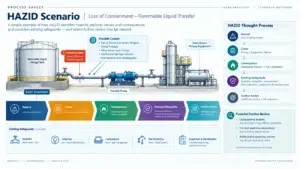
Consider a storage facility handling a flammable liquid.
The HAZID team identifies a potential loss of containment from a storage tank transfer line.
The discussion could develop as follows.
Hazard
Flammable liquid release.
Possible causes
- Transfer piping failure
- Flange leakage
- Valve failure
- Mechanical damage
- Incorrect maintenance activity
Potential consequences
If the released liquid forms a vapour cloud and encounters an ignition source, possible consequences could include:
- Flash fire
- Pool fire
- Equipment damage
- Personnel exposure
- Escalation to adjacent equipment
Existing safeguards
The team may identify controls such as:
- Isolation valves
- Leak detection
- Fire protection
- Inspection and maintenance
- Bunding or containment
- Emergency procedures
HAZID recommendation
Depending on the actual facility and scenario, the team may recommend reviewing:
- Isolation arrangements
- Detection coverage
- Drainage and containment
- Ignition source control
- Fire protection
- Separation from occupied areas
- Need for consequence modelling
Notice what the HAZID has achieved.
It has not attempted to calculate every possible consequence during the workshop.
Instead, it has established a credible scenario, considered the controls and identified where additional engineering attention may be required.
That is an important distinction between hazard identification and detailed quantitative analysis.
What Are the Outputs of a HAZID Study?
The exact deliverables depend on the project, but commonly include:
HAZID Report
The report normally records:
- Study objectives
- Scope and boundaries
- Methodology
- Participants
- Reference documents
- Assumptions
- Identified hazards
- Scenarios
- Consequences
- Existing safeguards
- Recommendations
- Risk evaluation, where applicable
- Action tracking
Hazard Register
The hazard register provides a structured record of identified hazards and relevant information.
Action Register
Recommendations requiring further work should be tracked to closure.
Inputs to Further Studies
One of the most valuable HAZID outputs may be the identification of issues requiring more detailed assessment.
Depending on the project, these may include:
- HAZOP
- QRA
- Consequence analysis
- Dispersion modelling
- Fire and explosion assessment
- LOPA
- SIL assessment
- Facility siting assessment
- Emergency response assessment
- Hazardous area classification
HAZID vs HAZOP
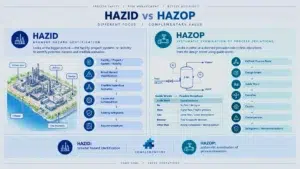
HAZID and HAZOP are often mentioned together, but they answer different questions.
HAZID
HAZID generally asks:
What significant hazards and credible scenarios exist within this project, facility, system or activity?
HAZOP
HAZOP asks:
What deviations from the design intent could occur, what could cause them, what consequences could result, and what safeguards exist?
HAZOP uses a structured guideword-based methodology. IEC 61882 provides guidance for the application of HAZOP studies, including preparation, examination sessions, documentation and follow-up.
| Aspect | HAZID | HAZOP |
|---|---|---|
| Primary focus | Broad hazard identification | Detailed deviation analysis |
| Typical scope | Facility, project, system or activity | Process systems or defined nodes |
| Method | Structured hazard identification | Guideword-based examination |
| Typical timing | Often early project stages, but can be used throughout the life cycle | Usually when sufficient process design information is available |
| Main question | What could be hazardous? | What could deviate from design intent? |
| Level of detail | Broad to intermediate | More detailed |
| Relationship | Can identify areas requiring further study | Can provide detailed analysis of defined process systems |
They are complementary rather than competing techniques.
A HAZID may identify a broad hazard that requires detailed HAZOP examination later.
Already planning a HAZOP after HAZID?
HAZID findings can provide useful inputs for defining the scope and priorities of subsequent process safety studies.
[Contact us for HAZOP Services]
HAZID vs HIRA
The terminology can become confusing because different organizations use these terms differently.
HIRA commonly refers to Hazard Identification and Risk Analysis and can be used as a broader term covering activities used to identify hazards and analyze risk.
HAZID is a specific structured hazard identification approach.
Therefore, HAZID can form part of a broader HIRA framework.
The terminology used by a project should be explicitly defined so that everyone understands:
- What methodology is being used
- What is included in the study
- What risk evaluation is performed
- What outputs are expected
The name of the study is less important than the actual scope and methodology applied.
HAZID vs QRA
HAZID and QRA should not be treated as interchangeable.
A HAZID primarily identifies hazards and credible scenarios and determines where further risk analysis may be required.
A Quantitative Risk Assessment, or QRA, uses quantitative methods to estimate risk using defined inputs such as initiating event frequencies, consequence modelling and other relevant parameters.
For example, a HAZID may identify:
Potential toxic release from process equipment.
The project may then determine that the scenario requires:
- Source term estimation
- Atmospheric dispersion modelling
- Exposure assessment
- Frequency estimation
- Individual and/or societal risk assessment
Those activities would generally belong to a more detailed consequence or QRA process rather than the basic HAZID workshop.
How Does HAZID Relate to LOPA and SIL?
HAZID, HAZOP, LOPA and SIL assessment can contribute to different parts of the process safety assessment framework.
A simplified relationship may look like:
HAZID
Broad hazard and scenario identification
↓
HAZOP
Detailed examination of process deviations
↓
LOPA
Semi quantitative evaluation of selected scenarios and protection layers
↓
SIL Assessment
Determination of required Safety Integrity Level for applicable safety instrumented functions
However, this should not be interpreted as a mandatory sequence for every project.
A project may use some techniques without using all of them, and the appropriate methodology depends on the hazards, design stage, applicable requirements and objectives.
For example, not every HAZID finding automatically requires LOPA, and not every HAZOP deviation requires a SIL assessment.
The analysis should be proportionate to the scenario and the decision that needs to be made.
Need to determine whether identified scenarios require LOPA or SIL assessment?
INDSAFE can support the transition from hazard identification to more detailed process safety analysis where the project requires it.
[Contact us for LOPA and Functional Safety Services]
What Makes a HAZID Study Effective?
A HAZID can be completed according to a documented procedure and still provide limited value if the underlying study process is weak.
Several factors make a difference.
The Right Participants
A multidisciplinary team brings different perspectives to the same scenario.
The Right Information
The team needs enough information to make meaningful decisions while recognizing what remains uncertain.
Good Facilitation
The facilitator should keep the discussion systematic, encourage participation and prevent the workshop from becoming dominated by a single discipline.
Scenario Quality
“Fire” or “toxic release” is not always enough.
The team should understand the credible scenario sufficiently to determine its relevance and required safeguards.
Appropriate Risk Evaluation
Where risk ranking is used, the criteria should be defined and applied consistently.
Practical Recommendations
Recommendations should be specific enough to be acted upon.
“Improve safety” is not a useful action.
“Review isolation coverage for the identified release scenario” is much more actionable.
Action Closeout
An open recommendation that disappears into a report is not effective risk management.
The action needs an owner, a decision and documented closure.
Common HAZID Mistakes
Some of the most important weaknesses in HAZID studies are not caused by the absence of a checklist.
They arise from how the study is conducted.
Treating HAZID as a Compliance Exercise
If the objective becomes simply completing the worksheet, the discussion can lose its engineering value.
Using the Same Checklist for Every Facility
A refinery, pharmaceutical plant, gas terminal and manufacturing facility do not have identical hazard profiles.
Checklists should support engineering judgement, not replace it.
Ignoring Human and Maintenance Activities
Normal operation is only part of the facility life cycle.
Maintenance, isolation, startup, shutdown and intervention can introduce significant hazards.
Focusing Only on Process Equipment
Facility layout, occupied buildings, access, utilities, external events and interfaces can be equally important.
Recording Hazards Without Scenarios
A register containing only “fire,” “explosion” and “toxic release” provides limited insight.
The team needs enough scenario definition to understand what can actually happen.
Ignoring Uncertainty
Early design information is often incomplete.
The study should document important assumptions and identify where further information or analysis is required.
Failing to Close Actions
This is one of the most important practical weaknesses.
The value of a HAZID is ultimately reflected in how its findings influence engineering and operational decisions.
Does HAZID Identify Risk?
This requires some clarification.
A HAZID identifies hazards and scenarios and may include risk evaluation depending on the methodology used.
However, HAZID should not automatically be assumed to provide a complete quantitative assessment of facility risk.
The depth of risk evaluation should be defined by the study objectives.
A qualitative or semi quantitative screening may be sufficient for some purposes.
Other scenarios may require detailed QRA, consequence modelling, LOPA or another specialized assessment.
This distinction prevents HAZID from being asked to answer questions it was never designed to answer.
Can HAZID Identify SIL Requirements?
Not directly in every case.
HAZID may identify hazardous scenarios and highlight the need for additional safeguards.
If a scenario involves a safety instrumented function, further analysis may be required to determine whether a SIF is necessary and, where applicable, what SIL is required.
Depending on the methodology and project requirements, this may involve HAZOP, LOPA and subsequent SIL assessment or verification.
Therefore:
HAZID can identify scenarios that may eventually lead to functional safety assessment, but it should not automatically be treated as a SIL determination method.
How Detailed Should a HAZID Be?
The answer depends on the project stage and study objective.
A conceptual HAZID may appropriately remain broad.
A HAZID performed on a mature design may consider more specific equipment, interfaces and scenarios.
The principle is:
The depth of the HAZID should be appropriate to the decisions the study is intended to support.
Too little detail can miss important scenarios.
Too much detail can duplicate later studies and make the HAZID unnecessarily difficult to manage.
A good study finds the appropriate level.
Is HAZID Required by Law or a Specific Standard?
There is no universal rule that every industrial project in every jurisdiction must conduct a study called “HAZID” using one prescribed methodology.
Whether a HAZID or another hazard identification study is required can depend on:
- Applicable legislation
- Regulatory requirements
- Industry requirements
- Client specifications
- Project standards
- Company process safety procedures
- Facility hazard profile
- Insurer or stakeholder requirements
This is why a technical assessment should identify the applicable requirements rather than claiming that HAZID is universally mandatory.
HAZID should also not be confused with HAZOP requirements where specific standards or project requirements apply.
HAZID in a Broader Process Safety Framework
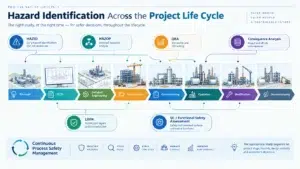
HAZID works best when it is connected to the wider process safety management system.
A simplified view is:
Identify hazards
↓
Understand credible scenarios
↓
Evaluate risk where required
↓
Select appropriate safeguards
↓
Verify the design
↓
Manage changes
↓
Maintain the safeguards
↓
Monitor and improve
A HAZID therefore represents one part of a larger risk management process.
The ultimate objective is not the HAZID report itself.
The objective is to make better engineering and operational decisions based on a structured understanding of hazards.
How INDSAFE Approaches HAZID Studies
At INDSAFE, HAZID studies can be tailored to the project phase, facility type, process complexity and objectives of the assessment.
The study scope can consider relevant process, facility, operational and external hazards and can be structured around the information available at the time of assessment.
Depending on project requirements, the assessment may consider:
- Process and chemical hazards
- Loss of containment
- Fire and explosion scenarios
- Toxic release scenarios
- Utility failures
- Human and operational factors
- SIMOPS
- Facility and layout considerations
- External and natural hazards
- Existing safeguards
- Risk reduction opportunities
- Recommendations for further studies
Where the HAZID identifies scenarios requiring more detailed assessment, the findings can provide inputs to subsequent studies such as HAZOP, QRA, consequence analysis, LOPA, SIL assessment and other process safety evaluations.
The methodology, study scope, participants and deliverables should be defined according to the specific project rather than applying an identical template to every facility.
Planning a HAZID for your facility or project?
Share your project stage, facility type and assessment objectives with the INDSAFE team to discuss the appropriate study scope.
Frequently Asked Questions About HAZID
What does HAZID stand for?
HAZID generally stands for Hazard Identification or Hazard Identification Study. The terminology can vary between organizations and projects.
What is the main purpose of HAZID?
The main purpose of HAZID is to systematically identify potential hazards and credible hazardous scenarios, consider their consequences and safeguards, and determine whether additional controls or further analysis are required.
When should a HAZID study be conducted?
HAZID is often conducted during conceptual design and FEED, but it can also be performed during detailed engineering, construction, commissioning, operation, modification and decommissioning when appropriate.
Who participates in a HAZID workshop?
HAZID workshops are typically multidisciplinary. Participants may include process, process safety, operations, mechanical, instrumentation, electrical, HSE, maintenance, fire protection and project personnel, depending on the study scope.
What is the difference between HAZID and HAZOP?
HAZID is generally broader and focuses on identifying hazards and credible scenarios. HAZOP uses guide words to systematically examine deviations from design intent within defined process systems.
Is HAZID the same as HIRA?
No. HIRA is commonly used as a broader term for Hazard Identification and Risk Analysis activities. HAZID is one structured approach to hazard identification.
Is HAZID the same as QRA?
No. HAZID primarily identifies hazards and scenarios. QRA uses quantitative methods to estimate risk using defined frequency, consequence and other relevant inputs.
Does HAZID replace HAZOP?
No. HAZID and HAZOP serve different purposes and can complement one another.
Does HAZID replace QRA?
No. A HAZID may identify scenarios that require detailed QRA, but it does not replace a QRA where quantitative risk analysis is required.
Can HAZID determine SIL?
HAZID can identify scenarios that may require functional safety assessment, but SIL determination normally requires an appropriate functional safety methodology such as LOPA or another recognized assessment approach.
What are the outputs of HAZID?
Typical outputs include a HAZID report, hazard register, identified scenarios, safeguard information, recommendations and an action register. Additional study recommendations may also be included.
How long does a HAZID study take?
There is no universal duration. The time required depends on the size and complexity of the facility, study scope, available information, number of systems or areas being reviewed and composition of the workshop team.
Can HAZID be conducted for an existing plant?
Yes. HAZID can be applied to existing facilities, particularly during major modifications, expansions, process changes, operational changes or other situations where a structured hazard review is appropriate.
Conclusion
HAZID is fundamentally about asking the right questions early enough for the answers to influence decisions.
What can go wrong?
What could cause it?
What could happen next?
Who or what could be affected?
What safeguards already exist?
And where is further action necessary?
The value of a HAZID does not come from producing the longest hazard register. It comes from developing a structured understanding of credible scenarios and ensuring that important findings are carried forward into design, detailed analysis and operations.
HAZID is also not a replacement for HAZOP, QRA, LOPA, SIL assessment or other specialized process safety studies. Each technique addresses different questions and levels of analysis.
Used appropriately, HAZID can provide an important early layer of hazard understanding and help project teams make informed decisions before design choices become difficult to change.
For complex industrial projects, effective hazard identification is not simply about finding hazards.
It is about understanding them well enough to make better decisions about prevention, protection and risk reduction.
Technical References
Center for Chemical Process Safety, AIChE
Introduction to Hazard Identification and Risk Analysis.
Center for Chemical Process Safety, AIChE
Guidelines for Hazard Evaluation Procedures.
Center for Chemical Process Safety, AIChE
Guidelines for Risk Based Process Safety.
International Electrotechnical Commission
IEC 61882:2016, Hazard and operability studies, HAZOP studies, Application guide.
Important technical note: IEC 61882 is specifically guidance for HAZOP studies. It should not be presented as a universal HAZID standard.