


HAZOP revalidation is an important part of process safety management, helping industrial facilities determine whether an existing Hazard and Operability (HAZOP) study still reflects their current process design, equipment configuration and operating conditions.
As plants undergo modifications, introduce new chemicals, change operating parameters or update safety systems, the assumptions documented in an earlier HAZOP study may no longer remain valid. Equipment may be modified, process parameters may be revised, operating procedures may be updated, and recommendations from the original study may remain unresolved.
This raises an important question: How can a facility determine whether its existing HAZOP study still represents the risks of its current operations?
HAZOP revalidation provides a structured way to review an existing study, assess changes since the original assessment and determine whether the previous hazard analysis remains adequate or requires further examination.
In this article, we explain when HAZOP revalidation should be considered, what factors need to be reviewed, how the process is performed and what facilities should consider when planning a revalidation.
What Is HAZOP Revalidation?
HAZOP revalidation is a systematic review of an existing HAZOP study to determine whether its findings, assumptions, identified hazards, safeguards and recommendations remain relevant to the current process and operating conditions.
The purpose is not simply to confirm that a previous HAZOP report exists. It is to establish whether the study still reflects the facility’s actual design intent and operating practices.
During revalidation, the review team may examine:
- Changes to process design, equipment and piping.
- Modifications to operating conditions and process parameters.
- Changes in raw materials, chemicals or process composition.
- Updates to control systems, alarms and protective functions.
- Changes to operating and maintenance procedures.
- Previous HAZOP recommendations and their implementation status.
- Incident history, near misses and relevant operating experience.
- Changes in the assumptions on which the original study was based.
The outcome may be confirmation that the existing HAZOP remains suitable, an updated HAZOP record, a focused review of affected sections, or a recommendation to conduct a more comprehensive HAZOP.
The appropriate outcome depends on the nature and extent of the changes identified.
Why Is HAZOP Revalidation Important?
A HAZOP study is based on a defined process configuration and design intent. If the facility changes but the original study is not reviewed, there can be a gap between the hazards documented in the report and the risks associated with current operations.
Revalidation helps facilities identify this gap.
1. Identifying Hazards Introduced by Plant Modifications
Even modifications that appear minor can affect process behaviour or existing safeguards.
For example, changing a control valve, modifying a bypass line or increasing a pump capacity may influence flow, pressure, temperature or operating conditions. These changes may introduce deviations that were not considered in the original HAZOP.
A revalidation review helps determine whether previous findings remain applicable and whether additional hazard analysis is necessary.
2. Accounting for Changes in Operating Conditions
Process facilities do not always operate under exactly the same conditions throughout their operating life.
Changes in production rates, operating pressure, temperature, chemical composition or equipment operating philosophy can affect the original process assumptions.
Revalidation provides an opportunity to assess whether these changes have altered the causes, consequences or likelihood of previously identified deviations.
3. Reviewing the Status of Existing Safeguards
A safeguard identified in an original HAZOP should not automatically be assumed to remain effective.
The review should consider whether the safeguard is still installed, available, maintained and suitable for the scenario for which it was credited.
For example, an alarm may have been modified, an interlock may have been bypassed, or an operating procedure may no longer reflect the current plant configuration.
Where safeguard performance is important to the risk assessment, the relevant function and supporting evidence should be checked.
4. Evaluating Previous HAZOP Recommendations
Recommendations from the original study may have been completed, partially implemented, deferred or left open.
Revalidation should examine the status of these recommendations and whether the actions taken adequately address the original concern.
It should also consider whether changes made while implementing an action have introduced new hazards or affected other parts of the process.
5. Addressing Changes That Accumulate Over Time
Not every modification requires a full HAZOP study. However, several small changes made over a period of time can collectively alter the original design intent or risk profile.
This is sometimes referred to as creeping change.
A review that considers only individual modifications may fail to identify their combined effect. HAZOP revalidation provides an opportunity to examine the cumulative impact of changes since the previous study.
When Should a HAZOP Study Be Revalidated?
There is no single revalidation interval that should be applied automatically to every facility. The appropriate timing depends on applicable regulations, industry requirements, company procedures, the facility’s risk profile and the extent of changes since the previous study.
The following are important situations in which HAZOP revalidation should be considered.
1. At Defined Periodic Review Intervals
Facilities should establish a documented schedule for reviewing existing HAZOP studies.
The interval should be determined using applicable legal and regulatory requirements, corporate standards, industry guidance and a risk-based assessment of the facility.
Some operating companies use a five-year review cycle as part of their internal HAZOP procedures. However, five years should not be presented as a universal statutory requirement or a substitute for reviewing significant changes as they occur.
A periodic review should assess whether the original study continues to represent the current plant configuration, operating conditions and hazards.
2. After Significant Process or Equipment Modifications
A HAZOP review should be considered when modifications affect process design, equipment configuration or operating philosophy.
Examples include:
- Installation of new process equipment.
- Changes to reactor, vessel or column configuration.
- Modifications to process piping and pipeline connections.
- Changes in pump or compressor capacity.
- Alterations to pressure or temperature operating limits.
- Addition or modification of process bypass lines.
- Changes to utility systems that support process operation.
The need for a new or updated HAZOP should be determined through the facility’s Management of Change (MOC) and process hazard analysis procedures.
A minor modification may require a focused review, while a major process change may justify a comprehensive HAZOP.
3. When New Chemicals or Raw Materials Are Introduced
Introducing a new chemical, changing a raw material or modifying the composition of a process stream can affect the hazard profile of a facility.
The review should consider relevant changes in:
- Chemical reactivity.
- Flammability and explosivity.
- Toxicity.
- Corrosivity.
- Thermal stability.
- Potential incompatibility with existing materials.
- Process reaction behaviour.
For example, changing a solvent or introducing a new reactant may alter the potential for unwanted reactions, vapour generation, pressure build-up or material incompatibility.
Where the change affects process hazards or design assumptions, the existing HAZOP should be reviewed and updated as appropriate.
4. After Changes to Control and Safety Systems
Instrumentation and control system modifications can affect the way process deviations are detected and controlled.
Examples include:
- Changes to alarm set points.
- Modification of control logic.
- Changes to interlocks and shutdown functions.
- Replacement or relocation of process instruments.
- Changes to control valve operating philosophy.
- Modifications to safety instrumented functions.
The review should establish whether the existing HAZOP assumptions about alarms, interlocks and other safeguards remain valid.
Where a change affects a Safety Instrumented Function (SIF), the relevant functional safety lifecycle activities should also be considered. A HAZOP revalidation does not replace required SIL verification, functional safety assessment or other functional safety activities.
5. Following Process Incidents or Repeated Operational Problems
An incident, near miss or recurring operational problem may reveal a hazard or scenario that was not adequately addressed in the original study.
Examples include:
- Repeated high-pressure or high-temperature events.
- Unexpected process reactions.
- Loss of containment.
- Equipment failures affecting process safety.
- Repeated activation of alarms or shutdown systems.
- Unplanned process interruptions associated with hazardous conditions.
The incident should first be investigated using the facility’s incident investigation process. Its findings can then be used to determine whether the original HAZOP needs to be reviewed, updated or supplemented by another risk assessment.
6. When Operating Procedures or Process Modes Change
A change in the way a process is operated can introduce hazards even when the physical equipment remains unchanged.
Examples include:
- Changes to start-up or shutdown sequences.
- Introduction of new operating modes.
- Changes to manual intervention requirements.
- Revised maintenance or cleaning procedures.
- Changes to batch processing sequences.
- Introduction of temporary operating conditions.
These changes should be assessed to determine whether the original HAZOP adequately considered the current operating practices and associated deviations.
7. Before Major Plant Upgrades or Life Extension Projects
Major upgrades, capacity expansions, equipment replacement programmes and plant life extension projects can affect the original process safety assumptions.
A review of existing HAZOP records can help identify areas where the original study may no longer provide an adequate basis for understanding the facility’s hazards.
Where the scope of the modification is extensive, a new or comprehensive process hazard analysis may be more appropriate than a limited revalidation.
Practical Example: HAZOP Revalidation After a Process Modification

Consider a chemical processing facility where the capacity of an existing transfer pump is increased to support higher production.
Although the modification may appear straightforward, it can affect:
- Flow rates through downstream equipment.
- Operating pressure within connected pipelines.
- Potential for overpressure under blocked-outlet conditions.
- Existing control valve operating ranges.
- Alarm and trip set points.
During HAZOP revalidation, the review team compares the original study assumptions with the modified operating conditions and checks whether the previously identified causes, consequences and safeguards remain applicable.
If the modification introduces new deviations or changes the consequences of existing scenarios, the affected HAZOP sections may need to be updated or subjected to further risk assessment.
This example illustrates why seemingly straightforward plant modifications should be evaluated against the original process safety assumptions.
HAZOP Revalidation vs. a New HAZOP Study
One of the most important decisions during the review process is whether the existing HAZOP can be revalidated or whether a new study is required.
These approaches are related, but they are not interchangeable.
| Aspect | HAZOP Revalidation | New HAZOP Study |
|---|---|---|
| Main purpose | Assess whether an existing study remains valid | Systematically examine the defined process or system |
| Starting point | Previous HAZOP report and current plant information | Current design intent and process information |
| Scope | Existing study, changes and identified gaps | Defined system or facility scope |
| Review focus | Continued validity of hazards, assumptions and safeguards | Identification of deviations, causes and consequences |
| Typical outcome | Confirmation, update, focused review or recommendation for further study | New HAZOP records, findings and recommendations |
| When considered | Where an existing study is available and its continued validity needs assessment | Where the process has changed substantially, the previous study is inadequate or a new analysis is required |
A revalidation exercise may conclude that a new HAZOP is necessary. For example, a major process expansion or substantial change in process technology may make the original study unsuitable as the basis for the current facility.
The decision should be documented and supported by the review findings.
How Is a HAZOP Revalidation Performed?
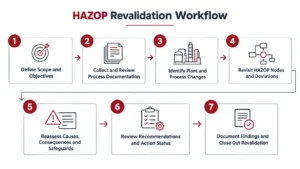
A structured revalidation process helps ensure that the review is based on current and reliable information rather than simply checking the previous report.
The following steps describe a typical approach.
Step 1: Review the Previous HAZOP Study
The first step is to examine the original HAZOP report and associated records.
The review should consider:
- Study scope and boundaries.
- Design intent for each node.
- Process parameters and deviations examined.
- Identified causes and consequences.
- Existing safeguards.
- Recommendations and action status.
- Assumptions and limitations recorded during the original study.
The team should also determine whether the original study was sufficiently detailed and whether its documentation is suitable for revalidation.
Step 2: Collect and Verify Current Plant Information
The review requires accurate information about the facility as it currently exists and operates.
Depending on the scope, relevant documents may include:
- Latest Process Flow Diagrams (PFDs).
- Updated Piping and Instrumentation Diagrams (P&IDs).
- Process design basis and operating limits.
- Equipment specifications and data sheets.
- Process descriptions.
- Operating and maintenance procedures.
- Control narratives and cause-and-effect diagrams.
- Alarm and trip information.
- Management of Change records.
- Incident and near-miss investigation reports.
- Previous HAZOP action tracking records.
Document revisions should be checked against the actual plant configuration. Outdated drawings or incomplete modification records can undermine the reliability of the review.
Step 3: Identify Changes Since the Previous HAZOP
The next step is to compare the original study basis with the current facility.
The review should identify changes to:
- Process design and operating conditions.
- Equipment and piping arrangements.
- Chemicals and process materials.
- Instrumentation and control systems.
- Safeguards and protective functions.
- Operating and maintenance procedures.
- Plant operating modes.
- Relevant incident and operational experience.
The team should also assess the cumulative impact of multiple modifications rather than considering each change in isolation.
Step 4: Evaluate Existing Hazards and Safeguards
For each relevant HAZOP node or scenario, the review should determine whether the original causes, consequences and safeguards remain valid.
Questions may include:
- Does the original design intent still apply?
- Have any new causes of deviation been introduced?
- Could the consequences be different under current operating conditions?
- Are the identified safeguards still available and suitable?
- Have any safeguards been modified, bypassed or removed?
- Are the original assumptions about operator intervention still valid?
- Have new hazards emerged from cumulative changes?
Where a safeguard is credited as providing risk reduction, its suitability should be assessed using relevant technical information. A safeguard should not be assumed effective merely because it appears in the previous HAZOP report.
Step 5: Determine the Required Level of Further Study
Based on the review, the team should decide whether:
- The existing HAZOP remains valid.
- Specific sections or nodes need to be updated.
- A focused HAZOP review is required.
- Additional risk assessment is necessary.
- A comprehensive new HAZOP study should be conducted.
This decision should be based on the technical significance of the changes and the adequacy of the existing study.
Step 6: Document Findings and Recommendations
The revalidation outcome should be recorded in a clear and traceable format.
Depending on the agreed scope, the documentation may include:
- Revalidation scope and methodology.
- Reference to the original HAZOP study.
- Documents reviewed and their revision status.
- Changes identified since the previous study.
- Review findings and technical justifications.
- Updated or additional HAZOP records, where applicable.
- Recommendations and assigned actions.
- Items requiring further assessment.
- Conclusions regarding the continued validity of the original study.
Step 7: Track Actions and Verify Implementation
Revalidation is not complete from a risk management perspective simply because a report has been issued.
Recommendations should be assigned to responsible persons, given appropriate priorities and tracked through the facility’s action management system.
Where modifications are implemented, relevant drawings, procedures and operating information should be updated. Any required training, testing and pre-start-up verification should also be completed before the modified system is returned to service, as applicable.
What Documents Are Required for HAZOP Revalidation?
The quality of a revalidation depends on the availability and accuracy of supporting documentation.
The following table outlines commonly required inputs. The exact document list will depend on the facility and the agreed scope.
| Document or Record | Purpose |
|---|---|
| Previous HAZOP report | Provides the original study basis and findings |
| Latest P&IDs | Shows current piping, instrumentation and equipment configuration |
| Process Flow Diagrams | Helps understand process flow and major operating conditions |
| Process design basis | Defines intended process parameters and design assumptions |
| Equipment data sheets | Provides equipment design and operating information |
| Operating procedures | Helps verify current operating practices and process modes |
| Control narratives | Supports review of process control philosophy |
| Cause-and-effect diagrams | Helps assess relevant alarms, trips and interlocks |
| MOC records | Identifies modifications since the original HAZOP |
| Incident and near-miss reports | Provides relevant operating experience |
| HAZOP action register | Shows the status of previous recommendations |
Where documentation is incomplete or inconsistent with the actual plant, the gap should be identified and resolved or explicitly considered in the revalidation conclusions.
Common Gaps in HAZOP Revalidation
A revalidation exercise may fail to provide meaningful assurance if it is treated as an administrative activity rather than a technical review.
Common gaps include:
1. Repeating the Previous Report Without Assessing Changes
Simply reviewing the old HAZOP report and confirming that it remains available does not establish whether the findings are still valid.
The review must consider what has changed and whether those changes affect the original analysis.
2. Using Outdated P&IDs
If the P&IDs do not reflect the actual plant configuration, the review may overlook important changes to piping, equipment connections, instruments or safeguards.
Current drawings should be verified before they are used as the basis for technical assessment.
3. Ignoring Cumulative Modifications
Several individually minor modifications may collectively affect process safety.
Reviewing only major projects or changes that triggered a separate HAZOP can leave gaps in the understanding of cumulative risk.
4. Assuming All Previous Safeguards Remain Effective
The existence of an alarm, interlock or operating procedure in an old HAZOP report does not demonstrate that it is still available or effective.
Relevant safeguards should be checked against current system information and supporting evidence.
5. Failing to Review Previous Recommendations
Open recommendations may represent unresolved process safety concerns.
Their status, technical adequacy and any changes made during implementation should be reviewed.
6. Not Involving the Right Technical Personnel
HAZOP revalidation requires input from people who understand the process, equipment, instrumentation and current operating practices.
Depending on the scope, the review team may include process engineers, operations personnel, instrumentation and control engineers, maintenance representatives and process safety specialists.
Which Standard Provides Guidance for HAZOP Studies?
IEC 61882:2016 – Hazard and operability studies (HAZOP studies) – Application guide is an important international reference for conducting HAZOP studies.
It provides guidance on the application of the HAZOP technique, including:
- Study definition and preparation.
- Examination sessions.
- Use of guide words.
- Recording of findings.
- Study documentation.
- Follow-up of identified issues.
The standard also addresses the review of existing HAZOP studies to evaluate changes in design intent and hazards.
However, it is important to distinguish between guidance on the HAZOP methodology and requirements imposed by applicable legislation or company procedures. The required revalidation frequency and scope should be established using the regulations and standards relevant to the facility and its location.
Frequently Asked Questions About HAZOP Revalidation
1. How often should a HAZOP study be revalidated?
There is no single universal interval that applies to every facility. The review frequency should be established based on applicable regulations, company standards, industry guidance and the facility’s risk profile.
Some organisations use a five-year periodic review cycle, but this should not be treated as a universal legal requirement. Significant changes should be assessed when they occur rather than waiting for the next scheduled review.
2. Is HAZOP revalidation the same as repeating a HAZOP study?
No. HAZOP revalidation evaluates whether an existing study remains representative of the current process and its hazards. A new HAZOP systematically examines the defined process or system again.
Revalidation may identify the need for a new HAZOP if significant changes or gaps are found.
3. Is a new HAZOP required after every plant modification?
Not necessarily. The need for a HAZOP should be determined through the facility’s Management of Change and process hazard analysis procedures.
A minor modification may require a focused risk review, while a significant change to process design, equipment or operating conditions may require a more comprehensive HAZOP.
4. What is the difference between HAZOP revalidation and HAZOP review?
The terms are sometimes used interchangeably, but their intended scope should be clearly defined.
A HAZOP review may refer to a general examination of an existing study or selected findings. HAZOP revalidation specifically aims to determine whether the existing study remains valid for the current process and operating conditions.
5. What happens if a HAZOP study is outdated?
An outdated HAZOP may no longer reflect the current plant configuration, process conditions or safeguards.
A technical review should identify the gaps and determine whether the study needs updating, focused reassessment or replacement with a new HAZOP.
6. Can HAZOP revalidation be performed using the previous HAZOP report alone?
No. The previous report is an important starting point, but it should be reviewed alongside current process documentation, modification records, operating procedures and relevant plant information.
Without current information, it may not be possible to establish whether the original findings remain applicable.
7. Who should participate in HAZOP revalidation?
The review should involve personnel with appropriate knowledge of the process and the changes being assessed. Depending on the facility, this may include process engineering, operations, instrumentation and control, maintenance and process safety specialists.
The required expertise and level of participation should reflect the complexity and risk of the system under review.
8. Does HAZOP revalidation replace Management of Change?
No. Management of Change (MOC) is a process for reviewing and controlling changes before implementation. HAZOP revalidation is a review of an existing hazard study to determine whether it remains valid.
Both activities support process safety management, but they serve different purposes.
Keep Your HAZOP Study Relevant to Current Plant Operations
A HAZOP study should remain a useful technical reference throughout the operating life of a process facility. As equipment, process conditions and operating practices change, the original study needs to be reviewed to establish whether its findings and assumptions remain valid.
A structured HAZOP revalidation helps identify changes that may affect process hazards, evaluate existing safeguards, review previous recommendations and determine whether additional risk assessment is required.
INDSAFE provides HAZOP study and process hazard identification services to help industrial facilities systematically evaluate process deviations, potential consequences and existing safeguards.
Whether you are planning a periodic HAZOP review, assessing the impact of plant modifications or evaluating the need for a new HAZOP study, our team can help determine an appropriate scope of assessment.
Explore our HAZOP Study Services to learn more.