

The UP OSH Rules 2026, formally notified as the Uttar Pradesh Occupational Safety, Health and Working Conditions Rules, 2026, introduce a consolidated framework for occupational safety, health, welfare, factory compliance and working conditions across the state. The rules have important implications for factories, EHS teams, plant heads and employers, covering areas such as statutory safety requirements, worker welfare, occupational health, hazardous processes and regulatory compliance. Here is what factories need to review.
Executive Summary
The Government of Uttar Pradesh notified the Uttar Pradesh Occupational Safety, Health and Working Conditions Rules, 2026 on 27 August 2026 under the Occupational Safety, Health and Working Conditions Code, 2020.
The Rules came into force from the date of publication in the Official Gazette and consolidate the state’s regulatory framework covering factories, occupational safety and health, contract labour, inter-State migrant workers, building and other construction work, welfare provisions and related compliance requirements. They also supersede several earlier state rules, including the Uttar Pradesh Factories Rules, 1950 and the Uttar Pradesh Factories (Safety Officers) Rules, 1984.
For factories operating in Uttar Pradesh, the notification means that existing safety, health, welfare, documentation and statutory-compliance arrangements should be reviewed against the new framework.
This is particularly relevant for factory management, EHS/HSE teams, safety officers, HR and compliance departments, hazardous-process industries and establishments engaging contract labour.
What Are the Uttar Pradesh OSH Rules 2026?
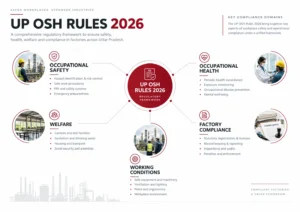
The Uttar Pradesh Occupational Safety, Health and Working Conditions Rules, 2026 are state rules framed under the Occupational Safety, Health and Working Conditions Code, 2020.
The Rules provide detailed requirements relating to establishment registration, factory licensing and plans, occupational safety, health and welfare, safety committees, safety officers, accident reporting, hazardous processes, contract labour, records and returns, and other workplace requirements.
The Rules apply across Uttar Pradesh to factories, construction-related workplaces and other establishments covered by the OSH framework.
When did the UP OSH Rules 2026 come into force?
The final Rules were notified on 27 August 2026 and came into force from the date of their publication in the Official Gazette.
Key Compliance Areas Under the UP OSH Rules 2026
1. UP OSH Rules 2026: Factory Registration, Plans and Regulatory Compliance

Factories need to ensure that their registration, licensing and related statutory documentation are aligned with the applicable requirements.
The Rules provide for electronic processes and prescribe requirements concerning factory plans, registration and licensing. For new construction, occupation or expansion, prescribed applications and plans need to be submitted through the applicable process before the relevant activity proceeds.
For factories, this makes it important to review:
- Factory registration and licence status
- Approved building and site plans
- Process layouts and relevant technical documentation
- Changes or expansions made after earlier approvals
- Applicable statutory submissions
- Electronic records and compliance documentation
Factories undertaking expansion or process modifications should specifically verify whether the proposed change requires prior approval or updated statutory documentation.
2. UP OSH Rules 2026: Safety Officer Requirements

Safety Officer requirements are an important part of the new framework.
Under the UP Rules, a Safety Officer is required in:
- Factories employing 500 or more workers
- Factories carrying on hazardous processes employing 250 or more workers
- Certain other establishments covered by the prescribed provisions, including specified construction establishments and major accident hazard installations
The Rules also provide for additional Safety Officers as workforce levels increase.
What should factories review?
Factories should assess:
- Whether a Safety Officer is legally required
- Whether the appointed professional meets the prescribed qualification requirements
- Whether the number of Safety Officers is adequate for workforce strength
- Whether the appointment has been appropriately documented
- Whether safety functions and statutory responsibilities are being effectively discharged
For companies that do not maintain sufficient in-house safety manpower, qualified safety manpower outsourcing can also be evaluated as part of their compliance strategy.
3. UP OSH Rules 2026: Safety Committees & Worker Participation
The Rules provide for Safety Committees in specified establishments, including factories employing 250 or more workers and establishments carrying on hazardous processes.
The Safety Committee is intended to provide a structured platform for management and workers to address occupational safety and health matters.
The Committee is required to meet at least once every quarter, with minutes and follow-up actions maintained for inspection when required.
A factory’s review should therefore include:
- Safety Committee constitution
- Management and worker representation
- Meeting frequency
- Minutes and action points
- Closure of identified safety issues
- Review of accident and occupational-health information
- Follow-up of audit and risk-assessment recommendations
4. UP OSH Rules 2026: Working Hours, Rest & Overtime
The UP Rules prescribe requirements concerning working hours, rest intervals, shift arrangements and overtime.
The normal weekly working limit is 48 hours, while the Rules prescribe a daily spread-over and rest requirements. Overtime is subject to prescribed limits and is payable at twice the normal rate of wages under the applicable provisions.
Factories should therefore review:
- Shift schedules
- Attendance records
- Rest intervals
- Overtime records
- Overtime wage calculations
- Weekly rest arrangements
- Records maintained for statutory inspection
The Rules also contain provisions and exceptions for specified continuous-process operations, so factories should assess their specific applicability rather than applying a single rule uniformly to every process.
5. UP OSH Rules 2026: Occupational Health & Medical Examination
Occupational health is another important component of the new compliance framework.
Factories should review their systems for:
- Periodic medical examinations
- Occupational-health records
- Medical surveillance for relevant exposures
- Health monitoring for workers engaged in hazardous operations
- Preservation of medical and statutory records
- Identification of occupational-health risks
The Rules include provisions for health examinations, including annual health examination requirements for specified workers, making occupational-health documentation an important part of factory compliance.
6. UP OSH Rules 2026: Accident & Dangerous Occurrence Reporting
The new framework consolidates requirements concerning the reporting of accidents and dangerous occurrences.
Importantly, reporting is not limited to incidents involving fatalities.
The Rules cover specified dangerous occurrences such as:
- Fires
- Explosions
- Release or leakage of hazardous substances
- Failure or collapse of cranes and lifting equipment
- Structural collapse
- Certain machinery failures
- Major uncontrolled emissions or chemical incidents
- Other prescribed dangerous occurrences
Where an accident prevents an injured person from working for 48 hours or more, prescribed reporting requirements are triggered. Dangerous occurrences covered by the Rules also have specific reporting requirements.
What should factories do?
Factories should verify that they have:
- Defined incident-reporting procedures
- Clearly assigned reporting responsibilities
- Emergency escalation mechanisms
- Statutory reporting formats
- Incident investigation procedures
- Corrective and preventive action (CAPA) systems
- Records of incident closure
7. Hazardous Processes and Chemical Safety
For chemical and other hazardous-process industries, the compliance assessment needs to go beyond general factory safety.
Factories handling hazardous chemicals should review their requirements under the applicable regulatory framework, including:
- Hazard identification
- Chemical inventory
- Risk assessment
- Safe operating procedures
- Emergency preparedness
- Personal protective equipment
- Occupational-health surveillance
- Hazardous-process controls
- Emergency response arrangements
- Safety documentation
Where the installation falls within the scope of the Manufacture, Storage and Import of Hazardous Chemical Rules, 1989 (MSIHC Rules) and related major-accident requirements, the factory should assess those obligations separately.
This is particularly important for chemical plants, petrochemical facilities, pharmaceutical manufacturing units, fertilizer plants and other hazardous-process industries.
8. Contract Labour and Contractor Compliance
The new framework also addresses contract labour and contractor-related compliance.
The Rules provide for electronic licensing and prescribe requirements relating to establishments and contractors covered by the applicable threshold. The current framework uses a 50-worker threshold for the relevant contract-labour licensing provisions.
Factories should therefore review:
- Contractor licences
- Number of contract workers
- Contractor documentation
- Statutory records
- Safety induction
- PPE compliance
- Training and competency
- Welfare arrangements
- Emergency preparedness for contract workers
- Principal-employer oversight
Contractor management should be treated as part of the factory’s overall EHS management system rather than as an isolated HR activity.
9. Employment of Women During Night Shifts
The Rules permit employment of women during night shifts subject to prescribed safeguards.
For establishments operating night shifts between 7:00 PM and 6:00 AM, the framework includes requirements such as written consent and specified safety and welfare measures, including transportation and workplace safeguards.
Factories employing women during night hours should therefore review the applicable requirements concerning:
- Written consent
- Safe transportation
- Workplace security
- CCTV and surveillance arrangements where applicable
- POSH compliance
- Emergency assistance
- Shift-specific safety arrangements
- Required statutory reporting
Because the detailed conditions can depend on the applicable provision and establishment, employers should verify the exact requirements before implementing or revising night-shift arrangements.
10. Electronic Records, Registers and Returns
One of the broader shifts under the new framework is the increased emphasis on electronic compliance processes and records.
Factories should review the status of:
- Registration records
- Attendance records
- Accident records
- Medical records
- Safety Committee records
- Training records
- Statutory registers
- Returns and submissions
- Inspection-related documentation
The Rules prescribe record-maintenance requirements, including specified retention periods for different categories of records.
The practical objective for factory management should be simple:
If an inspector asks for evidence of compliance, can the factory produce the relevant record quickly and accurately?
What Should Factories in Uttar Pradesh Do Now?
The notification should not be treated simply as a change in terminology.
Factories should conduct a structured review of their existing compliance systems against the applicable provisions of the 2026 Rules.
Factory Compliance Readiness Checklist
Registration & Approvals
☐ Factory registration/licence reviewed
☐ Approved building/site plans available
☐ Changes and expansions assessed for approval requirements
☐ Statutory submissions reviewed
Safety Management
☐ Safety Officer applicability assessed
☐ Required Safety Officers appointed
☐ Safety Committee constituted where applicable
☐ Quarterly Safety Committee meetings documented
☐ Safety policy and procedures reviewed
Audits & Risk Management
☐ Statutory safety audit status reviewed
☐ IS 14489 applicability/assessment reviewed
☐ Hazard identification and risk assessment updated
☐ Corrective actions tracked to closure
Occupational Health
☐ Medical examination programme reviewed
☐ Occupational-health records maintained
☐ Hazard-exposure monitoring assessed
☐ Medical surveillance requirements reviewed
Emergency Preparedness
☐ Emergency response procedures reviewed
☐ On-site emergency plan reviewed
☐ ERDMP requirements assessed where applicable
☐ Emergency drills conducted and documented
☐ Incident escalation procedures tested
Hazardous Chemical Compliance
☐ Hazardous chemical inventory reviewed
☐ MSIHC applicability assessed
☐ MAH-related requirements assessed where applicable
☐ Chemical emergency scenarios evaluated
Contractor Management
☐ Contractor licences verified where applicable
☐ Contractor safety induction implemented
☐ PPE and training records maintained
☐ Contractor emergency preparedness reviewed
Documentation
☐ Statutory registers updated
☐ Electronic records maintained
☐ Accident/dangerous-occurrence reporting procedure verified
☐ Inspection-readiness documentation organized
How Can INDSAFE Support Factory Compliance?
The new UP framework reinforces the need for factories to maintain an integrated approach to occupational safety, statutory compliance, emergency preparedness and technical safety management.
INDSAFE can support factories through a multidisciplinary compliance approach covering:
Factory & State OHS Compliance
Assessment of applicable state occupational safety and factory requirements and identification of compliance gaps.
IS 14489 Safety Audits
Comprehensive safety assessment covering workplace hazards, fire and life safety, electrical and machinery safety, process hazards, emergency preparedness and other relevant safety areas.
Factory Inspectorate / DISH Compliance Support
Technical compliance assessment, inspection readiness, documentation support and corrective-action assistance.
MSIHC & Hazardous Chemical Compliance

Assessment and support for hazardous chemical management, major-accident hazard requirements and related emergency preparedness.
Competent Person & Statutory Safety Training
Support for applicable competent-person requirements and statutory safety training through appropriately qualified resources.
ERDMP & Emergency Preparedness
Preparation/review of emergency response and disaster management arrangements, emergency scenarios, response structures, drills and preparedness assessments.
Qualified Fire & Safety Manpower
Deployment/outsourcing support for qualified fire and safety professionals based on applicable requirements and site needs.
Regulatory Documentation & Liaisoning Support
Technical documentation, submission support, coordination and assistance in addressing regulatory compliance requirements.
Frequently Asked Questions
What are the UP OSH Rules 2026?
The Uttar Pradesh Occupational Safety, Health and Working Conditions Rules, 2026 are state rules framed under the Occupational Safety, Health and Working Conditions Code, 2020. They establish requirements covering occupational safety, health, welfare, factories, contract labour, construction and other covered establishments in Uttar Pradesh.
When did the UP OSH Rules 2026 come into force?
The Rules were notified on 27 August 2026 and came into force from the date of publication in the Official Gazette.
Do the UP OSH Rules 2026 replace the UP Factories Rules, 1950?
The 2026 Rules supersede several earlier state rules, including the Uttar Pradesh Factories Rules, 1950, the Factory Safety Officer Rules and other specified rules, subject to the savings provisions in the notification.
When is a Safety Officer required in a factory in Uttar Pradesh?
The UP Rules prescribe Safety Officer requirements for factories employing 500 or more workers, and for factories carrying on hazardous processes employing 250 or more workers, subject to the applicable provisions.
Is a Safety Committee required in factories?
The Rules provide for Safety Committees in specified establishments, including factories with 250 or more workers and establishments carrying on hazardous processes. The Committee is required to meet at least once every quarter under the prescribed provisions.
Do the new rules affect hazardous-process industries?
Yes. The framework contains specific occupational-safety, hazardous-process, emergency-preparedness and chemical-safety requirements. Factories covered by the MSIHC Rules or other hazardous-industry regulations should also assess those requirements separately.
What should factories do after the UP OSH Rules 2026 notification?
Factories should review their applicable registration, licensing, safety, occupational-health, emergency-preparedness, contractor-management, statutory-audit and record-keeping requirements against the 2026 Rules and identify gaps requiring corrective action.
Conclusion
The Uttar Pradesh Occupational Safety, Health and Working Conditions Rules, 2026 represent a significant change in the state’s framework for occupational safety, health and factory-related compliance.
For factory management, the immediate priority should be to understand which provisions apply to the establishment, identify gaps in the existing compliance system and establish a documented action plan for closure.
A structured factory compliance assessment can help organizations evaluate their current position across statutory requirements, safety management, occupational health, hazardous processes, emergency preparedness, audits, training and documentation.
INDSAFE supports factories and industrial establishments with integrated safety, statutory compliance, audit, emergency preparedness, training and technical consulting services.
Planning a factory compliance review? Connect with INDSAFE for a technical assessment of your applicable safety and statutory requirements.