


Key Takeaways
- A gap assessment compares expected arrangements with existing arrangements to identify deficiencies.
- Conduct one before a detailed safety study when needed, after significant modifications, following an incident, or as part of a periodic review.
- Prioritize every finding by risk, not by how easy it is to fix. A missing document can indicate uncertainty about the design basis of a critical safeguard.
- A finding is not closed until evidence demonstrates that the underlying issue has been resolved.
- The main outputs are a gap register and a corrective action plan, not just a report.
Table of Contents
- What Is a Process Safety Gap Assessment?
- Gap Assessment vs PSM Audit vs HAZOP vs QRA
- Why Is a Process Safety Gap Assessment Important?
- When Should You Conduct One?
- Regulatory and Standards Context
- How to Conduct a Gap Assessment: 7 Steps
- How to Prioritize Process Safety Gaps
- What Does a Process Safety Gap Look Like in Practice?
- Sample Gap Register
- 7 Common Mistakes to Avoid
- Typical Deliverables
- Supporting Continuous Improvement
- How INDSAFE Can Help
- FAQs
What Is a Process Safety Gap Assessment?
A process safety gap assessment, also called a process safety gap analysis, is a systematic evaluation of a facility’s process safety arrangements against defined requirements, including applicable regulations, recognized engineering standards and approved company procedures.
It answers one practical question: Are our safety systems, engineering controls, operating practices and management processes adequate to control major accident hazards, and can we demonstrate that they are implemented effectively?
The assessment compares three things:
| Aspect | What it covers |
|---|---|
| Expected arrangements | What regulations, standards, engineering requirements and company procedures require |
| Existing arrangements | What the facility has actually designed, documented, implemented and maintained |
| Identified gaps | Where existing arrangements do not adequately meet the criteria or demonstrate effective risk control |
A gap is not simply a missing procedure. For example, a facility may have a pressure safety valve (PSV) maintenance procedure, but the assessment may identify incomplete equipment records, overdue inspections and no evidence that earlier deficiencies were resolved. The gap is that the overall arrangement does not provide adequate and demonstrable control.
Depending on the agreed scope, an assessment can cover process safety information, hazard identification, operating procedures, mechanical integrity, safety-critical equipment, management of change (MOC), emergency preparedness and other elements relevant to the facility’s hazards.
Gap Assessment vs PSM Audit vs HAZOP vs QRA
These terms are often confused. They address different questions and can complement one another.
| Aspect | Gap Assessment | PSM / Compliance Audit | HAZOP (PHA) | QRA |
|---|---|---|---|---|
| Core question | Where do our arrangements fall short of defined requirements or expectations? | To what extent are specified requirements met and implemented? | What can go wrong in the process, and are the safeguards adequate? | What is the quantified risk from defined scenarios? |
| Focus | Management systems, documentation, safeguards and evidence | Conformity with a defined standard, regulation or set of requirements | Process deviations, causes, consequences and safeguards | Frequencies and consequences of defined scenarios |
| Typical output | Gap register, priorities and corrective action plan | Audit findings, evidence and compliance status | Study findings and recommendations concerning process hazards and safeguards | Risk results, risk contours and risk ranking |
| Best used | To identify deficiencies and determine where improvement or further study is needed | To evaluate conformity and implementation against defined criteria | For new or modified processes and periodic revalidation, as applicable | When quantified risk information is needed for decisions or siting |
The scope of a gap assessment and a PSM audit can overlap. The key distinction is the assessment objective and the criteria used.
A gap assessment may identify where a HAZOP, QRA, SIL study or engineering verification is needed. It does not replace these activities.
Why Is a Process Safety Gap Assessment Important?
Process safety depends on multiple safeguards and management systems working together. A weakness in one area can reduce the reliability of others. Major incidents can result from combinations of technical, procedural and management failures. Investigations of events such as the 2005 Texas City refinery explosion and the 2020 styrene release at Visakhapatnam illustrate why these weaknesses need to be identified and addressed.
A structured gap assessment helps facilities identify deficiencies before they contribute to a serious incident.
1. It exposes weaknesses in existing safeguards
Alarms, interlocks, relief devices, procedures and emergency systems may all exist. Their presence alone does not prove that they are suitable or effective. An assessment can identify incomplete design information, unclear responsibilities, unresolved inspection findings and safeguards whose adequacy has not been demonstrated.
2. It tests whether safety studies are still valid
New equipment, revised operating limits, changed raw materials and control system modifications can affect the assumptions behind earlier risk assessments. A gap assessment can identify where existing studies, recommendations and engineering documentation need review.
3. It improves corrective action management
Audit findings and study recommendations can remain open for years when ownership, priority or closure criteria are unclear. A structured assessment assigns accountable owners, sets justified deadlines and defines how closure will be verified.
4. It supports compliance and management oversight
Facilities must identify and meet the statutory requirements applicable to their operations and demonstrate that relevant engineering standards and internal procedures are followed. A gap assessment highlights potential non-compliance and missing evidence.
Applicable legal requirements must still be confirmed separately for the facility, jurisdiction and process.
When Should a Facility Conduct a Process Safety Gap Assessment?
| Trigger | Why it matters |
|---|---|
| Before a HAZOP, QRA or other detailed study | Helps confirm that P&IDs, process safety information and previous reports are available, current and consistent, supporting an effective study |
| After significant process or equipment modifications | Changes to chemicals, equipment, operating parameters or instrumentation can affect safeguards and existing risk assumptions. Use the MOC process for the change itself and a gap assessment to identify broader deficiencies |
| After an incident, near miss or recurring failure | Checks whether similar weaknesses exist elsewhere. It complements, but does not replace, an incident investigation |
| During a periodic safety review or improvement programme | Reviews overall arrangements, the status of previous recommendations and priorities for the next review cycle |
There is no single assessment interval suitable for every facility. Frequency should reflect applicable statutory requirements, the facility’s risk profile, changes to operations and the objectives of the review.
Regulatory and Standards Context
The applicable requirements depend on the facility, its hazards and its jurisdiction. Commonly referenced frameworks include the following.
India
- Factories Act, 1948, including provisions relating to hazardous processes, where applicable.
- Manufacture, Storage and Import of Hazardous Chemicals (MSIHC) Rules, 1989.
- Chemical Accidents (Emergency Planning, Preparedness and Response) Rules, 1996.
- Petroleum and Explosives Safety Organisation (PESO) requirements applicable to regulated activities and installations.
- Oil Industry Safety Directorate (OISD) standards relevant to applicable oil and gas facilities.
For facilities covered by the MSIHC Rules, applicable obligations may include site notification, safety reports, safety audits and emergency planning, depending on the provisions and circumstances. Rule 10 addresses safety reports and safety audits, including the applicable annual audit requirement. The specific obligations should be verified against the current rules and the facility’s applicability.
International benchmarks
- OSHA Process Safety Management, 29 CFR 1910.119 – United States.
- CCPS Risk Based Process Safety – American Institute of Chemical Engineers.
- UK Health and Safety Executive (HSE) COMAH guidance – United Kingdom.
Important: This is a general overview, not legal advice. Confirm the current requirements applicable to your site with your compliance team or legal advisor. Under OSHA PSM, compliance audits are required at least every three years for covered facilities. Indian facilities should follow the statutory requirements applicable to their operations and any relevant company review schedules.
A good assessment separates mandatory requirements from recommended practices and internal expectations, so that every observation is not incorrectly classified as statutory non-compliance.
How to Conduct a Process Safety Gap Assessment in 7 Steps
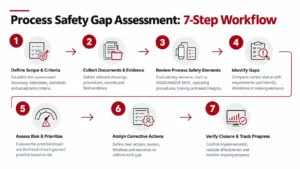
Step 1: Define the scope and assessment criteria
Decide what will be assessed: the whole facility, selected units, one PSM element, or a specific concern such as pressure protection or MOC.
Then establish the assessment criteria:
- Applicable statutory and regulatory requirements.
- Relevant engineering standards and good engineering practice.
- Approved company procedures and technical specifications.
- Findings from previous studies and audits.
- Facility-specific risk-control requirements.
Clearly document the assessment boundaries, objectives, exclusions and expected deliverables before starting the review.
Step 2: Collect and review relevant information
Review documentation to understand the design, hazards, operating arrangements and existing safeguards. Depending on the scope, this may include:
- Process flow diagrams and P&IDs.
- Process safety information.
- HAZOP and QRA reports.
- Operating procedures.
- Inspection and maintenance records.
- MOC records.
- Emergency plans and previous audit findings.
Check that documents are current, approved, consistent with one another and representative of the actual plant.
Record missing or inconsistent information as an evidence gap. A missing document does not, by itself, prove that a physical safeguard is inadequate, but the uncertainty must be evaluated and resolved where necessary.
Step 3: Evaluate existing arrangements
Compare the available evidence and observed practices against the assessment criteria through interviews with operations and maintenance staff, site walk-downs and verification of relevant equipment records.
Classify each issue as one of the following:
- A requirement that has not been addressed.
- A requirement that is documented but not consistently implemented.
- A safeguard whose suitability or performance has not been demonstrated.
- An issue requiring further technical investigation before a conclusion can be reached.
Each type of finding requires a different corrective action, so the distinction matters.
Step 4: Record findings and supporting evidence
A useful finding record includes:
- A unique reference number.
- The applicable requirement or assessment criterion.
- The observed condition or deficiency.
- Supporting evidence and relevant documents.
- The potential process safety implication.
- The recommended corrective action or next step.
- The responsible function and proposed completion date.
Recommendations must address the underlying deficiency, not simply repeat the observation.
For example, if available records do not establish whether a relief device is suitable for its service, updating the equipment register alone will not resolve the issue. The technical basis and suitability of the installed arrangement must be verified.
Step 5: Prioritize findings based on risk
Use a consistent, documented method that considers potential consequences, the effectiveness of existing safeguards and the uncertainty associated with the finding.
Credible major accident scenarios and potentially ineffective critical safeguards require prompt attention. Lower-risk administrative issues can be managed through planned improvement when the assessment confirms that they do not conceal a more significant concern.
See the next section for a practical prioritization framework.
Step 6: Develop and implement a corrective action plan
For each action, define:
- The required outcome.
- The accountable owner.
- The target completion date.
- Resources and dependencies.
- The evidence needed to demonstrate completion.
Some actions involve document or procedure updates. Others require inspection, engineering calculations, additional risk assessment or physical modifications.
Where a finding indicates a serious or immediate hazard, implement appropriate interim controls and escalation while the permanent corrective action is developed. Changes to equipment, process conditions, control systems or procedures should follow the applicable MOC and engineering approval processes.
Step 7: Verify closure and review effectiveness
An action is not closed simply because someone reports that the work is complete.
Closure requires evidence, such as an approved procedure, completed inspection report, verified calculation, updated drawing or confirmation that a safeguard performs as intended.
Where necessary, an independent, technically competent reviewer should confirm that the corrective action addresses the original finding. Also assess whether the finding indicates a wider weakness affecting other units or systems.
How to Prioritize Process Safety Gaps
Prioritization separates urgent safety concerns from findings that can be handled through planned improvement. The categories below are illustrative. Final classification must follow the facility’s approved risk assessment methodology.
| Priority | Typical considerations | Expected response |
|---|---|---|
| Critical / urgent | A credible major accident hazard may be inadequately controlled, or a critical safeguard may be unavailable or unsuitable | Prompt technical evaluation, escalation and immediate or interim risk controls, as required |
| High | A significant deficiency requires timely resolution, even if existing safeguards reduce the immediate risk | Accountable owner, justified deadline and close tracking |
| Medium | A material weakness that evidence shows can be managed through planned corrective action | Action plan, resources and suitable completion date |
| Low / administrative | A documentation or consistency issue with limited safety significance based on current evidence | Correct through normal improvement processes and verify completion |
Two rules keep prioritization honest:
- Never rank by ease or cost of fixing. A missing document may indicate serious uncertainty about the design basis of a critical safeguard. A documentation discrepancy may prove to be minor once the underlying engineering condition is verified.
- If risk cannot be established confidently, escalate for technical evaluation. Do not default to low priority simply because the available evidence is incomplete.
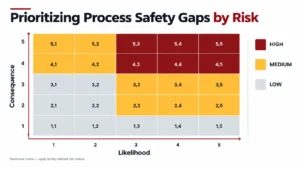
A generic scoring system is not a substitute for engineering analysis where potential consequences or safeguard adequacy remain uncertain.
What Does a Process Safety Gap Look Like in Practice?
Consider a hypothetical chemical facility where an assessment finds that the available records for a pressure safety valve (PSV) protecting a pressurized vessel do not establish its sizing basis or suitability for the required relief scenarios.
- Establish the uncertainty. Review vessel design data, process conditions, valve identification, existing calculations and maintenance records.
- Evaluate potential consequences. Determine whether the missing information creates uncertainty about protection against credible overpressure scenarios. The answer depends on the actual process, the relief requirements and the other safeguards in place.
- Define the technical work. A competent engineer verifies the applicable relief scenarios, required relief capacity, design assumptions and suitability of the installed arrangement.
- Apply interim controls if needed. If the evaluation identifies a potentially serious unresolved hazard, implement appropriate operating restrictions or other interim measures through the facility’s safety management process.
- Verify permanent resolution. Retain the technical assessment, approved calculations or design changes, updated records, and evidence of any required inspection or testing.
This example demonstrates why a gap assessment must connect observations to technical evaluation and verified corrective action. An incomplete valve record does not automatically establish that the valve is unsuitable. The appropriate response depends on the installation, the available evidence and the consequences of the unresolved uncertainty.
Sample Gap Register
A gap register is the working record of an assessment. This illustrative extract shows the level of traceability to aim for.
| ID | Criterion | Finding | Evidence | Priority | Owner | Due | Closure evidence |
|---|---|---|---|---|---|---|---|
| GA-001 | Relief-device design basis and suitability verified | Available records do not establish the sizing basis and suitability of PSV on Reactor R-101 | Equipment file; incomplete PSV datasheet | Pending technical evaluation; escalate according to potential consequences and uncertainty | Process Engineering | [Date] | Verified relief scenarios, approved calculations, confirmation of installed-device suitability and updated equipment records |
| GA-002 | Overdue inspection findings resolved | Three inspection recommendations for a storage tank remain open beyond their due dates | Inspection report; action tracker | Provisional — assess based on the nature and consequences of the findings | Maintenance / Inspection | [Date] | Completed repair record, where required, and re-inspection report |
| GA-003 | P&IDs reflect the as-built plant | P&ID revision does not show a recent line modification | Walk-down notes; MOC record | Provisional — assess the modification and associated risk | Engineering | [Date] | Updated, approved P&ID and verified MOC closure |
| GA-004 | Operating procedures reviewed on schedule | Review date is missing from the startup procedure record | Procedure register | Provisional — verify whether the procedure remains current and suitable | Operations | [Date] | Reviewed and reissued procedure, where required |
Illustrative example only. Entries are not drawn from a real facility. Final priorities and due dates must be assigned after evaluating the findings against the applicable risk methodology.
7 Common Mistakes to Avoid
- Treating it as a document-only exercise. Documents may not match the actual plant. Verify them against site conditions and consult operations and maintenance staff.
- Using the same checklist for every facility. A reaction facility, hydrocarbon unit and bulk storage installation need different assessment criteria and technical emphasis.
- Confusing gap assessment with HAZOP or QRA. These activities complement each other but are not interchangeable.
- Closing findings without verifying the outcome. Define closure criteria in advance and require supporting evidence.
- Failing to assign ownership. Every action needs an accountable owner, a deadline, resources and an escalation route for delays.
- Ranking by convenience. Priorities must reflect risk, not effort or cost alone.
- Ignoring wider implications. A finding in one unit may indicate the same weakness elsewhere in the facility.
What Are the Typical Deliverables?
Agree on deliverables during scope definition. A structured assessment typically produces the following:
| Deliverable | Description |
|---|---|
| Scope and criteria | Facility boundaries, systems reviewed and requirements used |
| Gap register | Traceable findings with supporting evidence and assessment criteria |
| Risk-based prioritization | Basis for priorities and escalation of findings requiring further evaluation |
| Recommendations | Corrective measures or additional technical work required |
| Corrective action plan | Owners, target dates, resources and completion criteria |
| Final report | Methodology, findings, limitations, conclusions and next steps |
Detailed HAZOP or QRA reports, equipment sizing calculations, design modifications and implementation work are generally separate work packages unless specifically included in the agreed scope.
How Does a Gap Assessment Support Continuous Improvement?
A gap assessment is most valuable when its findings feed into the wider process safety management system. The gap register can support management reviews, maintenance planning, engineering improvements, procedure updates and decisions about further risk studies.
Review the status of significant actions regularly, investigate overdue items, and look for recurring findings that indicate a systemic weakness. New incidents, modifications, inspection findings or changes in requirements may justify revisiting earlier conclusions.
The goal is not simply to reduce the number of open findings. It is to ensure that significant deficiencies are understood, addressed and prevented from recurring.
How INDSAFE Can Support Your Process Safety Gap Assessment
INDSAFE provides Process Safety Gap Assessment services to help industrial facilities evaluate existing safety arrangements, identify deficiencies and determine appropriate next steps.
Depending on the agreed scope, our work may include:
- Document and process safety information review.
- Evaluation of existing safeguards and site verification.
- Identification and documentation of gaps in a traceable gap register.
- Risk-based prioritization and corrective action planning.
- Recommendations for further technical studies where needed.
The assessment scope, methodology, deliverables and duration should be agreed based on the facility’s requirements, complexity, document readiness and site access.
Where deeper investigation is required, related services may include:
- Process Safety Management: Reviewing and strengthening process safety management arrangements.
- HAZOP Study: Systematic examination of process deviations, causes, consequences and safeguards.
- Quantitative Risk Assessment (QRA): Quantified evaluation of major accident scenarios.
- Other relevant services, such as SIL/LOPA, PSSR or MOC support: Further technical evaluation and improvement, depending on the identified requirements.
Identify and Prioritize Process Safety Gaps at Your Facility
Unresolved process safety deficiencies can affect safeguard reliability, regulatory compliance and operational risk. INDSAFE supports industrial facilities in reviewing existing process safety arrangements, documenting gaps, prioritizing corrective actions and identifying where further technical evaluation is required.
Discuss your facility’s assessment requirements with our team to establish an appropriate scope, assessment criteria and deliverables.
Contact INDSAFE
- Phone: +91-9773776223
- Email: consult@indsafe.in
- Website: indsafe.in
Frequently Asked Questions
What is a process safety gap assessment?
It is a structured review that compares a facility’s existing process safety systems, procedures and records with regulatory requirements, engineering standards and company expectations. It identifies deficiencies, evaluates their significance, prioritizes corrective actions and establishes a basis for verifying closure.
What is the difference between a process safety gap assessment and a PSM audit?
A PSM or compliance audit systematically evaluates conformity with specified requirements and whether the relevant procedures and practices are adequately implemented. A process safety gap assessment compares existing arrangements against defined regulatory, engineering and organizational criteria to identify deficiencies and prioritize improvements. Their scopes can overlap, so the objectives and criteria should be established before the work begins.
Is a gap assessment the same as a HAZOP?
No. A gap assessment evaluates existing arrangements against defined criteria and identifies deficiencies. A HAZOP systematically examines process deviations, their causes, consequences and safeguards. A gap assessment can identify where a HAZOP is needed or requires review, but it does not replace the study.
How long does a process safety gap assessment take?
Duration depends on the scope, facility size, document readiness and site access. A single process unit or one PSM element may take days to a few weeks, while a multi-unit facility generally requires more time. A scoping discussion helps establish a realistic estimate.
How often should a gap assessment be done?
There is no universal interval for every facility. Frequency should reflect applicable statutory requirements, the facility’s risk profile, operational changes and review objectives. Common triggers include significant modifications, incidents and periodic reviews. Under OSHA PSM, compliance audits are required at least every three years for covered facilities.
What documents are needed for a gap assessment?
Typically, the required information includes P&IDs, process flow diagrams, process safety information, HAZOP and QRA reports, operating procedures, inspection and maintenance records, MOC records, emergency plans, and previous audit findings with their closure status. The exact list depends on the agreed assessment scope.
Is a process safety gap assessment mandatory in India?
The legal obligations applicable to a facility depend on its operations, hazards and the specific statutory provisions governing it. Indian regulations, including the Factories Act, 1948 and the MSIHC Rules, 1989, establish requirements for applicable facilities and activities. A gap assessment is a method of identifying deficiencies against defined criteria, but it should not be described as universally mandatory without verifying the applicable requirements. Confirm your obligations with your compliance team or legal advisor.
What is a gap register?
A gap register is a traceable record of assessment findings. Each entry includes the applicable criterion, observed deficiency, supporting evidence, priority, owner, due date and closure evidence, allowing progress to be tracked until the finding is verified as resolved.
Who should carry out a gap assessment?
The assessment should be carried out by a team with appropriate process safety, engineering, operations and maintenance competence and familiarity with the facility’s hazards and applicable requirements. An independent specialist may help provide an objective assessment and relevant technical expertise.
Related Reading
- Process Safety Management
- HAZOP Study: What It Is and When You Need One
- Quantitative Risk Assessment (QRA) Explained
This article is for general information and does not constitute legal or engineering advice. Requirements vary by facility, process and jurisdiction. Site-specific decisions should be based on appropriate technical evaluation and the requirements applicable to the facility.