


A Dust Hazard Analysis (DHA) is a systematic engineering assessment used to identify and evaluate fire, flash-fire and explosion risks associated with combustible dust in industrial facilities. Grinding, milling, conveying, mixing, drying and powder transfer can release fine particles into the air or allow them to accumulate on equipment, floors and elevated surfaces. Under the right conditions, these deposits and airborne dust clouds can contribute to serious fire and explosion incidents.
A properly conducted DHA does more than identify locations where dust is present. It examines how a hazardous event could develop, how it could spread and what additional safeguards may be needed to reduce the risk.
What Is a Dust Hazard Analysis?
A Dust Hazard Analysis (DHA) is a systematic assessment of fire, flash-fire and explosion hazards associated with combustible dusts and particulate solids. It identifies where combustible dust can be generated, released, transported or accumulated; evaluates relevant material properties and ignition sources; examines credible incident scenarios; and reviews the adequacy of existing safeguards.
The assessment produces documented findings and recommendations, usually supported by a prioritised action plan.
A DHA typically examines:
- Combustible materials and dust-generating operations
- Material explosibility and ignition-sensitivity data
- Dust release, dispersion and accumulation locations
- Potential ignition sources
- Dust collection and material-handling systems
- Fire and explosion prevention and protection measures
- Interconnected equipment and potential incident propagation
- Recommended safeguards and corrective actions
Key Takeaways
- Combustible dust hazards can occur in food, pharmaceutical, chemical, metal, wood, plastics, rubber and other industries.
- A DHA should evaluate connected process systems and relevant building areas, not just individual machines.
- Material-specific explosibility testing may be required to determine parameters such as Kst, Pmax, MIE, MEC and ignition temperatures.
- Dust collectors, silos, conveyors, ducts and transfer points deserve particular attention because dust can concentrate and incidents can propagate through connected equipment.
- Housekeeping is important, but it cannot replace process containment, ignition control and appropriate explosion protection.
- Under NFPA 660:2025, the DHA must be reviewed and updated at least every five years, with additional reviews when relevant changes affect the hazards.
1. Why Is Dust Hazard Analysis Important for Industrial Facilities?
Many materials appear relatively harmless when stored or handled as bulk solids. However, when processed into fine particles and dispersed in air, some can form explosible dust clouds.
Examples include:
- Flour, sugar, starch and grain dust
- Wood and paper dust
- Pharmaceutical powders and chemical intermediates
- Plastic and rubber particles
- Aluminium, magnesium and other combustible metal powders
- Coal and other combustible particulate materials
Whether a dust can create a fire or explosion hazard depends on its properties and the conditions in which it is handled. Particle size, moisture content, concentration, dispersion, oxygen availability and ignition sources can all influence the hazard.
The risk is not limited to the point where dust is generated. Material can move through conveyors, ducts, filters, hoppers and storage vessels. An incident originating in one piece of equipment may affect connected systems or surrounding building compartments.
A DHA helps identify these potential pathways and evaluate whether the existing design and operating safeguards adequately address them.
2. Where Should a Dust Hazard Analysis Identify Combustible Dust Hazards?
A DHA should consider the complete material-handling and production cycle, including normal operations, cleaning and foreseeable abnormal conditions.
Raw material receiving and unloading
Bag emptying, bulk unloading, pneumatic transfer and charging operations can release dust. Review containment, extraction effectiveness, dust deposits around unloading stations and electrostatic charging during material transfer.
Grinding, milling and crushing
Size-reduction operations can generate fine particles and high dust concentrations inside equipment. Consider mechanical friction, overheating, foreign-body entry, bearing condition and other potential ignition sources.
Mixing, blending and screening
Mixers, blenders and sifters can release dust during charging, operation and discharge. Evaluate enclosure integrity, extraction arrangements and the potential for dust accumulation.
Conveying and transfer
Mechanical and pneumatic conveying systems can transport combustible dust through interconnected equipment. Examine leakage from joints, transfer points, electrostatic charge accumulation, overheating and possible flame or pressure propagation.
Dust collection systems
Dust collectors and bag filters concentrate collected particulate material. Assess the dust characteristics, loading conditions, collector design, potential ignition sources, explosion venting or suppression, isolation from connected equipment, and the location and arrangement of discharge systems.
Storage and packaging
Silos, bins, hoppers and bagging stations can release dust during filling, discharge and cleaning. Also inspect elevated surfaces, concealed spaces and structural members where deposits may accumulate.
3. Dust Explosion Hazards: Understanding the Explosion Pentagon
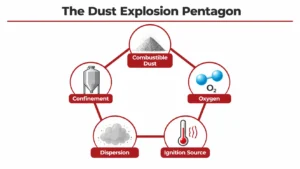
A dust explosion generally requires five elements to come together:
- Combustible dust: A particulate material capable of combustion.
- Oxygen: Usually supplied by the surrounding air.
- Ignition source: An energy source capable of initiating combustion.
- Dispersion: Dust suspended in air at an explosible concentration.
- Confinement: An enclosure or partial enclosure in which pressure can build.
The first three elements form the familiar fire triangle. Dispersion and confinement complete the dust explosion pentagon.
An important distinction is that a flash fire can occur in a dispersed combustible dust cloud without the degree of confinement needed for an explosion. A DHA should therefore evaluate both flash-fire and explosion scenarios, rather than treating them as identical events.
Primary and Secondary Dust Explosions
A primary explosion may occur inside process equipment, such as a dust collector, silo or conveying system. The resulting pressure wave and equipment damage can disturb accumulated dust in surrounding areas.
If this newly dispersed dust ignites, a secondary explosion or flash fire may follow. Such events can involve a much larger quantity of combustible material and cause extensive damage.
This is why a DHA must consider dust deposits, connected equipment, building compartments and potential incident escalation—not just the equipment where an initial ignition could occur.
4. Dust Hazard Analysis Methodology: 7 Essential Stages
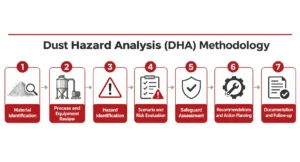
The assessment methodology should be appropriate to the facility, material properties, process configuration and applicable technical standard.
NFPA 660:2025 requires the DHA to be performed or led by a qualified person with documented education and experience relevant to evaluating the hazards of the combustible dusts involved and identifying suitable mitigation measures.
Its Chapter 7 methodology requires evaluation of relevant process and facility areas, credible fire, flash-fire and explosion scenarios, operating limits, existing safeguards and additional safeguards where warranted.
The following seven stages provide a practical structure for conducting the assessment.
Step 1: Define the Scope and Collect Information
Begin by establishing the assessment boundaries, objectives, processes and facility areas to be covered.
Typical information includes:
- Process Flow Diagrams (PFDs) and Piping and Instrumentation Diagrams (P&IDs)
- Equipment layouts and general arrangement drawings
- Process descriptions and operating procedures
- Material inventories and Safety Data Sheets (SDS)
- Dust collection and ventilation arrangements
- Equipment specifications and design information
- Existing hazardous area classification drawings
- Incident, near-miss and maintenance records
- Housekeeping and inspection procedures
Consider normal operation, start-up, shutdown, cleaning, maintenance and foreseeable abnormal conditions.
Step 2: Identify Combustible Materials and Their Properties
Identify materials that may generate combustible particulate during handling or processing.
Do not rely only on a trade name, chemical composition or general SDS. Where reliable material-specific information is unavailable, representative laboratory testing may be necessary.
Relevant properties can include:
- Particle size distribution
- Moisture content
- Maximum explosion pressure (Pmax)
- Dust deflagration index (Kst)
- Minimum ignition energy (MIE)
- Minimum autoignition temperature of a dust cloud
- Hot-surface ignition temperature of a dust layer
- Minimum explosible concentration (MEC)
- Limiting oxygen concentration (LOC), where relevant
The test programme should reflect the material and the engineering decisions that need to be made. Sample selection and preparation matter: the tested sample should be representative of the dust present in the process, including relevant fine fractions or collected dust where appropriate.
Step 3: Identify Dust Release and Accumulation Locations
Conduct a site inspection to identify where dust can escape containment, become airborne or settle.
Typical locations include:
- Charging and discharge points
- Conveyor transfer points
- Mills, crushers and mixers
- Screens and filters
- Dust collectors and associated ducts
- Silos, bins and hoppers
- Bagging and packaging stations
- Elevated structures and concealed spaces
Drawings and operating procedures may not reflect actual site conditions. The inspection should therefore examine equipment condition, containment, extraction arrangements, housekeeping practices and locations where dust may accumulate unnoticed.
Step 4: Identify Potential Ignition Sources
Evaluate ignition sources that could be present where combustible dust clouds or layers may occur.
Potential sources include:
- Electrostatic discharges
- Electrical faults and unsuitable electrical equipment
- Hot surfaces and overheated bearings
- Mechanically generated sparks and friction
- Equipment malfunction
- Hot work, including welding and cutting
- Open flames and hot gases
- Self-heating or smouldering material
Review the effectiveness of grounding and bonding, equipment suitability, maintenance, temperature monitoring and permit-to-work arrangements.
The assessment should consider whether these sources could occur under normal operation, foreseeable deviations, equipment failure or maintenance activities.
Step 5: Evaluate Credible Fire and Explosion Scenarios
Develop scenarios based on the hazards identified during document review and site inspection.
Examples include:
- Ignition inside a dust collector
- Explosion within a silo or process vessel
- Ignition during powder transfer
- Fire caused by overheated conveying equipment
- Flame or pressure propagation through interconnected ducts
- Flash fire involving airborne dust
- Secondary explosion caused by disturbed dust deposits
For each scenario, document the initiating event, potential escalation paths, affected equipment or areas, personnel exposure and existing safeguards.
Evaluate the consequences and likelihood using a suitable, documented risk-assessment approach. The method and risk-ranking criteria should be appropriate to the facility and agreed assessment scope.
Step 6: Review Existing Prevention and Protection Measures
Evaluate the safeguards already provided to prevent or mitigate combustible dust incidents.
These may include:
- Enclosed material handling
- Local exhaust ventilation and dust extraction
- Housekeeping and dust accumulation controls
- Grounding and bonding
- Suitable electrical and mechanical equipment
- Temperature and spark detection
- Explosion venting
- Explosion suppression
- Explosion isolation
- Appropriate equipment location and safe discharge arrangements
The presence of a safeguard does not automatically demonstrate that it is adequate.
Review its design basis, suitability for the dust and equipment involved, installation, maintenance, inspection and expected performance. Also consider whether the failure of one safeguard could affect other protection measures.
Step 7: Develop Recommendations and an Action Plan
Convert the assessment findings into a prioritised risk-reduction programme.
Each recommendation should clearly identify:
- The gap or deficiency
- The associated hazard or scenario
- The recommended corrective measure
- Priority and justification
- Responsible function or department
- Target completion date
- Method for verifying completion
Recommendations should be practical, technically justified and linked to the relevant findings. The action plan should also provide a means of tracking implementation and confirming that identified risks have been addressed.
5. Dust Explosibility Testing in a Dust Hazard Analysis
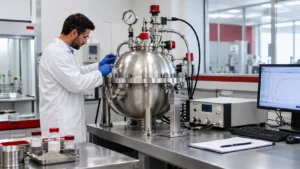
Assumptions based on similar materials may not provide a reliable basis for engineering decisions. Laboratory testing can provide material-specific data to support the evaluation of ignition sensitivity and explosion severity.
The appropriate test programme depends on the material, process conditions, available data and intended application.
| Parameter | What it indicates | Common ASTM test method |
|---|---|---|
| Pmax | Maximum explosion pressure measured during the test | ASTM E1226 |
| Kst | Normalised maximum rate of pressure rise | ASTM E1226 |
| MIE | Minimum ignition energy of a dust cloud in air | ASTM E2019 |
| Cloud ignition temperature | Minimum autoignition temperature of a dust cloud | ASTM E1491 |
| Layer ignition temperature | Hot-surface ignition temperature of a dust layer | ASTM E2021 |
| MEC | Minimum explosible concentration of combustible dust | ASTM E1515 |
| LOC | Limiting oxygen concentration of a combustible dust cloud | ASTM E2931 |
Use the current applicable edition of each test method. Equivalent ISO or EN methods may also be appropriate where accepted for the project.
Understanding Kst and Pmax
Pmax is the maximum pressure reached during a standardised dust explosion test. It provides information about the pressure that can develop during the test under the specified conditions.
Kst is the dust deflagration index. It is calculated by normalising the maximum rate of pressure rise to the test vessel volume:
Kst = (dP/dt)max × V^(1/3)
It is expressed in bar·m/s and is commonly used to group combustible dusts into St 1, St 2 and St 3 explosion-severity classes.
Both parameters can be important inputs to explosion protection engineering, including explosion vent sizing. However, neither parameter alone establishes the overall risk of a process. Equipment configuration, operating conditions, dust handling, connected systems and the effectiveness of safeguards must also be evaluated.
Test results are specific to the sample and test method used. They should not be treated as universal material constants or applied to a different dust condition without technical justification.
6. Dust Hazard Analysis vs Hazardous Area Classification (HAC)
A Dust Hazard Analysis and a Hazardous Area Classification (HAC) study are related, but they have different objectives and outputs.
| Aspect | Dust Hazard Analysis | Hazardous Area Classification |
|---|---|---|
| Primary objective | Evaluate dust-related fire, flash-fire and explosion hazards | Classify locations where explosive dust atmospheres may occur |
| Main focus | Materials, processes, equipment, ignition sources, scenarios and safeguards | Likelihood, duration and extent of explosive dust atmospheres |
| Typical output | Hazard scenarios, safeguard evaluation and recommendations | Zone classification and classification drawings |
| Application | Explosion prevention, protection and risk reduction | Selection and installation of suitable equipment and ignition controls |
For combustible dust atmospheres, the commonly used zones are:
- Zone 20: An explosive dust atmosphere is present continuously, for long periods or frequently.
- Zone 21: An explosive dust atmosphere is likely to occur occasionally in normal operation.
- Zone 22: An explosive dust atmosphere is not likely to occur in normal operation and, if it does occur, persists only for a short period.
IEC 60079-10-2 provides the framework for classifying areas where explosive dust atmospheres and combustible dust layers are present. The 2026 edition should be considered when establishing the applicable technical basis.
Equipment selection and installation must then follow the applicable requirements of the IEC 60079 series, including the relevant equipment protection standards.
A DHA can provide important inputs to HAC, but the two assessments are not interchangeable. A DHA evaluates hazards and safeguards; HAC classifies locations to support appropriate equipment selection and ignition-source control.
7. Common Dust Hazard Analysis Mistakes
1. Assuming all dusts behave alike
Ignition sensitivity and explosion severity vary between materials and can also be affected by particle size and moisture. Use representative material data where required.
2. Relying only on the SDS
An SDS is an important starting point, but it may not contain the explosibility parameters required for engineering decisions.
3. Assessing only visible dust
Dust can accumulate on elevated structures, inside equipment, in ducts and in concealed spaces. A site inspection should examine these locations.
4. Ignoring interconnected equipment
An incident in a collector or vessel can propagate through connected ducts and conveying systems. Evaluate the potential for flame and pressure propagation.
5. Treating housekeeping as the only control
Housekeeping helps limit accumulation but cannot replace process containment, dust extraction, ignition control and appropriate explosion protection.
6. Installing explosion protection without an engineering evaluation
Explosion venting, suppression and isolation systems must be suitable for the dust, equipment and installation. Incorrect sizing, unsuitable discharge arrangements or inadequate isolation can compromise protection.
7. Failing to review changes
New materials, altered particle sizes, modified collectors, increased throughput and process changes can affect the original assessment. Review the DHA through the facility’s management-of-change process.
8. Dust Hazard Analysis Report: Key Deliverables
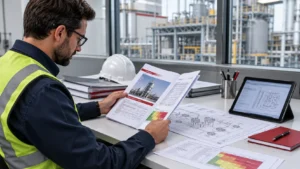
The final report should document the assessment sufficiently to explain the hazards identified, the evaluation performed and the actions required.
Depending on the agreed scope, deliverables may include:
- Scope, objectives and assessment methodology
- Facility and process description
- Inventory of combustible materials and available test data
- Dust generation, release and accumulation locations
- Register of potential ignition sources
- Evaluation of credible fire, flash-fire and explosion scenarios
- Review of existing prevention and protection measures
- Identified gaps and technical recommendations
- Prioritised action plan with responsibilities and target dates
- Supporting drawings, photographs, records and technical documentation
If Hazardous Area Classification, detailed explosibility testing or explosion protection design is included, these activities and their deliverables should be clearly defined in the assessment scope. They should not be assumed to be automatically included in every DHA.
9. When Should a Dust Hazard Analysis Be Conducted or Updated?
A DHA should be considered during facility design and before commissioning relevant new processes or equipment. Existing facilities should evaluate combustible dust hazards where the materials and processes fall within the applicable assessment requirements.
Review the assessment when changes could affect the hazards, including:
- Introduction of a new combustible powder
- Changes in particle size or material characteristics
- Installation of new powder-handling equipment
- Modification of conveying or dust extraction systems
- Addition or replacement of dust collectors
- Increased production capacity or throughput
- Changes to operating temperatures or process conditions
- Changes to housekeeping or maintenance practices
- Dust-related fires, flash fires, explosions or near misses
- Newly identified dust accumulation or previously unrecognised hazards
NFPA 660:2025 requires the DHA to be reviewed and updated at least every five years. Significant changes and incidents may require an earlier review. Facilities should also consider applicable regulatory requirements, management-of-change procedures and the actual risk profile of the process.
10. Standards and Technical References for Dust Hazard Analysis
The technical basis for a DHA should be selected according to the facility, material, process, project requirements and applicable regulations.
NFPA 660: Standard for Combustible Dusts and Particulate Solids (2025)
NFPA 660 consolidates the earlier NFPA 61, 484, 652, 654, 655 and 664 standards into a single document. Chapter 7 addresses Dust Hazards Analysis, including its general requirements, qualification criteria and methodology.
Under Section 7.1.4, the DHA must be reviewed and updated at least every five years. Section 7.2.2 addresses the qualifications of the person performing or leading the DHA. The standard also addresses the evaluation of process and facility areas, credible scenarios, safeguards and recommendations.
NFPA 660 is a technical standard; its legal applicability in India depends on the relevant regulatory, contractual, project or authority requirements.
ASTM dust explosibility and ignition-sensitivity test methods
Relevant methods include ASTM E1226 for dust-cloud explosibility, E2019 for minimum ignition energy, E1491 for dust-cloud autoignition temperature, E2021 for dust-layer hot-surface ignition temperature, E1515 for minimum explosible concentration and E2931 for limiting oxygen concentration.
IEC 60079-10-2:2026 — Classification of Areas: Explosive Dust Atmospheres
This standard provides a framework for identifying and classifying areas where explosive dust atmospheres and combustible dust layers are present.
OSHA combustible dust guidance
OSHA publications provide useful technical information on combustible dust identification, accumulation, ignition sources, prevention and explosion hazards. OSHA guidance is not, by itself, an Indian statutory requirement.
Indian regulatory context
The Occupational Safety, Health and Working Conditions Code, 2020 came into force on 21 November 2025. The applicable Central and State Rules, together with relevant provisions concerning occupational safety, hazardous processes, fire protection and electrical safety, should be considered for the facility.
Requirements can differ according to the establishment, process, location and applicable State Rules. For example, the Uttar Pradesh Occupational Safety, Health and Working Conditions Rules, 2026 were notified on 27 August 2026.
The Code should not be interpreted as establishing a universal standalone DHA format or a single DHA review interval for every Indian facility. Where a specific technical framework is required by the applicable authority, project specification, client or corporate standard, that requirement should be followed. NFPA 660 and relevant IEC standards may be used as technical references where appropriate.
Frequently Asked Questions About Dust Hazard Analysis
What is a Dust Hazard Analysis (DHA)?
A DHA is a structured engineering assessment of fire, flash-fire and explosion hazards associated with combustible dust. It evaluates materials, processes, equipment, ignition sources, credible scenarios and existing safeguards, and produces documented recommendations.
Is a Dust Hazard Analysis required for every manufacturing facility?
The need for a DHA depends on the materials handled, whether combustible particulate is present or generated, the process configuration and the applicable standard or regulatory requirements. Facilities should evaluate the potential hazard rather than assume that dust is harmless.
Is a DHA mandatory in India?
The OSHWC Code, 2020 and applicable State Rules establish occupational safety and health duties, but should not be described as creating one universal standalone DHA format for every manufacturing facility. Specific technical requirements may also arise from applicable regulations, project specifications, client requirements or adopted standards. The facility’s compliance team should determine the requirements applicable to its location and process.
What industries need a Dust Hazard Analysis?
Industries handling combustible particulate materials may require a DHA. These include food processing, pharmaceuticals, chemicals, plastics, rubber, woodworking, grain handling and metal processing, among others.
Is dust explosibility testing necessary for a DHA?
Testing is appropriate when reliable material-specific data is unavailable or when engineering decisions depend on parameters such as Kst, Pmax, MIE, MEC or ignition temperatures. The test programme should be selected according to the material, process conditions and assessment objectives.
What is the difference between Kst and Pmax?
Pmax is the maximum pressure measured during a standardised dust explosion test. Kst is the normalised maximum rate of pressure rise. Both describe different aspects of dust explosion severity and can support explosion protection engineering.
Does a DHA include Hazardous Area Classification?
Not automatically. A DHA evaluates dust-related hazards and safeguards, while HAC classifies locations where explosive dust atmospheres may occur. Both may be required, depending on the facility and assessment scope.
Can housekeeping alone prevent dust explosions?
No. Housekeeping helps control dust accumulation, but it cannot replace process containment, dust extraction, ignition-source control, suitable equipment and appropriate explosion protection.
How often should a DHA be reviewed?
Under NFPA 660:2025, the DHA must be reviewed and updated at least every five years. It should also be reviewed when significant changes or incidents affect the dust hazards, and in accordance with applicable regulatory and facility requirements.
Conclusion
A Dust Hazard Analysis is an important part of managing combustible dust risks in industrial facilities. Its purpose is not simply to confirm the presence of dust, but to establish how material properties, process operations, ignition sources and equipment configuration can combine to create a fire, flash-fire or explosion hazard.
A reliable DHA requires a structured evaluation of the facility, representative material data, actual site conditions, credible incident scenarios and the effectiveness of existing safeguards. Where required, explosibility testing and Hazardous Area Classification provide additional engineering information to support the selection of suitable controls.
For organisations handling combustible powders, integrating dust hazard evaluation into process safety management helps protect people and assets while supporting safer and more reliable operations.
Is Your Powder-Handling Process Covered?
INDSAFE provides engineering-led process safety and explosion safety services for facilities handling combustible materials, including:
- Dust Explosion Risk Assessment and DHA support
- Hazardous Area Classification (HAC)
- ATEX-related assessments where applicable
- Electrostatic Hazard Assessment
- Ignition Source Analysis
- Explosion prevention and protection recommendations
Planning a new facility, modifying a powder-handling process or reviewing existing explosion safeguards?
Explore INDSAFE’s ATEX, HAC and Dust Explosion Safety Services
For enquiries: consult@indsafe.in
References
- NFPA 660 – Standard for Combustible Dusts and Particulate Solids
- ASTM E1226 – Standard Test Method for Explosibility of Dust Clouds
- ASTM E2019 – Standard Test Method for Minimum Ignition Energy of a Dust Cloud in Air
- ASTM E1491 – Standard Test Method for Minimum Autoignition Temperature of Dust Clouds
- ASTM E2021 – Standard Test Method for Hot-Surface Ignition Temperature of Dust Layers
- ASTM E1515 – Standard Test Method for Minimum Explosible Concentration of Combustible Dusts
- ASTM E2931 – Standard Test Method for Limiting Oxygen Concentration of Combustible Dust Clouds
- IEC 60079-10-2:2026 – Classification of Areas: Explosive Dust Atmospheres
- OSHA – Combustible Dust: An Explosion Hazard
- India Code – Occupational Safety, Health and Working Conditions Code, 2020
- Uttar Pradesh Occupational Safety, Health and Working Conditions Rules, 2026