

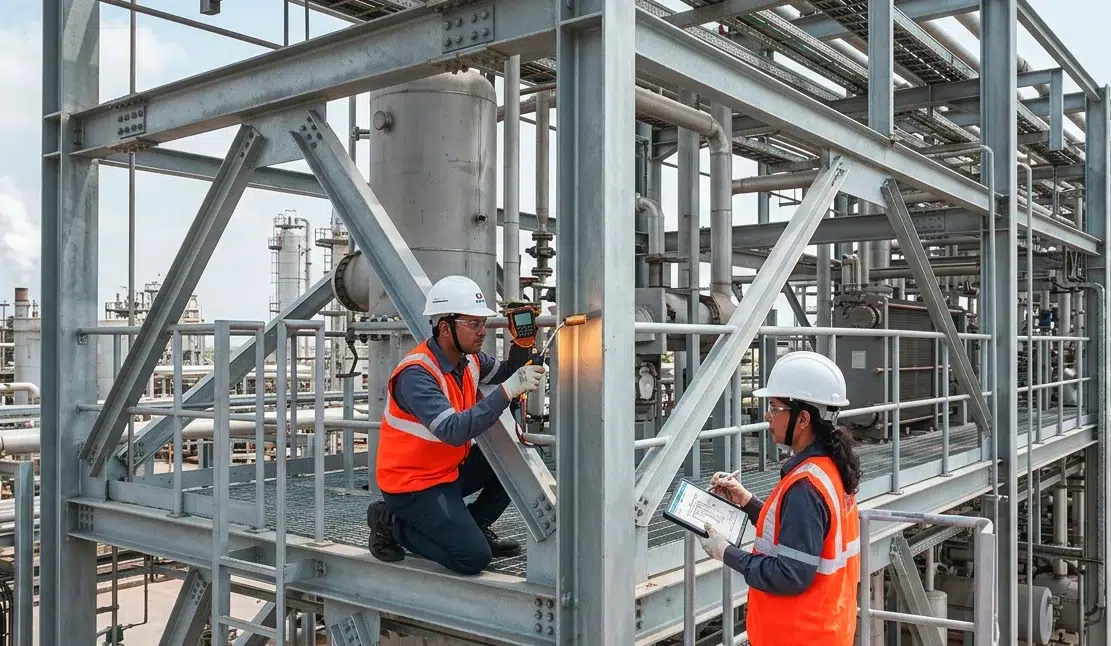
Industrial facilities evolve throughout their operating life. Equipment may be replaced, storage capacities may increase, platforms may be modified, pipelines may be rerouted, and structural members may experience corrosion, vibration, or changing loads. A structural safety assessment helps determine whether the existing structure remains adequate for its current condition, loading, and intended use.
A structural safety assessment of an industrial facility is not simply a visual inspection of whether a structure “looks safe.” It is a systematic engineering evaluation of the condition, structural adequacy, stability, and serviceability of relevant structural components against applicable design requirements and the loads and conditions they are expected to withstand.
What Is a Structural Safety Assessment?
A structural safety assessment is an engineering evaluation undertaken to determine whether an existing structure or structural system has adequate capacity, stability, and serviceability for its current or proposed use.
For industrial facilities, the assessment may cover structures such as:
- Industrial buildings and sheds
- Equipment support structures
- Pipe racks and pipe-support structures
- Platforms, walkways, and access structures
- Structural steel frames
- Reinforced-concrete structures
- Equipment foundations
- Storage and utility structures
- Towers and supporting structures
- Other safety-critical or load-bearing structures
The exact scope depends on the facility, structure type, available documentation, operating conditions, modifications, observed condition, and the purpose of the assessment.
A structural safety assessment should therefore be treated as a site- and structure-specific engineering exercise rather than a one-size-fits-all checklist.
Why Do Industrial Facilities Need Structural Safety Assessments?
One of the biggest challenges with existing industrial structures is that their present condition may differ significantly from their original design basis.
Consider an older process facility.
Over the years, an additional vessel has been installed, a pipe route has changed, a platform has been extended, and some structural members have experienced corrosion. None of these changes may have caused an immediate failure.
Yet collectively, they can change the structural demand and available capacity.
This is why structural assessment becomes particularly relevant when there has been a:
Change in loading
New equipment, tanks, piping, stored materials, maintenance loads, or operational changes can increase structural demand.
Structural modification
Extensions, openings, removed members, added platforms, altered connections, or other modifications can affect load paths and structural behaviour.
Change in equipment or process configuration
Industrial structures often support equipment and associated piping. Changes to equipment arrangement can introduce new loads, eccentricities, vibration, or other effects that need engineering consideration.
Evidence of deterioration
Corrosion, cracking, deformation, spalling, leakage, settlement, damaged connections, or other defects can reduce structural capacity or affect serviceability.
Change in intended use
A structure designed for one purpose may not automatically be adequate for a substantially different use or loading condition.
Ageing and continued operation
Age alone does not establish that a structure is unsafe. However, ageing can make inspection, condition assessment, and verification increasingly important—particularly where deterioration mechanisms are credible.
What Does a Structural Safety Assessment Cover?
There is no universal scope applicable to every industrial facility.
A competent assessment should be developed around the specific structure, loading conditions, failure mechanisms, and purpose of the assessment.
Depending on the project, the scope may include:
1. Review of available documentation
The assessment typically begins with whatever reliable information is available, such as:
- Original structural drawings
- Design calculations
- Structural specifications
- Material information
- Equipment loads
- Previous inspection reports
- Modification records
- Repair records
- Previous assessment reports
- Relevant geotechnical information
For older facilities, documentation may be incomplete or inconsistent with the structure as it exists today.
That itself is an important finding.
2. Site inspection
A physical inspection helps establish the as-is condition of the structure.
Depending on the assessment objectives, inspection may look for:
- Corrosion and section loss
- Cracking
- Deformation
- Buckling
- Damaged or loose connections
- Deteriorated concrete
- Exposed or corroded reinforcement
- Foundation distress
- Water ingress
- Unsupported or altered members
- Unauthorised modifications
- Other visible signs of deterioration or distress
The inspection should be appropriate to the structure and the suspected failure mechanisms. A visual inspection alone may not be sufficient where hidden deterioration or material degradation is suspected.
Where required, further investigation may include NDT testing or other appropriate techniques to assess material condition and identify defects that may not be apparent through visual inspection alone.
3. Verification of geometry and configuration
The existing structure may differ from the original drawings.
Therefore, relevant dimensions, member sizes, structural arrangement, equipment locations, modifications, and other important characteristics may need to be verified.
This distinction between the designed structure and the as-built/as-is structure can be critical to the assessment.
4. Identification of loads and load combinations
The assessment needs to establish the loads that the structure is expected to resist.
Depending on the facility, these may include:
- Dead loads
- Live/operational loads
- Equipment loads
- Piping loads
- Wind loads
- Seismic actions
- Thermal effects
- Crane or handling loads
- Impact or accidental actions, where applicable
- Other project-specific actions
The applicable load combinations and design criteria should be established using relevant codes and standards, project requirements, and the engineering basis applicable to the structure.
For structures where changes in equipment, loading, or supporting conditions are significant, a detailed structural load and foundation assessment may be required to evaluate the adequacy of the supporting system.
Structural Analysis and Capacity Assessment
Once the existing configuration and relevant loads are established, engineering analysis may be required to determine whether structural components have adequate capacity.
This can involve evaluating:
- Member strength
- Connection capacity
- Stability
- Buckling
- Deflection and serviceability
- Foundation adequacy
- Load paths
- Global structural behaviour
- Localised overstress
- Other structure-specific limit states
The level of analysis should be proportionate to the complexity and risk of the structure.
A simple structure with well-established geometry and loading may require a different assessment approach from a complex process-support structure with significant modifications, uncertain material properties, and multiple interacting loads.
Material and Condition Verification
In existing industrial facilities, one of the key challenges is determining whether the assumptions used in an assessment accurately represent the structure today.
Depending on the circumstances, engineering teams may require additional investigation such as:
- Material testing
- Thickness measurements
- Non-destructive examination
- Concrete investigation
- Reinforcement verification
- Corrosion assessment
- Other appropriate condition-assessment techniques
These investigations should be selected based on the uncertainty that needs to be resolved.
The objective is not to collect data for its own sake. It is to obtain sufficient reliable information to make a technically defensible assessment.
Structural Safety Assessment Methodology
A practical structural assessment can generally be understood as a sequence of interconnected stages:
Define the assessment objective → Collect existing information → Inspect the structure → Establish the as-is configuration → Identify loads and conditions → Assess material/condition where necessary → Perform engineering analysis → Evaluate capacity and deficiencies → Recommend corrective measures → Document conclusions
Each stage influences the next.
For example, an inspection may identify significant corrosion. That finding may require thickness measurements. The measured section loss may then change the structural model or member capacity calculations.
This is why structural assessment should not be treated as a purely desk-based calculation exercise.
Key Considerations for Industrial Structural Assessments
1. Existing condition matters as much as original design
A structure may have been adequately designed when it was constructed but may no longer have the same capacity after years of exposure, modifications, or deterioration.
Assessment therefore needs to consider the current condition, not simply the original design intent.
2. Modifications can change load paths
Adding or removing structural members, equipment, platforms, piping supports, or other components can alter how loads travel through a structure.
Even apparently minor modifications can therefore warrant engineering review when they affect structural behaviour.
3. Corrosion can be a capacity issue
Corrosion does not merely create an aesthetic defect.
Where material loss reduces the effective cross-section of a structural member, its resistance can also be affected.
The significance depends on factors such as location, extent, severity, member function, and governing failure mode.
4. Foundations should not be overlooked
Structural assessment should not automatically stop at the steel or concrete superstructure.
Where relevant, foundations and supporting ground conditions may also need consideration, particularly where there are changes in equipment loads, settlement concerns, structural modifications, or other factors affecting foundation performance.
5. Industrial structures may experience unusual loading conditions
Industrial facilities can involve equipment, piping, cranes, thermal effects, vibration, accidental actions, and operational loads that are not typical of conventional commercial buildings.
The assessment therefore needs to reflect the actual operating environment.
6. Code selection must match the assessment
The applicable codes and standards depend on the structure, material, location, design basis, assessment objective, and project requirements.
A strong assessment should clearly identify the engineering criteria and standards used, rather than simply listing codes without explaining their relevance.
What Happens When a Structural Deficiency Is Identified?
Finding a deficiency does not automatically mean that an entire facility is unsafe or must be shut down.
The engineering significance of a deficiency depends on factors such as:
- Location
- Severity
- Structural role
- Available capacity
- Load demand
- Failure mode
- Redundancy
- Extent of deterioration
- Consequence of failure
- Operating conditions
Depending on the findings, recommendations may include:
- Repair
- Strengthening
- Replacement of damaged components
- Corrosion mitigation
- Load restrictions
- Increased inspection frequency
- Monitoring
- Further investigation
- Engineering re-analysis
- Other risk-reduction measures
The appropriate recommendation should be based on engineering evaluation rather than a blanket response.
When Should a Structural Safety Assessment Be Considered?
A structural safety assessment may be appropriate when:
- An industrial facility is being modified or expanded
- New or heavier equipment is being installed
- Existing structures are being repurposed
- Significant corrosion or deterioration has been identified
- Structural damage has occurred
- There are concerns about deformation, cracking, settlement, or stability
- Existing structural documentation is incomplete
- A structural adequacy or stability evaluation is required
- The facility has undergone significant modifications over its operating life
- A technical review is required before continued or changed operation
Depending on the findings and assessment objectives, the requirement may extend to structural stability certification, seismic vulnerability assessment, or structural retrofitting and rehabilitation where these are relevant to the facility’s condition and intended use.
The exact need, scope, and level of assessment should be determined by a suitably qualified structural engineering professional based on the facility, structure, loading conditions, applicable requirements, and assessment objectives.
Structural Safety Assessment Is More Than a Checklist
A useful structural assessment does not end with:
“No visible defects observed.”
Nor should it simply produce a calculation report detached from the realities of the operating facility.
The real objective is to understand the relationship between:
Structure + Condition + Loads + Modifications + Operating Environment + Failure Consequences
That is what allows an assessment to move beyond simply identifying defects and toward understanding structural risk and appropriate engineering action.
Frequently Asked Questions
What is a structural safety assessment?
A structural safety assessment is an engineering evaluation of an existing or proposed structure to determine its adequacy, stability, capacity, and serviceability under relevant loads and conditions.
What is included in an industrial structural safety assessment?
Depending on the project, it can include document review, site inspection, verification of the existing configuration, load assessment, condition/material investigation, structural analysis, capacity evaluation, identification of deficiencies, and recommendations for corrective action.
When is a structural safety assessment required for an industrial facility?
It may be required or advisable following structural modifications, changes in equipment or loading, deterioration, damage, change of use, expansion, or where structural adequacy needs to be verified. The specific requirement depends on the facility and applicable regulations, codes, and project requirements.
Is visual inspection enough to assess structural safety?
Not always. A visual inspection can identify many visible defects, but additional measurements, testing, or structural analysis may be necessary depending on the structure, condition, uncertainty, and assessment objective.
Does an old industrial structure automatically become unsafe?
No. Age alone does not establish structural inadequacy. Structural safety depends on factors including original design, current loads, condition, modifications, deterioration, and the structure’s assessed capacity.
What is the difference between structural inspection and structural safety assessment?
A structural inspection primarily establishes the observed physical condition of a structure. A structural safety assessment goes further by evaluating the engineering significance of the condition, loads, structural behaviour, capacity, and other relevant factors.
Conclusion
Industrial facilities evolve continuously. Equipment changes, structures are modified, loads increase, and materials are exposed to operating and environmental conditions over time.
A structural safety assessment provides a systematic way to evaluate whether the existing structural system remains adequate for the conditions it is expected to withstand.
The strongest assessments combine reliable information, appropriate inspection, realistic loading, sound engineering analysis, and a clear understanding of the facility’s current condition and intended use.
For industrial operators, the objective is not simply to obtain a report. It is to gain a technically defensible understanding of structural adequacy and, where necessary, identify practical measures to maintain safe and reliable operation.
If you are evaluating the structural adequacy of an existing industrial facility, the appropriate scope should be established based on the structure, its condition, loading, modifications, and intended use.